
Level:
Correct: 0
Incorrect: 0
Marks: 0/0
Exam Practice
Subject:
Topics:
AQA GCSE Physics Smart practice A mixed round aimed at your weak spots
Unit 1
Energy
Energy changes in a system, and the ways energy is stored before and after such changes
Energy stores and systems
0%
Changes in energy
0%
Energy changes in systems
0%
Power
0%
Conservation and dissipation of energy
Energy transfers in a system
0%
Efficiency
0%
Unit 2
Electricity
Unit 3
Particle model of matter
Unit 4
Atomic structure
Unit 5
Forces
Unit 6
Waves
Unit 7
Magnetism and electromagnetism
Unit 8
Space physics (physics only)
Avg
score:
–
Topics
done:
0/91

Transformers (physics only) (HT only)

Practise 41 exam-style questions on Transformers (physics only) (HT only) for AQA GCSE Physics. Write your answer as you would in the exam and get it marked in seconds against the mark scheme, point by point, with an AI tutor on hand if you get stuck.

  • 41 questions
  • 1–6 marks each
  • Instant marking
  • No sign-up needed
20 questions, marked as you go

Sample questions with model answers

Here are 4 of the questions in this topic, each with a model answer, an explanation of why it earns the marks and the mark scheme an examiner would use.

Question 1

2 marks

A student says: "In a transformer, the current flows from the primary coil through the iron core into the secondary coil."

Explain why the student is wrong.

Model answer

No current flows through the core: the coils are not electrically connected to each other. Instead, the alternating current in the primary coil produces a changing magnetic field in the iron core, and this changing field induces a potential difference, and so a current, in the secondary coil.

Explanation

The core carries a magnetic field, not a current. Energy is transferred between the coils magnetically, which is why a transformer needs a changing (alternating) current to work.

Mark scheme
  1. 1 mark

    there is no electrical connection between the coils / no current passes through the core

    allow the coils are insulated from the core and each other

  2. 1 mark

    the current in the primary produces a changing magnetic field (in the core), which induces a p.d. / current in the secondary coil
Question 2

3 marks

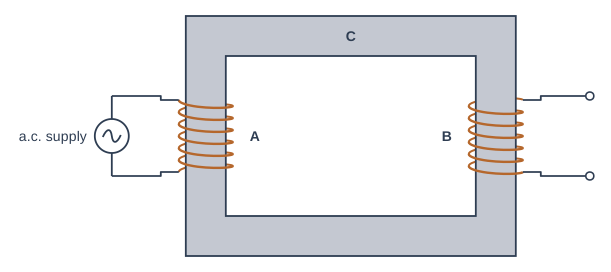
The diagram shows a basic transformer.

Name the parts labelled A, B and C.

Transformer: a square ring-shaped core labelled C with a coil labelled A wound on its left side (6 turns drawn) and a coil labelled B wound on its right side (6 turns drawn). The left coil is connected to an a.c. supply. The right coil's leads end in output terminals.

Model answer

A is the primary coil, B is the secondary coil and C is the iron core.

Explanation

The primary coil is the one connected to the a.c. supply; the secondary coil provides the output. Both are wound on the same iron core, which links the changing magnetic field from one coil to the other.

Mark scheme
  1. 1 mark

    A: primary coil

    allow input coil

  2. 1 mark

    B: secondary coil

    allow output coil

  3. 1 mark

    C: (iron) core

    allow soft iron core; do not accept magnet

Question 3

3 marks

At a power station, a step-up transformer increases the potential difference from 25 kV to 400 kV. The current in the primary coil is 8000 A.

Assume the transformer is 100% efficient.

Calculate the current in the secondary coil.

Use the equation:
Vp × Ip = Vs × Is

Model answer

Vp × Ip = Vs × Is
25 000 × 8000 = 400 000 × Is
Is = 2.0 × 10⁸ ÷ 400 000
Is = 500 A

Explanation

The p.d. is increased 16 times, so the current falls to one-sixteenth: 8000 ÷ 16 = 500 A. This is exactly why the National Grid steps up the p.d.: a much smaller current in the cables wastes far less energy by heating.

Mark scheme
  1. 1 mark

    25 000 × 8000 = 400 000 × Is

    allow p.d.s kept in kV: 25 × 8000 = 400 × Is; an answer of 500 (A) scores 3 marks

  2. 1 mark

    Is = 25 000 × 8000 ÷ 400 000

  3. 1 mark

    500 (A)

Question 4

4 marks

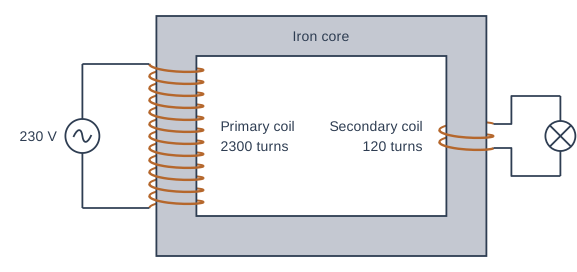
The diagram shows a transformer connected to the 230 V mains supply. A lamp is connected to the secondary coil. The lamp is rated at 12 V, 36 W.

Show that the lamp works at its normal brightness, and calculate the current in the primary coil. Assume the transformer is 100% efficient.
Give your answer to 2 significant figures.

Use the equation:
Vp ÷ Vs = np ÷ ns

Transformer: a square ring-shaped core labelled "Iron core" with a coil labelled "Primary coil" wound on its left side (12 turns drawn) and a coil labelled "Secondary coil" wound on its right side (2 turns drawn). The left coil is marked 2300 turns. The right coil is marked 120 turns. The left coil is connected to an a.c. supply marked 230 V. The right coil is connected to a lamp.

Model answer

Vp ÷ Vs = np ÷ ns
230 ÷ Vs = 2300 ÷ 120
Vs = 230 × 120 ÷ 2300 = 12 V
This equals the lamp's rated p.d., so the lamp works at normal brightness.
Power input = power output = 36 W
36 = 230 × Ip
Ip = 36 ÷ 230 = 0.1565 A
Ip = 0.16 A (2 s.f.)

Explanation

First use the turns ratio to find the output p.d. and compare it with the lamp's rating. Then, because the transformer is 100% efficient, the power taken from the mains equals the 36 W used by the lamp, so P = V × I gives the primary current.

Mark scheme
  1. 1 mark

    230 ÷ Vs = 2300 ÷ 120

    allow Vs = 230 × 120 ÷ 2300

  2. 1 mark

    Vs = 12 V, which is the lamp's rated p.d. (so it works normally)

  3. 1 mark

    power input = 36 W, so 36 = 230 × Ip

    allow Ip = 36 ÷ 230

  4. 1 mark

    Ip = 0.16 (A)

    answer to 2 significant figures; allow ecf

Ready to try the rest? Every answer you write is marked against the mark scheme, so you can see exactly where the marks are.

AI Tutor Hints first, answers after you try

Hi! Stuck? Ask me for a hint and I’ll help you work it out. Once you’ve checked your answer I can explain exactly where the marks are.