Practise 41 exam-style questions on Properties of waves for AQA GCSE Physics. Write your answer as you would in the exam and get it marked in seconds against the mark scheme, point by point, with an AI tutor on hand if you get stuck.
41 questions
1–6 marks each
Instant marking
No sign-up needed
20 questions, marked as you go
Sample questions with model answers
Here are 4 of the questions in this topic, each with a model answer, an explanation of why it earns the marks and the mark scheme an examiner would use.
Question 1
2 marks
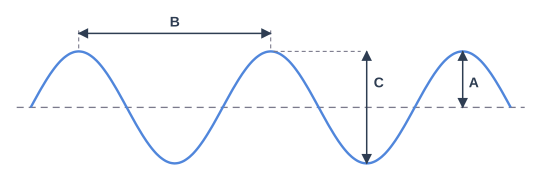
The diagram shows a transverse wave.
Which letter shows the amplitude of the wave, and which letter shows the wavelength?
Model answer
A shows the amplitude and B shows the wavelength.
Explanation
The amplitude is measured from the rest position (the dashed line) to the top of a crest, which is A. C goes from a trough to a crest, so it is twice the amplitude. The wavelength, B, spans one complete wave from one crest to the next.
Mark scheme
1 mark
amplitude: A
do not accept C
1 mark
wavelength: B
Question 2
2 marks
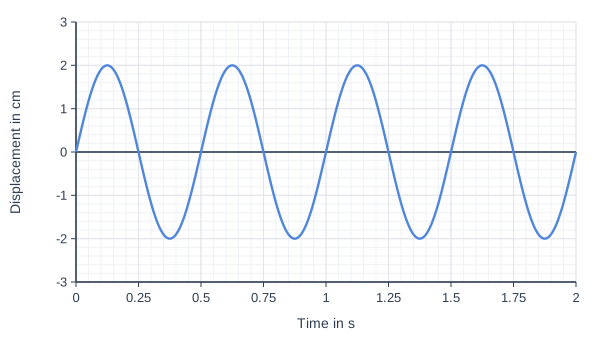
The graph shows how the displacement of a point on a water wave changes with time.
A student says: "The wavelength of this wave is 0.5."
Explain why the student is wrong.
Model answer
The horizontal axis shows time, so the 0.5 s between neighbouring crests is the period of the wave, the time for one complete wave. Wavelength is a distance, so it can only be read from a graph of displacement against distance (or calculated if the wave speed is known).
Explanation
Always check the axes. On a displacement-time graph, crest-to-crest gives the period (and frequency = 1 ÷ period); on a displacement-distance graph, crest-to-crest gives the wavelength.
Mark scheme
1 mark
the horizontal axis shows time, so the 0.5 s between crests is the period (not the wavelength)
1 mark
the wavelength is a distance and can only be found from a graph of displacement against distance
allow you would need the wave speed to calculate the wavelength
Question 3
3 marks
A student uses a vibration generator to make a standing wave on a string stretched between the vibration generator and a pulley. The signal generator shows the frequency.
Describe how the student should measure the wavelength of the waves on the string as accurately as possible.
Model answer
Adjust the frequency of the signal generator until a clear, steady standing wave with several loops is seen. Use a metre rule to measure the total length across as many loops as possible, for example from the vibration generator to the pulley. Divide this length by the number of loops to get the length of one loop, and multiply by 2, because each loop is half a wavelength.
Explanation
Measuring across several loops reduces the uncertainty compared with measuring one loop. Remember that a loop of a standing wave is only half a wavelength.
Mark scheme
1 mark
adjust the frequency until a clear, steady standing wave is seen
1 mark
use a metre rule to measure the length across as many loops as possible
allow measure from the vibration generator to the pulley
1 mark
divide by the number of loops to find the length of one loop, then multiply by 2 (one loop is half a wavelength)
Question 4
4 marks
An earthquake produces a P-wave with a frequency of 2.0 Hz. The P-wave travels through rock at a speed of 6.0 km/s.
Calculate the wavelength of the P-wave in metres.
Model answer
v = 6.0 km/s = 6000 m/s v = f × λ 6000 = 2.0 × λ λ = 6000 ÷ 2.0 = 3000 m
Explanation
Convert km/s to m/s first by multiplying by 1000. Seismic waves have low frequencies and very high speeds, so their wavelengths are kilometres long.
Mark scheme
1 mark
6.0 km/s = 6000 m/s
an answer of 3000 (m) scores 4 marks; an answer of 3.0 scores 3 marks
1 mark
6000 = 2.0 × λ
allow ecf
1 mark
λ = 6000 ÷ 2.0
rearrangement; allow ecf
1 mark
3000 (m)
allow 3.0 × 10³ (m); allow ecf
Ready to try the rest? Every answer you write is marked against the mark scheme, so you can see exactly where the marks are.
Ctrl + Enter to check
AI TutorHints first, answers after you try
Hi! Stuck? Ask me for a hint and I’ll help you work it out. Once you’ve checked your answer I can explain exactly where the marks are.