Practise 34 exam-style questions on Moments, levers and gears (physics only) for AQA GCSE Physics. Write your answer as you would in the exam and get it marked in seconds against the mark scheme, point by point, with an AI tutor on hand if you get stuck.
34 questions
1–6 marks each
Instant marking
No sign-up needed
20 questions, marked as you go
Sample questions with model answers
Here are 4 of the questions in this topic, each with a model answer, an explanation of why it earns the marks and the mark scheme an examiner would use.
Question 1
2 marks
State the principle of moments for an object that is balanced.
Model answer
If an object is balanced, the total clockwise moment about a pivot equals the total anticlockwise moment about that same pivot.
Explanation
This is used to calculate an unknown force or distance on a balanced object. All the moments must be taken about the same pivot, using the perpendicular distance from that pivot to each force.
Mark scheme
1 mark
the total clockwise moment equals the total anticlockwise moment
allow sum of clockwise moments = sum of anticlockwise moments
1 mark
about the same pivot / point
Question 2
2 marks
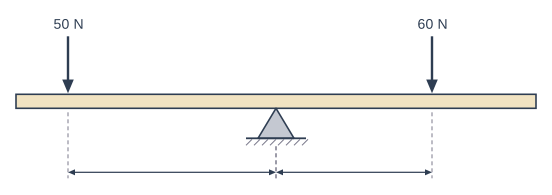
The diagram shows two downward forces acting on a beam that can turn about a pivot at its centre. Ignore the weight of the beam.
Determine which way the beam will turn. Show how you work out your answer.
Model answer
Anticlockwise moment (left) = 50 N × 0.8 m = 40 N m Clockwise moment (right) = 60 N × 0.6 m = 36 N m The anticlockwise moment is bigger, so the beam turns anticlockwise: the left end moves down.
Explanation
The larger force does not always win: what matters is the moment, force × distance from the pivot. The 50 N force is further from the pivot, so its moment is bigger than that of the 60 N force.
Mark scheme
1 mark
anticlockwise moment = 50 × 0.8 = 40 N m and clockwise moment = 60 × 0.6 = 36 N m
both moments needed; correct answer with no working scores full marks
1 mark
the beam turns anticlockwise / the left end moves down
Question 3
3 marks
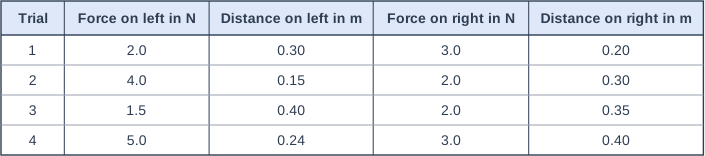
A student balanced a metre rule on a pivot at its centre and hung weights on either side of the pivot. The table shows her results for four trials. The rule was balanced in every trial.
Use the data to identify the trial that does not support the principle of moments. Suggest one reason for this result.
Model answer
Trial 1: 2.0 × 0.30 = 0.60 and 3.0 × 0.20 = 0.60 N m Trial 2: 4.0 × 0.15 = 0.60 and 2.0 × 0.30 = 0.60 N m Trial 3: 1.5 × 0.40 = 0.60 but 2.0 × 0.35 = 0.70 N m Trial 4: 5.0 × 0.24 = 1.2 and 3.0 × 0.40 = 1.2 N m Trial 3 does not support the principle of moments, because the clockwise and anticlockwise moments are not equal. The student probably measured or recorded the right-hand distance incorrectly - it should have been 0.30 m.
Explanation
Calculate force × distance on each side for every trial: when the rule balances, the two moments should be equal. The odd one out points to a measurement error, such as measuring to the edge of the thread loop rather than its centre.
Mark scheme
1 mark
moments calculated, e.g. trial 3: left = 1.5 × 0.40 = 0.60 N m and right = 2.0 × 0.35 = 0.70 N m
1 mark
trial 3
1 mark
any one sensible reason: a distance was measured or recorded incorrectly (e.g. not to the centre of the thread loop / from the end of the rule) / the rule was not exactly horizontal / a weight was labelled wrongly
Question 4
4 marks
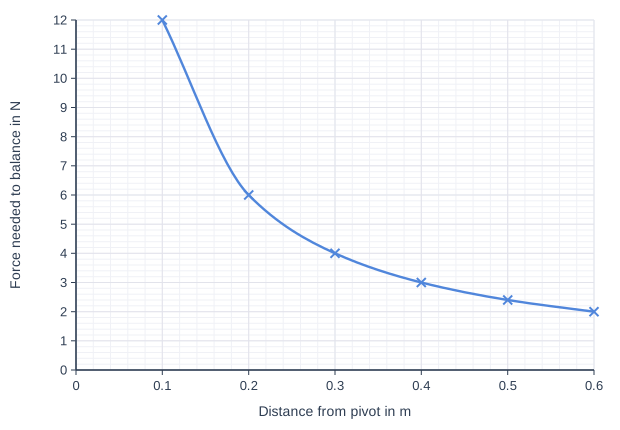
A student balances a metre rule on a pivot with a fixed load on one side. She then finds the force needed on the other side to balance the rule when it acts at different distances from the pivot. The graph shows her results.
Use the graph to show that the force needed is inversely proportional to its distance from the pivot. Determine the moment of the fixed load about the pivot.
Model answer
Force × distance for each result: 12 N × 0.1 m = 1.2 N m 6 N × 0.2 m = 1.2 N m 4 N × 0.3 m = 1.2 N m 2 N × 0.6 m = 1.2 N m Force × distance is constant, so the force is inversely proportional to the distance (doubling the distance halves the force). The rule is balanced each time, so the moment of the fixed load equals the moment of the balancing force: 1.2 N m.
Explanation
Two quantities are inversely proportional if their product is constant. Here the product is the moment of the balancing force, which must always equal the moment of the fixed load for the rule to balance - that is the principle of moments.
Mark scheme
1 mark
force × distance calculated for at least two points, e.g. 12 × 0.1 = 1.2 and 3 × 0.4 = 1.2
allow doubling the distance halves the force, e.g. 0.1 m to 0.2 m: 12 N to 6 N
1 mark
force × distance is constant (1.2) for all the points
1 mark
so force is inversely proportional to distance
1 mark
moment of load = 1.2 N m (because the rule is balanced, it equals F × d)
Ready to try the rest? Every answer you write is marked against the mark scheme, so you can see exactly where the marks are.
Ctrl + Enter to check
AI TutorHints first, answers after you try
Hi! Stuck? Ask me for a hint and I’ll help you work it out. Once you’ve checked your answer I can explain exactly where the marks are.