Practise 32 exam-style questions on Gravity for AQA GCSE Physics. Write your answer as you would in the exam and get it marked in seconds against the mark scheme, point by point, with an AI tutor on hand if you get stuck.
32 questions
1–6 marks each
Instant marking
No sign-up needed
20 questions, marked as you go
Sample questions with model answers
Here are 4 of the questions in this topic, each with a model answer, an explanation of why it earns the marks and the mark scheme an examiner would use.
Question 1
2 marks
A student has a mass of 65 kg.
gravitational field strength = 9.8 N/kg
Calculate the weight of the student.
Model answer
W = m g W = 65 kg × 9.8 N/kg W = 637 N
Explanation
Multiply the mass in kilograms by the gravitational field strength to get the weight in newtons. A common mistake is to give the answer in kilograms - weight is a force, so its unit is the newton.
Mark scheme
1 mark
W = 65 × 9.8
an answer of 637 (N) scores 2 marks
1 mark
W = 637 N
allow 640 N
Question 2
2 marks
A cargo ship has a mass of 2.5 × 10⁷ kg.
gravitational field strength = 9.8 N/kg
Calculate the weight of the ship. Give your answer in standard form.
Model answer
W = m g W = 2.5 × 10⁷ kg × 9.8 N/kg W = 2.45 × 10⁸ N
Explanation
Multiply 2.5 by 9.8 to get 24.5, giving 24.5 × 10⁷ N. In standard form the first number must be between 1 and 10, so this becomes 2.45 × 10⁸ N.
Mark scheme
1 mark
W = 2.5 × 10⁷ × 9.8
an answer of 2.45 × 10⁸ (N) scores 2 marks
1 mark
W = 2.45 × 10⁸ N
allow 2.5 × 10⁸ N; 245 000 000 N scores 1 mark
Question 3
3 marks
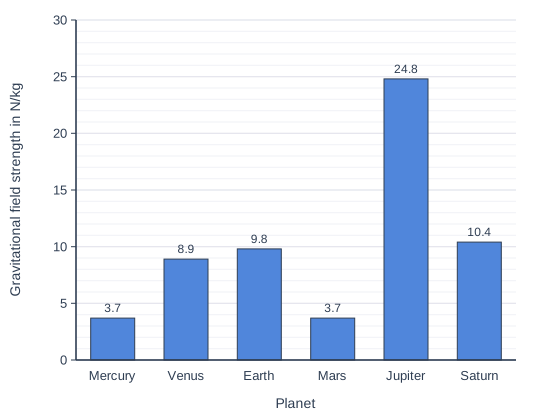
A space probe has a mass of 500 kg. The bar chart shows the gravitational field strength on the surface of six planets.
Calculate the weight of the probe on the planet where its weight would be greatest.
Model answer
The weight is greatest where the gravitational field strength is greatest: Jupiter, 24.8 N/kg. W = m g = 500 kg × 24.8 N/kg = 12 400 N
Explanation
The probe's mass is the same on every planet, so its weight is greatest where g is greatest. Weight is directly proportional to g, so on Jupiter the probe weighs about two and a half times as much as on Earth.
Mark scheme
1 mark
Jupiter (identified or used)
an answer of 12 400 (N) scores 3 marks
1 mark
W = 500 × 24.8
1 mark
W = 12 400 N
allow 12.4 kN; allow ecf for the wrong planet's value × 500 for 1 mark
Question 4
4 marks
A lift can safely carry a maximum load of 8.0 kN.
The average mass of a person is 75 kg. gravitational field strength = 9.8 N/kg
Calculate the maximum number of people of average mass that the lift can safely carry.
Model answer
Maximum load = 8.0 kN = 8000 N Weight of one person = m g = 75 kg × 9.8 N/kg = 735 N Number of people = 8000 N ÷ 735 N = 10.9 The lift can safely carry a maximum of 10 people.
Explanation
The safe load is a force, so compare it with the weight of each person, not their mass. The answer must be a whole number of people, and it must be rounded down: 11 people would weigh 8085 N, which is more than the safe limit.
Mark scheme
1 mark
8.0 kN = 8000 N
an answer of 10 (people) with working scores 4 marks
1 mark
weight of one person = 75 × 9.8 = 735 (N)
1 mark
8000 ÷ 735 = 10.9
allow 10.88; allow ecf
1 mark
10 (people)
must be rounded down to a whole number; do not accept 11
Ready to try the rest? Every answer you write is marked against the mark scheme, so you can see exactly where the marks are.
Ctrl + Enter to check
AI TutorHints first, answers after you try
Hi! Stuck? Ask me for a hint and I’ll help you work it out. Once you’ve checked your answer I can explain exactly where the marks are.