Practise 27 exam-style questions on The National Grid for AQA GCSE Physics. Write your answer as you would in the exam and get it marked in seconds against the mark scheme, point by point, with an AI tutor on hand if you get stuck.
27 questions
1–6 marks each
Instant marking
No sign-up needed
20 questions, marked as you go
Sample questions with model answers
Here are 4 of the questions in this topic, each with a model answer, an explanation of why it earns the marks and the mark scheme an examiner would use.
Question 1
2 marks
State the potential difference and the frequency of the domestic mains electricity supply in the UK.
Model answer
The UK mains supply has a potential difference of about 230 V and a frequency of 50 Hz.
Explanation
Step-down transformers reduce the very high potential difference of the transmission cables to about 230 V for use in homes. The supply is alternating current, which changes direction 50 times every second.
Mark scheme
1 mark
(about) 230 V
allow 230 volts
1 mark
50 Hz
allow 50 hertz
Question 2
2 marks
Explain why some energy is wasted when there is a current in the transmission cables of the National Grid.
Model answer
The cables have resistance. As the current passes through them, the cables heat up, so energy is transferred to the thermal energy store of the cables and then dissipated to the surroundings.
Explanation
Any wire with resistance is heated by a current through it. This heating is wasted energy, and it increases with the square of the current, so the National Grid keeps the current small.
Mark scheme
1 mark
the cables have resistance
allow electrons collide with the ions in the metal
1 mark
so the current heats the cables / energy is transferred to the thermal energy store of the cables and the surroundings
Question 3
3 marks
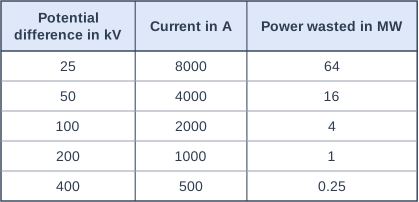
The table shows the current in the cables and the power wasted in the cables when 200 MW of power is transmitted through the same cables at different potential differences.
Calculate the efficiency of the transmission when the potential difference is 50 kV.
Model answer
Power wasted at 50 kV = 16 MW (from the table) Useful power delivered = 200 − 16 = 184 MW Efficiency = useful power output ÷ total power input = 184 ÷ 200 Efficiency = 0.92 (92%)
Explanation
Efficiency = useful power output ÷ total power input. The useful output is the power that reaches the end of the cables, which is the input minus the power wasted. At 400 kV only 0.25 MW is wasted, giving an efficiency of nearly 100%.
Mark scheme
1 mark
useful power delivered = 200 − 16 = 184 (MW)
an answer of 0.92 or 92% scores 3 marks
1 mark
efficiency = 184 ÷ 200
allow ecf from an incorrect value read from the table
1 mark
0.92 / 92%
an answer of 0.08 or 8% scores 1 mark
Question 4
4 marks
A power station transmits 150 MW of power at 275 kV. The transmission cables have a total resistance of 6.0 Ω.
Calculate the power wasted in the cables. Give your answer in megawatts to 2 significant figures.
Model answer
I = P ÷ V = 150 000 000 ÷ 275 000 = 545.45 A Power wasted = I² × R = 545.45² × 6.0 = 1 785 124 W = 1.8 MW (2 s.f.)
Explanation
This needs two steps: find the current in the cables using P = V I, then the power wasted using P = I² R. Do not use P = V² ÷ R with 275 kV - the 275 kV is across the whole system, not across the cables.
Mark scheme
1 mark
I = 150 000 000 ÷ 275 000
an answer of 1.8 (MW) scores 4 marks
1 mark
I = 545 (A)
allow 545.45...
1 mark
P = 545² × 6.0 (= 1 785 000 W)
allow ecf from an incorrect current
1 mark
1.8 (MW)
answer in MW to 2 significant figures; allow ecf
Ready to try the rest? Every answer you write is marked against the mark scheme, so you can see exactly where the marks are.
Ctrl + Enter to check
AI TutorHints first, answers after you try
Hi! Stuck? Ask me for a hint and I’ll help you work it out. Once you’ve checked your answer I can explain exactly where the marks are.