Practise 37 exam-style questions on Electromagnetism for AQA GCSE Physics. Write your answer as you would in the exam and get it marked in seconds against the mark scheme, point by point, with an AI tutor on hand if you get stuck.
37 questions
1–6 marks each
Instant marking
No sign-up needed
20 questions, marked as you go
Sample questions with model answers
Here are 4 of the questions in this topic, each with a model answer, an explanation of why it earns the marks and the mark scheme an examiner would use.
Question 1
2 marks
Give two factors that affect the strength of the magnetic field around a long, straight wire that is carrying a current.
Model answer
The size of the current in the wire, and the distance from the wire.
Explanation
A larger current produces a stronger magnetic field, and the field gets weaker further away from the wire. These are the two factors named in the specification.
Mark scheme
1 mark
the size of the current (in the wire)
allow a bigger current gives a stronger field
1 mark
the distance from the wire
allow the field is weaker further from the wire; ignore length or thickness of the wire
Question 2
2 marks
A student places a plotting compass under a straight wire carrying a very small current. The compass needle hardly moves.
Suggest two changes that would make the needle move more.
Model answer
Increase the current in the wire, and move the compass closer to the wire.
Explanation
The strength of the field around a wire depends on the current and the distance from the wire. A bigger current or a smaller distance gives a stronger field and a bigger deflection.
Mark scheme
1 mark
increase the current (in the wire)
max 2; any two from the list
1 mark
move the compass closer to the wire
1 mark
pass the wire over the compass several times / use a coil
1 mark
line the wire up north-south (so its field is at right angles to the Earth's)
Question 3
3 marks
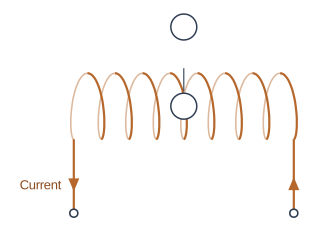
The diagram shows a solenoid carrying a current, with its poles labelled. Two plotting compasses are shown without their needles: compass A is inside the solenoid and compass C is just above it.
Describe the direction that the north end of each needle would point. Explain why the two needles point in opposite directions.
Model answer
The north end of the needle in compass A, inside the coil, points to the left, towards the north pole of the solenoid. The north end of the needle in compass C, above the coil, points to the right, towards the south pole. Outside a solenoid the field lines go from the north pole to the south pole, but they continue through the inside of the coil from the south end back to the north end, so the field inside points the opposite way to the field just outside.
Explanation
Field lines are closed loops: they leave the north end, go round the outside to the south end, and return through the inside of the coil. A common mistake is to think the field inside also points from N to S.
Mark scheme
1 mark
compass A (inside): the north end points to the left, towards the N pole of the solenoid
1 mark
compass C (outside): the north end points to the right, towards the S pole
1 mark
outside the solenoid the field goes from N to S, but inside it goes from S to N (the field lines form closed loops)
Question 4
4 marks
The electromagnet in a doorbell is made by winding many turns of thin, insulated copper wire around an iron core.
Explain why the wire must be insulated, and why the coil has many turns.
Model answer
The turns touch each other and the iron core. If the wire were bare, the current would take a short cut from one turn to the next (or through the core) instead of going round the coil, so insulation makes sure the current flows round every turn. Each turn carrying the current produces its own magnetic field, and the fields of all the turns add together, so having many turns gives a much stronger electromagnet for the same current.
Explanation
An electromagnet's strength depends on the current, the number of turns and the core. Insulation is essential so that every turn actually carries the current and contributes to the field.
Mark scheme
1 mark
insulation stops the current flowing directly between neighbouring turns (or into the iron core)
allow prevents a short circuit
1 mark
so the current flows all the way round every turn of the coil
1 mark
each turn produces a magnetic field, and the fields of the turns add together
1 mark
so more turns give a stronger magnetic field (for the same current)
Ready to try the rest? Every answer you write is marked against the mark scheme, so you can see exactly where the marks are.
Ctrl + Enter to check
AI TutorHints first, answers after you try
Hi! Stuck? Ask me for a hint and I’ll help you work it out. Once you’ve checked your answer I can explain exactly where the marks are.