Level:
Correct: 0
Incorrect: 0
Marks: 0/0
Exam Practice
Subject:
Topics:
AQA GCSE Physics Smart practice A mixed round aimed at your weak spots
Unit 1
Energy
Energy changes in a system, and the ways energy is stored before and after such changes
Energy stores and systems
0%
Changes in energy
0%
Energy changes in systems
0%
Power
0%
Conservation and dissipation of energy
Energy transfers in a system
0%
Efficiency
0%
Unit 2
Electricity
Unit 3
Particle model of matter
Unit 4
Atomic structure
Unit 5
Forces
Unit 6
Waves
Unit 7
Magnetism and electromagnetism
Unit 8
Space physics (physics only)
Avg
score:
–
Topics
done:
0/91

Electrical charge and current

Practise 26 exam-style questions on Electrical charge and current for AQA GCSE Physics. Write your answer as you would in the exam and get it marked in seconds against the mark scheme, point by point, with an AI tutor on hand if you get stuck.

  • 26 questions
  • 1–6 marks each
  • Instant marking
  • No sign-up needed
20 questions, marked as you go

Sample questions with model answers

Here are 4 of the questions in this topic, each with a model answer, an explanation of why it earns the marks and the mark scheme an examiner would use.

Question 1

2 marks

The circuit diagram shows a series circuit containing three ammeters, A₁, A₂ and A₃. The reading on ammeter A₁ is shown.

Give the readings on ammeters A₂ and A₃. Give a reason for your answer.
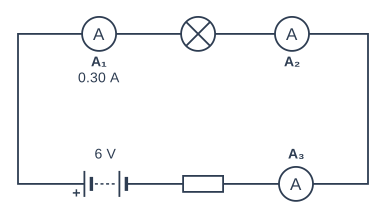
Circuit diagram. All the components are connected in series in a single loop. Going round the loop from the + terminal of the battery (labelled 6 V): ammeter A₁ (reading 0.30 A); then a lamp; then ammeter A₂; then ammeter A₃; then a resistor; and back to the − terminal of the battery.

Model answer

Both ammeters read 0.30 A, because there is only one loop and the current has the same value at any point in a single closed loop.

Explanation

In a series circuit there is only one path, so the same charge passes every point each second. The lamp and resistor transfer energy, but they do not use up any charge, so the current after them is the same as the current before them.

Mark scheme
  1. 1 mark

    A₂ = 0.30 A and A₃ = 0.30 A

    both needed; allow 0.3 A

  2. 1 mark

    the current is the same at every point in a single closed loop / series circuit

    allow current is not used up by the lamp or resistor
Question 2

2 marks

Copper wires used in circuits are covered with a plastic coating.

Explain why charge can flow through the copper but not through the plastic.

Model answer

Copper is a metal, so it contains free electrons that can move through it and carry charge when there is a potential difference. Plastic is an insulator: its electrons are held in place, so there are no charges free to move and no current flows through it.

Explanation

A current needs charges that are free to move. In metals these are free electrons. The plastic coating stops charge leaking from the wire, which keeps the circuit safe to touch.

Mark scheme
  1. 1 mark

    copper (a metal) has free / delocalised electrons that can move through it

    allow copper is a conductor with charges that are free to move

  2. 1 mark

    plastic has no free electrons / its charges cannot move, so it is an insulator

Question 3

3 marks

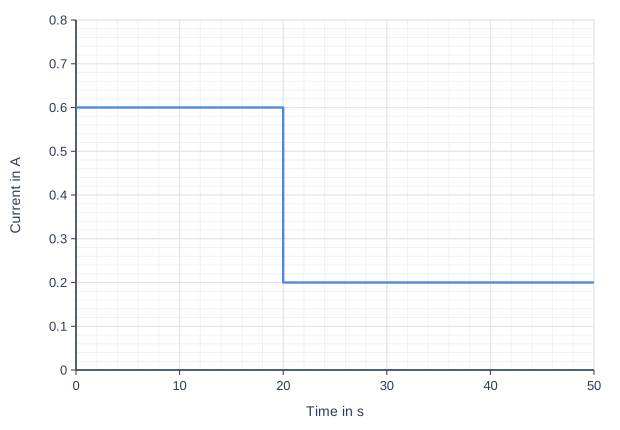
The graph shows how the current in a circuit changed during an experiment lasting 50 s.

Calculate the total charge that flowed in the 50 s.

Line graph of current in A (y-axis, 0 to 0.8) against time in s (x-axis, 0 to 50). The line joins the points (0, 0.6), (20, 0.6), (20, 0.2), (50, 0.2).

Model answer

First 20 s: Q = I t = 0.6 × 20 = 12 C
Next 30 s: Q = I t = 0.2 × 30 = 6 C
Total charge = 12 + 6 = 18 C

Explanation

Use Q = I t separately for each part of the time where the current is constant, then add the charges. This is the same as finding the area under a current-time graph. A common mistake is to use 50 s for the second part instead of 30 s.

Mark scheme
  1. 1 mark

    charge in the first 20 s = 0.6 × 20 = 12 (C)

    an answer of 18 (C) scores 3 marks

  2. 1 mark

    charge from 20 s to 50 s = 0.2 × 30 = 6 (C)

  3. 1 mark

    total = 18 (C)

    allow ecf from one incorrect value; allow the area under the graph calculated in one step

Question 4

4 marks

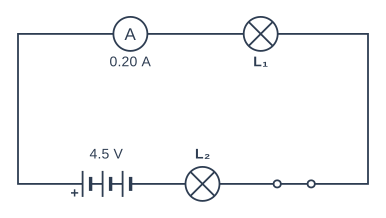
The circuit diagram shows two lamps, L₁ and L₂, connected in series with a battery, a closed switch and an ammeter. The ammeter reading is shown.

Calculate the charge that flows through lamp L₂ in 2 minutes.

Circuit diagram. All the components are connected in series in a single loop. Going round the loop from the + terminal of the battery of 3 cells (labelled 4.5 V): an ammeter (reading 0.20 A); then lamp L₁; then a closed switch; then lamp L₂; and back to the − terminal of the battery of 3 cells.

Model answer

The lamps are in a single series loop, so the current through L₂ is the same as the ammeter reading, 0.20 A.
t = 2 × 60 = 120 s
Q = I t = 0.20 × 120
Q = 24 C

Explanation

The ammeter is not next to L₂, but in a single closed loop the current is the same at every point, so it still gives the current through L₂. Then use Q = I t with the time in seconds.

Mark scheme
  1. 1 mark

    current through L₂ = 0.20 A (the same as the ammeter reading)

    an answer of 24 (C) scores 4 marks

  2. 1 mark

    t = 2 × 60 = 120 s

  3. 1 mark

    Q = 0.20 × 120

    allow ecf

  4. 1 mark

    24 (C)

    allow ecf

Ready to try the rest? Every answer you write is marked against the mark scheme, so you can see exactly where the marks are.

AI Tutor Hints first, answers after you try

Hi! Stuck? Ask me for a hint and I’ll help you work it out. Once you’ve checked your answer I can explain exactly where the marks are.