
Level:
Correct: 0
Incorrect: 0
Marks: 0/0
Exam Practice
Subject:
Topics:
AQA GCSE Physics Smart practice A mixed round aimed at your weak spots
Unit 1
Energy
Energy changes in a system, and the ways energy is stored before and after such changes
Energy stores and systems
0%
Changes in energy
0%
Energy changes in systems
0%
Power
0%
Conservation and dissipation of energy
Energy transfers in a system
0%
Efficiency
0%
Unit 2
Electricity
Unit 3
Particle model of matter
Unit 4
Atomic structure
Unit 5
Forces
Unit 6
Waves
Unit 7
Magnetism and electromagnetism
Unit 8
Space physics (physics only)
Avg
score:
–
Topics
done:
0/91

Induced potential (physics only) (HT only)

Practise 32 exam-style questions on Induced potential (physics only) (HT only) for AQA GCSE Physics. Write your answer as you would in the exam and get it marked in seconds against the mark scheme, point by point, with an AI tutor on hand if you get stuck.

  • 32 questions
  • 1–6 marks each
  • Instant marking
  • No sign-up needed
20 questions, marked as you go

Sample questions with model answers

Here are 4 of the questions in this topic, each with a model answer, an explanation of why it earns the marks and the mark scheme an examiner would use.

Question 1

2 marks

Give two factors that affect the direction of the potential difference induced when a magnet moves relative to a coil.

Model answer

The direction in which the magnet moves (into or out of the coil), and the direction of the magnetic field, which depends on which pole of the magnet is nearest the coil.

Explanation

Reversing either the movement or the field reverses the induced potential difference and current. Reversing both brings the direction back to the original one.

Mark scheme
  1. 1 mark

    the direction of the movement (into or out of the coil)

  2. 1 mark

    the direction / polarity of the magnetic field (which pole is used)

    allow which end of the magnet enters the coil
Question 2

3 marks

A magnet is moved into a coil of wire. Give three factors that affect the size of the potential difference induced across the coil.

Model answer

The speed at which the magnet moves, the strength of the magnet, and the number of turns on the coil.

Explanation

A larger induced potential difference comes from changing the magnetic field through the coil faster, using a stronger field, or having more turns, since each turn contributes to the induced p.d.

Mark scheme
  1. 1 mark

    the speed of the movement (of the magnet relative to the coil)

    max 3; any three from the list; allow how fast the magnetic field changes

  2. 1 mark

    the strength of the magnet / magnetic field

  3. 1 mark

    the number of turns on the coil

  4. 1 mark

    the area of the coil

Question 3

3 marks

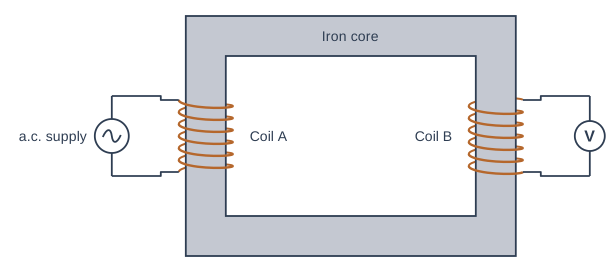
The diagram shows two coils, A and B, wound on an iron core. Coil A is connected to an alternating supply, and a voltmeter is connected across coil B.

Explain why there is an alternating potential difference across coil B, even though the coils are not connected to each other.

Transformer: a square ring-shaped core labelled "Iron core" with a coil labelled "Coil A" wound on its left side (6 turns drawn) and a coil labelled "Coil B" wound on its right side (6 turns drawn). The left coil is connected to an a.c. supply. A voltmeter is connected across the right coil.

Model answer

The alternating current in coil A produces a magnetic field in the iron core, which also passes through coil B. Because the current keeps changing in size and direction, the magnetic field through coil B is continuously changing and reversing. A changing field around a conductor induces a potential difference, so a potential difference is induced across coil B, and it reverses direction each time the field's change reverses, giving an alternating p.d.

Explanation

With a d.c. supply, a p.d. would only be induced at the moment of switching on or off. An alternating current keeps the field changing all the time, so it induces a continuous alternating p.d. - the principle behind the transformer.

Mark scheme
  1. 1 mark

    the alternating current in coil A produces a magnetic field in the iron core (which passes through coil B)

  2. 1 mark

    the field is continuously changing (in size and direction)

  3. 1 mark

    so a p.d. is induced in coil B, which keeps reversing direction (alternating)

Question 4

4 marks

A student moves a magnet in and out of a coil connected to a small lamp. The induced current in the lamp is 0.20 A and the potential difference across the lamp is 1.5 V. She keeps moving the magnet for 5.0 s.

Calculate the energy transferred to the lamp in 5.0 s, and explain where this energy comes from.

Model answer

P = V I = 1.5 × 0.20 = 0.30 W
E = P t = 0.30 × 5.0 = 1.5 J

The energy comes from the work done by the student. The induced current produces a magnetic field that opposes the movement of the magnet, so she has to push and pull against a force, and this work is transferred to the lamp.

Explanation

Energy is conserved: the generator effect does not create energy. Because the induced field always opposes the movement, the person (or turbine) moving the magnet must do work, and that work becomes the electrical energy transferred to the lamp.

Mark scheme
  1. 1 mark

    P = 1.5 × 0.20 = 0.30 W

    allow E = Q V with Q = 0.20 × 5.0 = 1.0 C; an answer of 1.5 (J) scores the first 3 marks

  2. 1 mark

    E = 0.30 × 5.0

    allow ecf

  3. 1 mark

    E = 1.5 J

  4. 1 mark

    the energy comes from the work done by the student moving the magnet against the opposing force from the induced current's magnetic field

    allow from the student's chemical energy store / her muscles, if linked to work done against the opposing force

Ready to try the rest? Every answer you write is marked against the mark scheme, so you can see exactly where the marks are.

AI Tutor Hints first, answers after you try

Hi! Stuck? Ask me for a hint and I’ll help you work it out. Once you’ve checked your answer I can explain exactly where the marks are.