Practise 40 exam-style questions on Energy transfers in a system for AQA GCSE Physics. Write your answer as you would in the exam and get it marked in seconds against the mark scheme, point by point, with an AI tutor on hand if you get stuck.
40 questions
1–6 marks each
Instant marking
No sign-up needed
20 questions, marked as you go
Sample questions with model answers
Here are 4 of the questions in this topic, each with a model answer, an explanation of why it earns the marks and the mark scheme an examiner would use.
Question 1
2 marks
Give two ways of reducing the rate of energy transfer from a house to the surroundings.
Model answer
Any two from: fitting loft insulation; filling the wall cavities with insulation; fitting double glazing; using draught excluders; building thicker walls from materials with a low thermal conductivity.
Explanation
Thermal insulation reduces unwanted energy transfers from a warm house to the cold surroundings. Materials with a low thermal conductivity, and thicker layers of them, reduce the rate at which the house cools.
Mark scheme
1 mark
loft insulation
max 2; 1 mark for each correct way
1 mark
cavity wall insulation
1 mark
double glazing
allow triple glazing
1 mark
draught excluders
1 mark
thicker walls
allow walls made of material with a lower thermal conductivity
1 mark
thick curtains / carpets
Question 2
2 marks
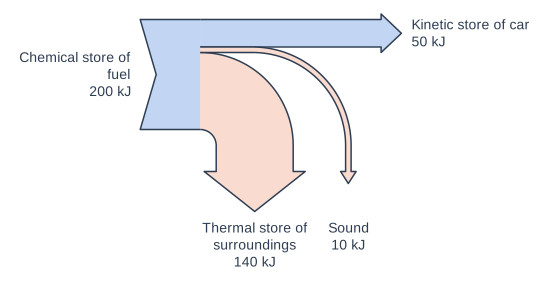
The Sankey diagram shows the energy transfers in a car engine.
Explain how the diagram shows that energy is conserved.
Model answer
The useful and wasted outputs add up to the input: 50 kJ + 140 kJ + 10 kJ = 200 kJ. No energy has been created or destroyed; it has only been transferred to useful or wasted stores.
Explanation
A Sankey diagram is drawn so that the arrows coming out add up to the arrow going in. The wasted energy is dissipated but is still there, which is what conservation of energy means.
Mark scheme
1 mark
the outputs add up to the input: 50 + 140 + 10 = 200 (kJ)
allow total energy out = total energy in
1 mark
energy is only transferred (usefully or dissipated); none is created or destroyed
Question 3
3 marks
Without an insulating jacket, a hot water tank transfers 2.4 MJ of energy to the surroundings each day. With a jacket fitted, it transfers 0.60 MJ each day.
Calculate the energy saved in one year (365 days) by fitting the jacket.
Model answer
Energy saved each day = 2.4 − 0.60 = 1.8 MJ Energy saved in a year = 1.8 × 365 = 657 MJ
Explanation
The jacket reduces the rate of unwanted energy transfer from the hot water, so the saving is the difference between the two daily values. Multiplying by the number of days gives the yearly saving.
Mark scheme
1 mark
energy saved each day = 2.4 − 0.60 = 1.8 (MJ)
an answer of 657 (MJ) scores 3 marks
1 mark
1.8 × 365
allow ecf
1 mark
657 (MJ)
allow 660 MJ; allow 6.57 × 10⁸ J; allow ecf
Question 4
4 marks
A student says: "Energy is always conserved, so we can never run out of energy resources."
Evaluate the student's statement.
Model answer
The student is right that energy is conserved: the total amount of energy never changes. However, when we use energy resources such as fossil fuels, the energy from their chemical stores is dissipated to the surroundings, mostly as thermal energy. This energy is spread out and stored in less useful ways, so it cannot easily be used again. The fuels themselves are used up and cannot be replaced, so we can run out of useful energy resources. The student is therefore wrong.
Explanation
Conservation of energy says the amount of energy stays the same, not that it stays useful. Every transfer dissipates some energy, so the supply of useful, concentrated energy stores, such as fuels, does run down.
Mark scheme
1 mark
the student is right that energy is conserved / the total energy never decreases
1 mark
but when fuels are used, energy is dissipated to the surroundings (mostly as thermal energy)
1 mark
dissipated energy is spread out / stored in less useful ways and cannot easily be used again
1 mark
fuels such as fossil fuels are used up (their chemical stores cannot be replaced), so the student is wrong that we cannot run out
allow non-renewable resources run out
Ready to try the rest? Every answer you write is marked against the mark scheme, so you can see exactly where the marks are.
Ctrl + Enter to check
AI TutorHints first, answers after you try
Hi! Stuck? Ask me for a hint and I’ll help you work it out. Once you’ve checked your answer I can explain exactly where the marks are.