
Level:
Correct: 0
Incorrect: 0
Marks: 0/0
Exam Practice
Subject:
Topics:
AQA GCSE Physics Smart practice A mixed round aimed at your weak spots
Unit 1
Energy
Energy changes in a system, and the ways energy is stored before and after such changes
Energy stores and systems
0%
Changes in energy
0%
Energy changes in systems
0%
Power
0%
Conservation and dissipation of energy
Energy transfers in a system
0%
Efficiency
0%
Unit 2
Electricity
Unit 3
Particle model of matter
Unit 4
Atomic structure
Unit 5
Forces
Unit 6
Waves
Unit 7
Magnetism and electromagnetism
Unit 8
Space physics (physics only)
Avg
score:
–
Topics
done:
0/91

Increasing the pressure of a gas (physics only) (HT only)

Practise 21 exam-style questions on Increasing the pressure of a gas (physics only) (HT only) for AQA GCSE Physics. Write your answer as you would in the exam and get it marked in seconds against the mark scheme, point by point, with an AI tutor on hand if you get stuck.

  • 21 questions
  • 1–6 marks each
  • Instant marking
  • No sign-up needed
20 questions, marked as you go

Sample questions with model answers

Here are 4 of the questions in this topic, each with a model answer, an explanation of why it earns the marks and the mark scheme an examiner would use.

Question 1

2 marks

A student calculates that one stroke of a bicycle pump should increase the temperature of the air inside by 50 °C. When she measures it, the temperature rise is much smaller.

Suggest two reasons why.

Model answer

Energy is transferred from the warm air to the metal barrel and piston, and from there to the surroundings, so the air does not keep all the energy. Also, some of the work done by the student is done against friction between the piston and the barrel, so not all of it is transferred to the air.

Explanation

The calculation assumes every joule of work ends up as internal energy of the air. Real systems waste energy, and the air quickly loses energy to the cooler pump around it.

Mark scheme
  1. 1 mark

    energy is transferred from the warm air to the barrel / piston / surroundings

    max 2; allow the pump is heated as well as the air

  2. 1 mark

    some of the work done is against friction (between piston and barrel), so not all of it goes to the air

  3. 1 mark

    some air leaks past the piston / out of the pump, so less work is done on the air

  4. 1 mark

    the thermometer takes time to respond / measures the barrel rather than the air
Question 2

3 marks

A cyclist uses a hand pump to pump up a bicycle tyre. After a while the barrel of the pump near the outlet becomes warm.

Explain why.

Model answer

When the cyclist pushes the piston in, the force moves through a distance, so work is done on the air in the pump. This transfers energy to the air and increases its internal energy. The air molecules gain kinetic energy, so the temperature of the air rises, and the hot air then warms the barrel of the pump.

Explanation

Compressing a gas is a way of transferring energy to it by doing work, just as heating is a way of transferring energy by a temperature difference. The barrel is hottest near the outlet, where the air is compressed the most.

Mark scheme
  1. 1 mark

    the force on the piston moves it through a distance, so work is done on the air

    allow the air is compressed so work is done on it

  2. 1 mark

    energy is transferred to the air, so its internal energy increases

  3. 1 mark

    the kinetic energy of the air molecules increases, so the temperature of the air (and then the barrel) rises

    allow the warm air heats the barrel

Question 3

3 marks

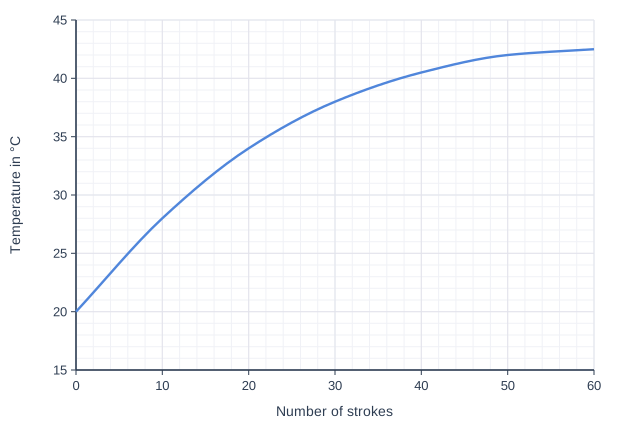
A student pumps a football with a bicycle pump at a steady rate and measures the temperature of the pump barrel after different numbers of strokes. The graph shows her results.

Describe how the temperature changes. Suggest why the temperature stops rising.

Line graph of temperature in °C (y-axis, 15 to 45) against number of strokes (x-axis, 0 to 60). The line is a smooth curve through (0, 20), (10, 28), (20, 34), (30, 38), (40, 40.5), (50, 42), (60, 42.5).

Model answer

The temperature rises from 20 °C, quickly at first and then more and more slowly, levelling off at about 42 °C after about 50 strokes. As the pump gets hotter, it transfers energy to the surroundings more quickly. Eventually the rate at which energy is transferred to the surroundings equals the rate at which work is being done on the air, so the temperature stops rising.

Explanation

The steady rate of pumping does work at a constant rate, but the rate of energy loss increases with the temperature difference between the pump and the room. When the two rates are equal, the temperature stays constant.

Mark scheme
  1. 1 mark

    the temperature increases (from 20 °C), quickly at first and then more slowly

    allow the rise in temperature per stroke decreases

  2. 1 mark

    it levels off at about 42-43 °C (after about 50 strokes)

  3. 1 mark

    the hotter the pump, the faster energy is transferred to the surroundings, until this equals the rate at which work is done on the air

    allow energy lost to the surroundings each second = energy supplied by doing work each second

Question 4

5 marks

An air compressor is powered by a 1.5 kW motor. The motor runs for 2.0 minutes, doing work on 3.0 kg of air in a tank. 60% of the work done increases the internal energy of the air.

Calculate the temperature rise of the air.

specific heat capacity of air = 1000 J/kg °C

Use the equation:
change in thermal energy = mass × specific heat capacity × temperature change

Model answer

P = 1.5 kW = 1500 W; t = 2.0 min = 120 s
E = P × t = 1500 × 120 = 180 000 J
Energy that increases the internal energy of the air = 0.60 × 180 000 = 108 000 J
ΔE = m c Δθ
108 000 = 3.0 × 1000 × Δθ
Δθ = 108 000 ÷ 3000 = 36 °C

Explanation

First find the total work done from energy = power × time, then take 60% of it as the energy that increases the internal energy of the air. Finally rearrange ΔE = m c Δθ to find the temperature rise.

Mark scheme
  1. 1 mark

    P = 1500 W and t = 120 s

    an answer of 36 (°C) scores 5 marks

  2. 1 mark

    E = 1500 × 120 = 180 000 (J)

    allow ecf from incorrect conversions

  3. 1 mark

    energy to the air = 0.60 × 180 000 = 108 000 (J)

    allow ecf

  4. 1 mark

    108 000 = 3.0 × 1000 × Δθ

    allow ecf

  5. 1 mark

    Δθ = 36 (°C)

    allow ecf; an answer of 60 °C (not using 60%) scores 4 marks

Ready to try the rest? Every answer you write is marked against the mark scheme, so you can see exactly where the marks are.

AI Tutor Hints first, answers after you try

Hi! Stuck? Ask me for a hint and I’ll help you work it out. Once you’ve checked your answer I can explain exactly where the marks are.