Practise 18 exam-style questions on Newton's Third Law for AQA GCSE Physics. Write your answer as you would in the exam and get it marked in seconds against the mark scheme, point by point, with an AI tutor on hand if you get stuck.
18 questions
1–6 marks each
Instant marking
No sign-up needed
18 questions, marked as you go
Sample questions with model answers
Here are 4 of the questions in this topic, each with a model answer, an explanation of why it earns the marks and the mark scheme an examiner would use.
Question 1
2 marks
State Newton's Third Law of motion.
Model answer
Whenever two objects interact, the forces they exert on each other are equal in size and opposite in direction.
Explanation
The key word is interact: a Newton's Third Law pair is always two forces of the same type acting on two different objects. Saying 'every action has an equal and opposite reaction' without mentioning two objects is not precise enough.
Mark scheme
1 mark
whenever two objects interact, each exerts a force on the other
allow the two forces act on different objects
1 mark
the forces are equal (in size) and opposite (in direction)
both 'equal' and 'opposite' needed; do not accept 'every action has a reaction' alone
Question 2
2 marks
An apple of weight 1.5 N falls from a tree. The Earth pulls the apple downwards with a force of 1.5 N, and the apple pulls the Earth upwards with a force of 1.5 N.
Explain why the apple accelerates towards the Earth but the Earth does not noticeably accelerate towards the apple.
Model answer
The two forces are equal in size, but the Earth's mass is enormous compared with the apple's. Since acceleration = force ÷ mass, the same 1.5 N force gives the Earth an acceleration that is far too small to notice, while the apple accelerates at about 9.8 m/s².
Explanation
Equal forces do not mean equal accelerations. Newton's Second Law shows that dividing the same force by a huge mass gives a tiny acceleration.
Mark scheme
1 mark
the forces are equal, but the Earth has a very much larger mass than the apple
1 mark
acceleration = force ÷ mass, so the Earth's acceleration is extremely small (too small to notice)
allow acceleration is inversely proportional to mass
Question 3
3 marks
Use Newton's Third Law to explain how friction allows a person to walk forwards. Explain why it is difficult to walk on smooth ice.
Model answer
When you walk, your foot pushes backwards on the ground. By Newton's Third Law the ground pushes forwards on your foot with an equal and opposite friction force, and this forward force moves you forwards. On smooth ice the friction between your shoe and the ice is very small, so your foot slips backwards instead of gripping, and the forward force on you is too small to walk normally.
Explanation
Friction is what lets your foot push on the ground; without it there is no interaction pair along the ground. This is why grit is spread on icy paths and why shoes have patterned soles.
Mark scheme
1 mark
the person's foot pushes backwards on the ground
1 mark
the ground exerts an equal and opposite (forward) friction force on the foot, which moves the person forwards
1 mark
on smooth ice the friction is very small, so the foot cannot push backwards hard and the forward force on the person is very small / the foot slips
Question 4
4 marks
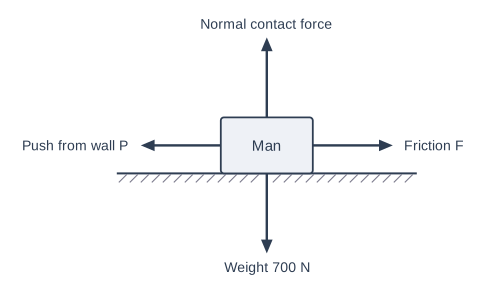
A man leans against a wall and stays at rest. He pushes horizontally on the wall with a force of 120 N. The diagram shows the forces acting on the man.
State the size of the push P from the wall and the size of the friction force F from the floor. Explain your answers.
Model answer
P = 120 N. The man pushes on the wall with 120 N, so by Newton's Third Law the wall pushes back on him with an equal and opposite force of 120 N. F = 120 N. The man is at rest, so the resultant force on him is zero: the friction from the floor must balance the push from the wall.
Explanation
This question uses two different laws. The Third Law links the force of the man on the wall to the force of the wall on the man (two objects). The First Law tells you that the forces on the man alone must balance because he is not moving.
Mark scheme
1 mark
P = 120 N
1 mark
the man pushes on the wall and the wall pushes back on him with an equal and opposite force (Newton's Third Law)
1 mark
F = 120 N
1 mark
the man is at rest, so the resultant force on him is zero / the horizontal forces on him are balanced
allow he is in equilibrium (Newton's First Law)
Ready to try the rest? Every answer you write is marked against the mark scheme, so you can see exactly where the marks are.
Ctrl + Enter to check
AI TutorHints first, answers after you try
Hi! Stuck? Ask me for a hint and I’ll help you work it out. Once you’ve checked your answer I can explain exactly where the marks are.