Practise 40 exam-style questions on The development of the model of the atom for AQA GCSE Physics. Write your answer as you would in the exam and get it marked in seconds against the mark scheme, point by point, with an AI tutor on hand if you get stuck.
40 questions
1–6 marks each
Instant marking
No sign-up needed
20 questions, marked as you go
Sample questions with model answers
Here are 4 of the questions in this topic, each with a model answer, an explanation of why it earns the marks and the mark scheme an examiner would use.
Question 1
2 marks
Describe the plum pudding model of the atom.
Model answer
In the plum pudding model the atom is a ball of positive charge with negative electrons embedded in it, like plums in a pudding.
Explanation
There is no nucleus in the plum pudding model: the positive charge (and the mass) is spread throughout the whole atom, with the electrons dotted through it.
Mark scheme
1 mark
the atom is a ball / sphere of positive charge
1 mark
with negative electrons embedded in it
allow electrons spread through it / scattered throughout; do not accept electrons orbiting a nucleus
Question 2
2 marks
Describe what James Chadwick's experimental work showed. State how long after the nucleus became an accepted idea this happened.
Model answer
Chadwick's experiments provided the evidence that neutrons exist within the nucleus. This was about 20 years after the nucleus had become an accepted scientific idea.
Explanation
The nuclear model was accepted long before anyone knew about neutrons. It took new experimental evidence to show that the nucleus contains uncharged particles as well as protons.
Mark scheme
1 mark
it provided evidence that neutrons exist in the nucleus
allow it discovered the neutron
1 mark
about 20 years later
allow 18-22 years
Question 3
3 marks
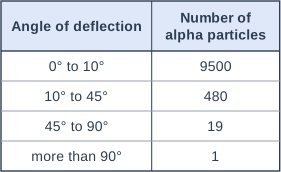
The table shows how many alpha particles were detected at different angles of deflection in a scattering experiment, out of every 10 000 alpha particles.
Use the data to explain why scientists concluded that the nucleus is very small compared with the atom.
Model answer
Out of 10 000 alpha particles, 9500 were deflected by less than 10° and only 1 was deflected by more than 90°. A large deflection only happens when an alpha particle passes very close to a nucleus. Since this happened so rarely, the nucleus must take up only a tiny fraction of the space in an atom - the rest of the atom is mostly empty space.
Explanation
Use numbers from the table to support the conclusion. The fewer the large deflections, the smaller the target that causes them must be.
Mark scheme
1 mark
only 1 in 10 000 alpha particles was deflected by more than 90° (and only 20 by more than 45°)
allow most (9500) were deflected by less than 10°
1 mark
large deflections only happen when an alpha particle passes very close to a nucleus
1 mark
so the nucleus must take up only a tiny fraction of the space in an atom
allow the atom is mostly empty space
Question 4
5 marks
In the nuclear model, the radius of an atom is about 1 × 10⁻¹⁰ m and the radius of its nucleus is about 1 × 10⁻¹⁴ m.
Calculate how many times larger the radius of the atom is than the radius of the nucleus. Use your answer to explain the results of the alpha particle scattering experiment.
Model answer
1 × 10⁻¹⁰ ÷ (1 × 10⁻¹⁴) = 1 × 10⁴, so the atom's radius is 10 000 times larger than the nucleus's radius. Because the nucleus is so tiny compared with the atom, most alpha particles pass through the foil far away from any nucleus, so they go straight through undeflected. Only the few alpha particles that happen to pass close to a nucleus are repelled by its positive charge and deflected. A very small number are aimed almost directly at a nucleus, and only these are deflected through large angles or bounce back.
Explanation
The size ratio explains the pattern of results: a tiny target means few close encounters. Dividing powers of ten means subtracting the powers: −10 − (−14) = 4.
Mark scheme
1 mark
1 × 10⁻¹⁰ ÷ 1 × 10⁻¹⁴
1 mark
= 10 000 (1 × 10⁴)
1 mark
the nucleus is tiny compared with the atom, so most alpha particles pass far from any nucleus and go straight through
1 mark
only the few that pass close to a nucleus are repelled by its positive charge and deflected
1 mark
very few are aimed almost directly at a nucleus, so very few are deflected through large angles / bounce back
Ready to try the rest? Every answer you write is marked against the mark scheme, so you can see exactly where the marks are.
Ctrl + Enter to check
AI TutorHints first, answers after you try
Hi! Stuck? Ask me for a hint and I’ll help you work it out. Once you’ve checked your answer I can explain exactly where the marks are.