Level:
Correct: 0
Incorrect: 0
Marks: 0/0
Exam Practice
Subject:
Topics:
AQA GCSE Physics Smart practice A mixed round aimed at your weak spots
Unit 1
Energy
Energy changes in a system, and the ways energy is stored before and after such changes
Energy stores and systems
0%
Changes in energy
0%
Energy changes in systems
0%
Power
0%
Conservation and dissipation of energy
Energy transfers in a system
0%
Efficiency
0%
Unit 2
Electricity
Unit 3
Particle model of matter
Unit 4
Atomic structure
Unit 5
Forces
Unit 6
Waves
Unit 7
Magnetism and electromagnetism
Unit 8
Space physics (physics only)
Avg
score:
–
Topics
done:
0/91

Poles of a magnet

Practise 31 exam-style questions on Poles of a magnet for AQA GCSE Physics. Write your answer as you would in the exam and get it marked in seconds against the mark scheme, point by point, with an AI tutor on hand if you get stuck.

  • 31 questions
  • 1–6 marks each
  • Instant marking
  • No sign-up needed
20 questions, marked as you go

Sample questions with model answers

Here are 4 of the questions in this topic, each with a model answer, an explanation of why it earns the marks and the mark scheme an examiner would use.

Question 1

1 mark

Name a metal, other than iron, that is a magnetic material.

Model answer

Nickel.

Explanation

The magnetic materials you need to know are iron, steel, cobalt and nickel. Most other metals, such as aluminium and copper, are not attracted to magnets.

Mark scheme
  1. 1 mark

    nickel / cobalt / steel

    do not accept aluminium, copper, brass, gold or silver

Question 2

2 marks

A bar magnet hangs from a thread so that it can turn freely. The north pole of a second bar magnet is brought close to the north pole of the hanging magnet.

Describe and explain what happens to the hanging magnet.

Model answer

The north pole of the hanging magnet is pushed away, so the magnet turns round until its south pole faces the second magnet. This is because like poles repel and unlike poles attract.

Explanation

The two north poles repel, so the hanging magnet rotates. It keeps turning until its south pole, which is attracted to the north pole of the second magnet, faces it.

Mark scheme
  1. 1 mark

    the hanging magnet turns so that its north pole moves away and its south pole turns towards the second magnet

    allow it turns / swings away

  2. 1 mark

    like poles repel (and unlike poles attract)

Question 3

3 marks

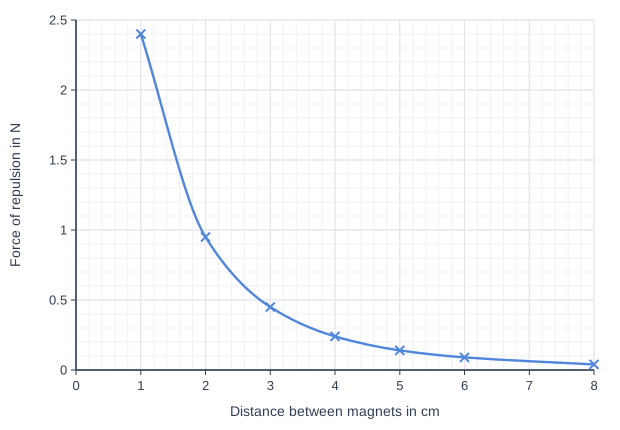
A student measures the force of repulsion between two magnets at different distances apart. The graph shows her results.

Describe how the force changes as the distance between the magnets increases. Use data from the graph.

Line graph of force of repulsion in N (y-axis, 0 to 2.5) against distance between magnets in cm (x-axis, 0 to 8). The line is a smooth curve through (1, 2.4), (2, 0.95), (3, 0.45), (4, 0.24), (5, 0.14), (6, 0.09), (8, 0.04).

Model answer

The force decreases as the distance between the magnets increases. It falls steeply at first, from 2.4 N at 1 cm to about 0.45 N at 3 cm, and then more slowly, reaching only about 0.04 N at 8 cm.

Explanation

Magnetic forces get weaker with distance from the poles, and the decrease is not linear: the curve is steep close to the magnet and flattens out further away. Always back up a described pattern with values read from the graph.

Mark scheme
  1. 1 mark

    the force decreases as the distance increases

  2. 1 mark

    the force decreases quickly at small distances and then more slowly at larger distances

    allow the relationship is not linear / the curve levels off

  3. 1 mark

    correct use of data, e.g. 2.4 N at 1 cm falls to about 0.45 N at 3 cm, but only to 0.04 N at 8 cm

    allow any two correctly read pairs of values used to support the pattern

Question 4

4 marks

A bar magnet is placed on a top-pan balance. The reading on the balance is 50.0 g. A second bar magnet is held directly above it, with its north pole facing down. The reading on the balance increases to 62.0 g.

The gravitational field strength is 9.8 N/kg.

Calculate the size of the magnetic force between the magnets, and state which pole of the magnet on the balance is facing upwards. Give a reason for your answer.

Model answer

Increase in reading = 62.0 − 50.0 = 12.0 g = 0.0120 kg
F = m × g = 0.0120 × 9.8
F = 0.1176 N ≈ 0.12 N

The upper face of the magnet on the balance is a north pole. The reading increased, so the lower magnet is being pushed down: the magnets repel, and only like poles repel.

Explanation

The extra 12.0 g on the balance is caused by the downward magnetic force, so convert it to kilograms and use W = m g to find the force. An increase means repulsion (pushed down); a decrease would mean attraction (pulled up).

Mark scheme
  1. 1 mark

    increase in reading = 12.0 g = 0.0120 kg

    an answer of 0.12 (N) scores the first 3 marks

  2. 1 mark

    F = 0.0120 × 9.8

    allow ecf from an incorrect mass

  3. 1 mark

    F = 0.12 N

    allow 0.1176 N; an answer of 117.6 (grams not converted to kg) scores 1 of the first 3 marks

  4. 1 mark

    north pole, because the reading increases so the lower magnet is pushed down: the magnets repel, and like poles repel

    pole and reason both needed

Ready to try the rest? Every answer you write is marked against the mark scheme, so you can see exactly where the marks are.

AI Tutor Hints first, answers after you try

Hi! Stuck? Ask me for a hint and I’ll help you work it out. Once you’ve checked your answer I can explain exactly where the marks are.