Momentum is a property of moving objects (HT only)
Practise 20 exam-style questions on Momentum is a property of moving objects (HT only) for AQA GCSE Physics. Write your answer as you would in the exam and get it marked in seconds against the mark scheme, point by point, with an AI tutor on hand if you get stuck.
20 questions
1–6 marks each
Instant marking
No sign-up needed
20 questions, marked as you go
Sample questions with model answers
Here are 4 of the questions in this topic, each with a model answer, an explanation of why it earns the marks and the mark scheme an examiner would use.
Question 1
2 marks
Momentum is a vector quantity.
Explain what this means.
Model answer
A vector quantity has both a size and a direction. Momentum = mass × velocity, and velocity has a direction, so momentum is in the same direction as the object's velocity. Momentum in one direction is positive and momentum in the opposite direction is negative.
Explanation
Mass is a scalar but velocity is a vector, so their product, momentum, is a vector. This is why the direction must always be considered: two identical objects moving at the same speed in opposite directions have momentum of the same size but opposite signs.
Mark scheme
1 mark
momentum has both magnitude (size) and direction
allow 'it has a size and a direction'
1 mark
the direction of an object's momentum is the same as the direction of its velocity
allow objects moving in opposite directions have momentum of opposite signs (one positive, one negative); allow because velocity is a vector
Question 2
2 marks
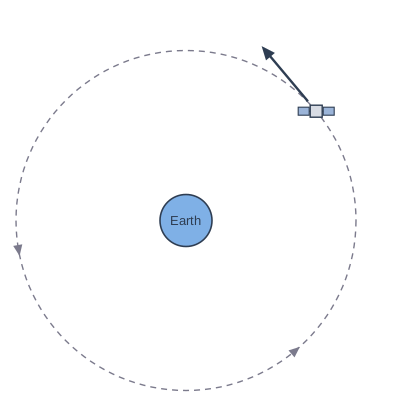
The diagram shows a satellite moving in a circular orbit around the Earth. The satellite moves at a constant speed.
Explain why the momentum of the satellite is changing, even though its speed is constant.
Model answer
As the satellite moves around the circle, its direction of motion is always changing, so its velocity is changing even though its speed stays the same. Momentum = mass × velocity, so momentum is also a vector: its direction keeps changing, so its momentum is changing.
Explanation
Speed has no direction, but velocity and momentum do. Any change in direction is a change in velocity and therefore a change in momentum, even if the size of the momentum stays the same.
Mark scheme
1 mark
the direction of motion (of the satellite) is continuously changing, so its velocity changes
allow velocity is a vector and its direction changes
1 mark
momentum = mass × velocity / momentum is a vector, so the (direction of the) momentum changes
Question 3
3 marks
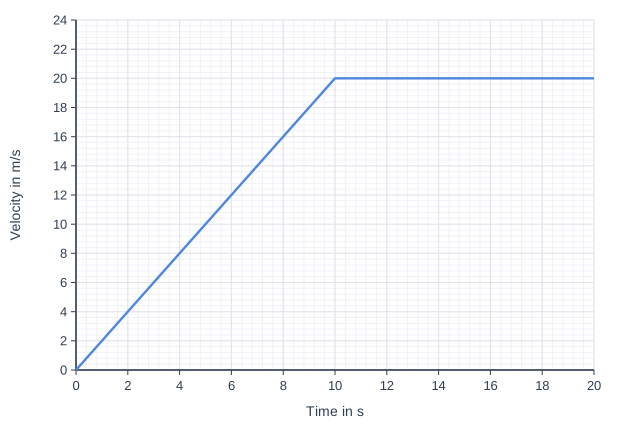
The graph shows how the velocity of a car changes during the first 20 seconds of a journey. The mass of the car is 900 kg.
Determine the momentum of the car at a time of 8 seconds.
Model answer
From the graph, at t = 8 s the velocity is 16 m/s. p = m × v p = 900 × 16 p = 14 400 kg m/s
Explanation
Read the velocity at 8 s from the graph first: the car speeds up steadily by 2 m/s every second, so after 8 s it is travelling at 16 m/s. Then use momentum = mass × velocity.
Mark scheme
1 mark
velocity at 8 s = 16 (m/s)
allow 15.8-16.2; an answer of 14 400 (kg m/s) scores 3 marks
1 mark
p = 900 × 16
allow ecf from an incorrect velocity read from the graph
1 mark
14 400 (kg m/s)
allow 14 200-14 600; allow ecf from an incorrect velocity
Question 4
4 marks
A cricket ball has a mass of 0.15 kg. When it is thrown, it has 30 J of kinetic energy.
Calculate the momentum of the ball.
Model answer
Eₖ = ½ m v² 30 = 0.5 × 0.15 × v² v² = 30 ÷ 0.075 = 400 v = 20 m/s p = m × v = 0.15 × 20 = 3.0 kg m/s
Explanation
Momentum needs the velocity, which is not given directly, so first use kinetic energy = ½ × mass × speed² to find the speed. Remember to take the square root of v² before multiplying by the mass.
Mark scheme
1 mark
30 = 0.5 × 0.15 × v²
an answer of 3.0 (kg m/s) scores 4 marks
1 mark
v² = 400
allow v² = 30 ÷ 0.075
1 mark
v = 20 (m/s)
1 mark
p = 0.15 × 20 = 3.0 (kg m/s)
allow ecf from an incorrect velocity
Ready to try the rest? Every answer you write is marked against the mark scheme, so you can see exactly where the marks are.
Ctrl + Enter to check
AI TutorHints first, answers after you try
Hi! Stuck? Ask me for a hint and I’ll help you work it out. Once you’ve checked your answer I can explain exactly where the marks are.