Level:
Correct: 0
Incorrect: 0
Marks: 0/0
Exam Practice
Subject:
Topics:
AQA GCSE Physics Smart practice A mixed round aimed at your weak spots
Unit 1
Energy
Energy changes in a system, and the ways energy is stored before and after such changes
Energy stores and systems
0%
Changes in energy
0%
Energy changes in systems
0%
Power
0%
Conservation and dissipation of energy
Energy transfers in a system
0%
Efficiency
0%
Unit 2
Electricity
Unit 3
Particle model of matter
Unit 4
Atomic structure
Unit 5
Forces
Unit 6
Waves
Unit 7
Magnetism and electromagnetism
Unit 8
Space physics (physics only)
Avg
score:
–
Topics
done:
0/91

Nuclear fusion (physics only)

Practise 18 exam-style questions on Nuclear fusion (physics only) for AQA GCSE Physics. Write your answer as you would in the exam and get it marked in seconds against the mark scheme, point by point, with an AI tutor on hand if you get stuck.

  • 18 questions
  • 1–6 marks each
  • Instant marking
  • No sign-up needed
18 questions, marked as you go

Sample questions with model answers

Here are 4 of the questions in this topic, each with a model answer, an explanation of why it earns the marks and the mark scheme an examiner would use.

Question 1

2 marks

State what is meant by nuclear fusion.

Model answer

Nuclear fusion is the joining of two light nuclei to form a single heavier nucleus. Some of the mass is converted into energy, which is released as radiation.

Explanation

Fusion is the opposite of fission: instead of a heavy nucleus splitting, two light nuclei (such as isotopes of hydrogen) join. Make sure you write 'nuclei', not 'atoms' - fusion is a nuclear process and the electrons play no part in it.

Mark scheme
  1. 1 mark

    two light nuclei join (together)

    allow small nuclei / hydrogen nuclei; allow fuse / combine for join; do not accept atoms or molecules joining

  2. 1 mark

    to form a (single) heavier nucleus

    allow larger nucleus; ignore references to energy being released
Question 2

2 marks

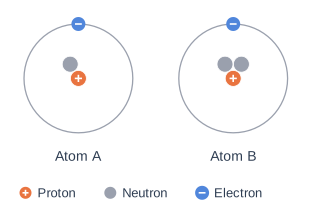
The diagram shows models of two atoms, A and B. Both atoms are used as fuel in fusion reactors.

Explain why atoms A and B are isotopes of the same element.

Diagram of two atoms side by side. Left - Atom A: a nucleus of 1 proton (+) and 1 neutron, with 1 electron (−) on 1 energy level (1 from the inside out). Right - Atom B: a nucleus of 1 proton (+) and 2 neutrons, with 1 electron (−) on 1 energy level (1 from the inside out). A key shows: orange circle with + = proton, grey circle = neutron, blue circle with − = electron.

Model answer

Both atoms have one proton, so they are the same element (hydrogen). Atom A has one neutron and atom B has two neutrons, so they are different isotopes of hydrogen: hydrogen-2 and hydrogen-3.

Explanation

Isotopes are atoms of the same element (same number of protons) with different numbers of neutrons, so they have different mass numbers. Hydrogen-2 and hydrogen-3 are the main fuel for fusion reactors because their nuclei have only a small positive charge, so they repel each other less than heavier nuclei.

Mark scheme
  1. 1 mark

    they have the same number of protons (one each)

    allow same atomic number

  2. 1 mark

    they have different numbers of neutrons (A has 1, B has 2)

    allow different mass numbers (2 and 3)

Question 3

3 marks

In an experimental fusion reactor, the hydrogen fuel is heated to about 150 million °C. At this temperature the fuel is a plasma: a gas of positively charged nuclei and free electrons.

The plasma is held away from the walls of the reactor by strong magnetic fields.

Suggest why the plasma must not touch the walls of the reactor and why magnetic fields can be used to hold it in place.

Model answer

The plasma is so hot that any wall it touched would melt or vaporise. Touching the walls would also cool the plasma, so its temperature would fall too low for fusion to continue. The plasma is made of charged particles (nuclei and electrons), and a magnetic field exerts a force on moving charged particles, so a magnetic field can keep the plasma away from the walls.

Explanation

Fusion needs temperatures far higher than the melting point of any material, which is one of the main reasons fusion power is so difficult. Because the hot fuel is made of charged particles, magnetic fields can push on it without anything solid touching it - like an invisible container.

Mark scheme
  1. 1 mark

    the walls would melt / vaporise / be damaged (because the plasma is so hot)

    allow no material can withstand the temperature

  2. 1 mark

    the plasma would be cooled (by the walls) so fusion would stop

    allow the plasma would lose energy / temperature would fall too low for fusion

  3. 1 mark

    the plasma is made of charged particles and magnetic fields exert forces on (moving) charged particles

    allow the nuclei and electrons are charged so they are affected by a magnetic field

Question 4

4 marks

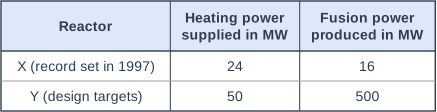
The table shows data for two experimental fusion reactors, X and Y. The values for reactor Y are the targets it has been designed to reach; it has not yet reached them.

A newspaper claims that fusion reactors are ready to supply electricity to the National Grid.

Use calculations based on the data to evaluate this claim.

Table with columns "Reactor", "Heating power supplied in MW", "Fusion power produced in MW". Reactor: X (record set in 1997); Heating power supplied in MW: 24; Fusion power produced in MW: 16 | Reactor: Y (design targets); Heating power supplied in MW: 50; Fusion power produced in MW: 500.

Model answer

Reactor X: 16 MW ÷ 24 MW = 0.67, so it produced only two-thirds of the power supplied to heat the fuel. It used more power than it produced, so it could not supply electricity.
Reactor Y: 500 MW ÷ 50 MW = 10, so it is designed to produce 10 times the power supplied.
However, reactor Y's values are only targets that it has not yet reached. The data does not show any reactor producing more power than it uses, so the claim is not justified yet.

Explanation

To evaluate a claim, use the data to calculate something useful (here, output ÷ input) and then make a judgement. A reactor can only supply electricity if it produces more power than is needed to run it. Be careful to separate measured results from design targets: a target is not evidence that something works.

Mark scheme
  1. 1 mark

    reactor X: 16 ÷ 24 = 0.67 / output is two-thirds of the input

    allow X produces 8 MW less than is supplied

  2. 1 mark

    reactor Y: 500 ÷ 50 = 10 / output is 10 times the input

    allow Y would produce 450 MW more than is supplied

  3. 1 mark

    reactor X produced less power than was supplied to heat it so it could not supply electricity (to the National Grid)

  4. 1 mark

    reactor Y's values are only targets that have not been achieved, so the claim is not justified (yet)

    allow the claim is wrong/premature because no reactor has yet produced more power than it uses (in the data)

Ready to try the rest? Every answer you write is marked against the mark scheme, so you can see exactly where the marks are.

AI Tutor Hints first, answers after you try

Hi! Stuck? Ask me for a hint and I’ll help you work it out. Once you’ve checked your answer I can explain exactly where the marks are.