Level:
Correct: 0
Incorrect: 0
Marks: 0/0
Exam Practice
Subject:
Topics:
AQA GCSE Physics Smart practice A mixed round aimed at your weak spots
Unit 1
Energy
Energy changes in a system, and the ways energy is stored before and after such changes
Energy stores and systems
0%
Changes in energy
0%
Energy changes in systems
0%
Power
0%
Conservation and dissipation of energy
Energy transfers in a system
0%
Efficiency
0%
Unit 2
Electricity
Unit 3
Particle model of matter
Unit 4
Atomic structure
Unit 5
Forces
Unit 6
Waves
Unit 7
Magnetism and electromagnetism
Unit 8
Space physics (physics only)
Avg
score:
–
Topics
done:
0/91

Stopping distance

Practise 27 exam-style questions on Stopping distance for AQA GCSE Physics. Write your answer as you would in the exam and get it marked in seconds against the mark scheme, point by point, with an AI tutor on hand if you get stuck.

  • 27 questions
  • 1–6 marks each
  • Instant marking
  • No sign-up needed
20 questions, marked as you go

Sample questions with model answers

Here are 4 of the questions in this topic, each with a model answer, an explanation of why it earns the marks and the mark scheme an examiner would use.

Question 1

2 marks

A car has a braking distance of 11 m when it is travelling at 12 m/s.

Predict the braking distance when the car is travelling at 24 m/s with the same braking force. Explain your answer.

Model answer

The speed doubles. Braking distance is proportional to the speed squared, so the braking distance becomes 2² = 4 times as big: 4 × 11 = 44 m.

Explanation

Doubling the speed gives the car four times as much kinetic energy. With the same braking force, the brakes must do four times as much work, so the car travels four times as far while braking.

Mark scheme
  1. 1 mark

    braking distance is proportional to speed squared, so doubling the speed makes the braking distance four times as big

    allow the kinetic energy is four times as big

  2. 1 mark

    44 (m)

    22 m scores 0 marks

Question 2

2 marks

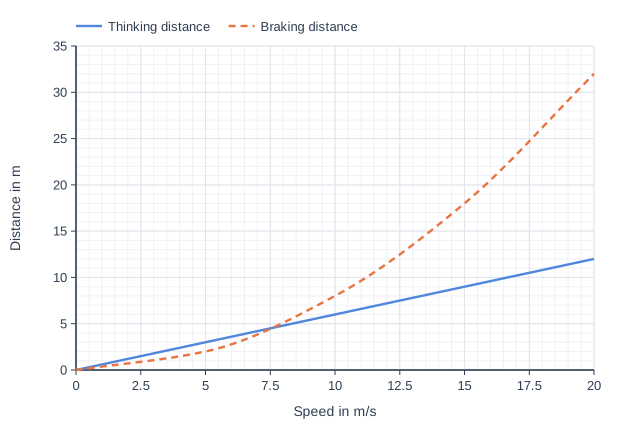
The graph shows how the thinking distance and the braking distance of a car depend on its speed.

Determine the speed at which the thinking distance is equal to the braking distance. State which distance is greater at speeds above this value.

Line graph of distance in m (y-axis, 0 to 35) against speed in m/s (x-axis, 0 to 20). "Thinking distance" joins the points (0, 0), (20, 12). "Braking distance" (dashed) is a smooth curve through (0, 0), (5, 2), (10, 8), (15, 18), (20, 32).

Model answer

The line and the curve cross at about 7.5 m/s, so the thinking distance equals the braking distance at about 7.5 m/s. At higher speeds the braking distance is greater than the thinking distance.

Explanation

Thinking distance is a straight line through the origin because it is proportional to speed. Braking distance is a curve that gets steeper because it is proportional to speed squared, so it overtakes the thinking distance and then increases much faster.

Mark scheme
  1. 1 mark

    7.5 (m/s)

    allow 7.0 to 8.0; the speed where the line and the curve cross; correct answer with no working scores full marks

  2. 1 mark

    the braking distance is greater (above this speed)

Question 3

3 marks

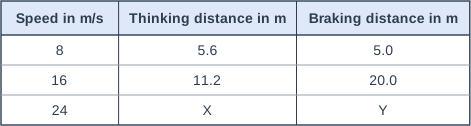
The table shows the thinking distance and the braking distance of a car at different speeds. The driver's reaction time and the braking force are the same at each speed.

Determine the values of X and Y.

Table with columns "Speed in m/s", "Thinking distance in m", "Braking distance in m". Speed in m/s: 8; Thinking distance in m: 5.6; Braking distance in m: 5.0 | Speed in m/s: 16; Thinking distance in m: 11.2; Braking distance in m: 20.0 | Speed in m/s: 24; Thinking distance in m: X; Braking distance in m: Y.

Model answer

Thinking distance is proportional to speed. 24 m/s is 3 × 8 m/s, so X = 3 × 5.6 = 16.8 m.
Braking distance is proportional to speed squared. The speed is 3 times as big, so the braking distance is 3² = 9 times as big: Y = 9 × 5.0 = 45 m.

Explanation

With the same reaction time, thinking distance increases in the same ratio as the speed. With the same braking force, braking distance increases in the ratio of the speeds squared, because the kinetic energy to be removed depends on v².

Mark scheme
  1. 1 mark

    X = 16.8 (m)

    allow thinking distance is proportional to speed, so X = 3 × 5.6; correct answer with no working scores full marks

  2. 1 mark

    braking distance is proportional to speed squared, e.g. speed × 3 so braking distance × 9, or speed × 1.5 so braking distance × 2.25

  3. 1 mark

    Y = 45 (m)

    allow 45.0; Y = 15 (m) (assuming proportional to speed) scores 0 for the last 2 marks

Question 4

4 marks

A car is travelling at 30 m/s on a motorway when the driver sees a broken-down vehicle 70 m ahead. The driver's reaction time is 0.60 s. The braking distance of the car at 30 m/s is 72 m.

If the car had been travelling at 25 m/s, its braking distance would have been 50 m.

Determine whether the car stops before reaching the broken-down vehicle at 30 m/s, and whether it would have stopped in time at 25 m/s.

Model answer

At 30 m/s: thinking distance = 30 × 0.60 = 18 m
Stopping distance = 18 + 72 = 90 m. This is more than 70 m, so the car does not stop in time.
At 25 m/s: thinking distance = 25 × 0.60 = 15 m
Stopping distance = 15 + 50 = 65 m. This is less than 70 m, so the car would have stopped with 5 m to spare.

Explanation

A drop in speed of only 5 m/s reduces the stopping distance by 25 m, because braking distance depends on speed squared. Always include the thinking distance when comparing a stopping distance with the distance to a hazard.

Mark scheme
  1. 1 mark

    at 30 m/s: thinking distance = 30 × 0.60 = 18 (m)

    correct answer with no working scores full marks

  2. 1 mark

    stopping distance = 18 + 72 = 90 m, which is more than 70 m, so the car does not stop in time

  3. 1 mark

    at 25 m/s: thinking distance = 25 × 0.60 = 15 m, stopping distance = 15 + 50 = 65 (m)

  4. 1 mark

    65 m is less than 70 m, so the car would stop in time (with 5 m to spare)

    allow ecf from their stopping distances

Ready to try the rest? Every answer you write is marked against the mark scheme, so you can see exactly where the marks are.

AI Tutor Hints first, answers after you try

Hi! Stuck? Ask me for a hint and I’ll help you work it out. Once you’ve checked your answer I can explain exactly where the marks are.