
Level:
Correct: 0
Incorrect: 0
Marks: 0/0
Exam Practice
Subject:
Topics:
AQA GCSE Physics Smart practice A mixed round aimed at your weak spots
Unit 1
Energy
Energy changes in a system, and the ways energy is stored before and after such changes
Energy stores and systems
0%
Changes in energy
0%
Energy changes in systems
0%
Power
0%
Conservation and dissipation of energy
Energy transfers in a system
0%
Efficiency
0%
Unit 2
Electricity
Unit 3
Particle model of matter
Unit 4
Atomic structure
Unit 5
Forces
Unit 6
Waves
Unit 7
Magnetism and electromagnetism
Unit 8
Space physics (physics only)
Avg
score:
–
Topics
done:
0/91

Waves for detection and exploration (physics only) (HT only)

Practise 41 exam-style questions on Waves for detection and exploration (physics only) (HT only) for AQA GCSE Physics. Write your answer as you would in the exam and get it marked in seconds against the mark scheme, point by point, with an AI tutor on hand if you get stuck.

  • 41 questions
  • 1–6 marks each
  • Instant marking
  • No sign-up needed
20 questions, marked as you go

Sample questions with model answers

Here are 4 of the questions in this topic, each with a model answer, an explanation of why it earns the marks and the mark scheme an examiner would use.

Question 1

2 marks

A pulse of ultrasound travels through the body and meets a boundary between two different types of tissue.

What happens to the ultrasound at the boundary?

Model answer

The ultrasound is partially reflected: some of it is reflected back towards the detector, and the rest is transmitted into the next tissue.

Explanation

Partial reflection is the key to ultrasound imaging. Because only some of the pulse is reflected at each boundary, the rest can travel on and be reflected by deeper boundaries, so one pulse gives several echoes.

Mark scheme
  1. 1 mark

    some of the ultrasound is reflected (back towards the detector)

    allow partially reflected

  2. 1 mark

    the rest is transmitted / passes into the next tissue

    allow some is absorbed
Question 2

2 marks

The first seismic waves to arrive at a seismometer after an earthquake are P-waves. For this reason they are called primary waves.

Explain why P-waves arrive before S-waves.

Model answer

P-waves travel faster than S-waves through rock. Both start at the earthquake at the same time and travel the same distance to the seismometer, so the P-waves take less time and arrive first.

Explanation

The gap between the arrival of the P-waves and the S-waves increases with distance from the earthquake, which allows seismologists to work out how far away the earthquake was.

Mark scheme
  1. 1 mark

    P-waves travel faster than S-waves (through the same rock)

  2. 1 mark

    so they take less time to travel the same distance to the seismometer

Question 3

3 marks

On the side of the Earth opposite to an earthquake, there is a large region where no S-waves are detected. This is called the S-wave shadow zone.

Explain how the S-wave shadow zone can be used to estimate the size of the Earth's core.

Model answer

S-waves cannot travel through the liquid outer core, so any S-wave whose path reaches the core is stopped. The S-waves that just miss the core mark the edge of the shadow zone, so a bigger core would block more waves and give a bigger shadow zone. By measuring where the shadow zone begins, as an angle from the earthquake, scientists can work out the radius of the core.

Explanation

The core casts a 'shadow' for S-waves in the same way that an object casts a shadow in light. The size of the shadow, together with the known paths of the waves, gives the size of the object.

Mark scheme
  1. 1 mark

    S-waves that reach the liquid outer core are stopped / cannot travel through it

  2. 1 mark

    so the size of the shadow zone depends on the size of the core: a bigger core gives a bigger shadow zone

  3. 1 mark

    by measuring where the shadow zone begins (the angle from the earthquake), scientists can work out the radius of the core

    allow the S-waves that just miss the core mark the edge of the shadow zone

Question 4

4 marks

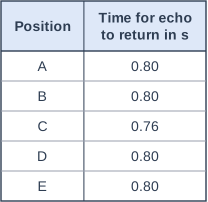
A ship uses echo sounding as it sails in a straight line over a flat part of the seabed. The table shows the time for the echo to return at five positions, A to E.

Speed of sound in sea water = 1500 m/s

Suggest what was detected at position C. Calculate its height above the seabed.

Table with columns "Position", "Time for echo to return in s". Position: A; Time for echo to return in s: 0.80 | Position: B; Time for echo to return in s: 0.80 | Position: C; Time for echo to return in s: 0.76 | Position: D; Time for echo to return in s: 0.80 | Position: E; Time for echo to return in s: 0.80.

Model answer

At A, B, D and E: depth = 1500 × 0.80 ÷ 2 = 600 m (the seabed)
At C: depth = 1500 × 0.76 ÷ 2 = 570 m
Height above the seabed = 600 − 570 = 30 m
The echo at C returns sooner, so something was sticking up 30 m above the flat seabed, such as a shipwreck or a large rock.

Explanation

A shorter echo time means the sound was reflected by a boundary nearer the ship. Echo sounding is used to detect objects in deep water as well as to measure depth.

Mark scheme
  1. 1 mark

    depth of the seabed (at A, B, D, E) = 1500 × 0.80 ÷ 2 = 600 (m)

    an answer of 30 (m) scores the first 3 marks

  2. 1 mark

    depth at C = 1500 × 0.76 ÷ 2 = 570 (m)

  3. 1 mark

    height = 600 − 570 = 30 (m)

    allow ecf; allow 1500 × 0.04 ÷ 2

  4. 1 mark

    an object on the seabed, e.g. a shipwreck / large rock / shoal of fish

    allow any sensible object

Ready to try the rest? Every answer you write is marked against the mark scheme, so you can see exactly where the marks are.

AI Tutor Hints first, answers after you try

Hi! Stuck? Ask me for a hint and I’ll help you work it out. Once you’ve checked your answer I can explain exactly where the marks are.