Practise 34 exam-style questions on Lenses (physics only) for AQA GCSE Physics. Write your answer as you would in the exam and get it marked in seconds against the mark scheme, point by point, with an AI tutor on hand if you get stuck.
34 questions
1–6 marks each
Instant marking
No sign-up needed
20 questions, marked as you go
Sample questions with model answers
Here are 4 of the questions in this topic, each with a model answer, an explanation of why it earns the marks and the mark scheme an examiner would use.
Question 1
2 marks
Lenses can produce real images and virtual images.
Describe the difference between a real image and a virtual image.
Model answer
A real image is formed where light rays actually meet, so it can be projected onto a screen. A virtual image is formed where the rays only appear to come from; the rays do not really meet there, so it cannot be projected onto a screen.
Explanation
The image formed by a camera or projector lens is real because light really arrives at the sensor or screen. The image seen through a magnifying glass is virtual: your eye traces the spreading rays back to a point they never actually pass through.
Mark scheme
1 mark
real image: light rays actually meet at the image / it can be projected onto a screen
1 mark
virtual image: the rays only appear to come from the image / it cannot be projected onto a screen
Question 2
2 marks
An object is placed exactly at the principal focus of a convex lens.
Describe what happens to the rays of light from the object after they pass through the lens, and state what this means for the image.
Model answer
The rays leave the lens parallel to each other. Parallel rays never meet (and do not appear to come from a point), so no image is formed.
Explanation
This is the reverse of parallel rays being focused at F: light from a point at F becomes parallel after the lens. It is the boundary between the real images formed when the object is beyond F and the virtual images formed when it is inside F.
Mark scheme
1 mark
the rays leave the lens parallel to each other
1 mark
so they never meet / no image is formed
allow the image is at infinity
Question 3
3 marks
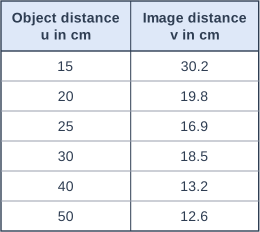
A student measured the image distance v for different object distances u using a convex lens. The table shows her results.
Describe the pattern shown by the results and identify the anomalous result.
Model answer
As the object distance increases, the image distance decreases, but it decreases by smaller amounts each time and levels off. The anomalous result is the image distance of 18.5 cm at an object distance of 30 cm, which should be between 16.9 cm and 13.2 cm.
Explanation
An anomalous result does not fit the pattern of the others: here v should keep falling as u increases, but 18.5 cm is larger than the value before it. For a lens, as the object moves far away the image approaches the principal focus, so v levels off at the focal length.
Mark scheme
1 mark
as the object distance increases, the image distance decreases
1 mark
the image distance decreases by less each time / levels off (towards about 10-12 cm)
allow not inversely proportional / not a linear decrease
1 mark
the anomalous result is v = 18.5 cm (at u = 30 cm)
Question 4
4 marks
An object 3.0 cm tall is placed 20 cm from a convex lens. The focal length of the lens is 10 cm.
Describe the position, size and nature of the image.
Model answer
The object is at 2F (twice the focal length). The image is formed at 2F on the other side of the lens, 20 cm from it. It is the same size as the object, 3.0 cm tall, and it is real and inverted.
Explanation
At 2F the ray diagram is symmetrical: the ray parallel to the axis and the ray through the centre cross at the same distance on the other side, giving an image the same size as the object. Objects further away than 2F give smaller images; objects between F and 2F give larger ones.
Mark scheme
1 mark
the image is 20 cm from the lens on the other side (at 2F)
1 mark
the image is the same size as the object / 3.0 cm tall
allow magnification = 1
1 mark
the image is real
1 mark
the image is inverted
Ready to try the rest? Every answer you write is marked against the mark scheme, so you can see exactly where the marks are.
Ctrl + Enter to check
AI TutorHints first, answers after you try
Hi! Stuck? Ask me for a hint and I’ll help you work it out. Once you’ve checked your answer I can explain exactly where the marks are.