
Level:
Correct: 0
Incorrect: 0
Marks: 0/0
Exam Practice
Course:
Topics:
OCR GCSE Maths (Higher calculator) Smart practice A mixed round aimed at your weak spots
Unit 1
Number Operations and Integers
Unit 2
Fractions, Decimals and Percentages
Unit 3
Indices and Surds
Unit 4
Approximation and Estimation
Unit 5
Ratio, Proportion and Rates of Change
Unit 6
Algebra
Unit 7
Graphs of Equations and Functions
Unit 8
Basic Geometry
Unit 9
Congruence and Similarity
Unit 10
Mensuration
Unit 11
Probability
Unit 12
Statistics
Avg
score:
–
Topics
done:
0/121

Writing expressions and formulae

Practise 14 exam-style questions on Writing expressions and formulae for OCR GCSE Maths (Higher calculator). Write your answer as you would in the exam and get it marked in seconds against the mark scheme, point by point, with the Study Helper on hand if you get stuck.

  • 14 questions
  • 1–4 marks each
  • Instant marking
  • No sign-up needed
14 questions, marked as you go

Sample questions with model answers

Here are 4 of the questions in this topic, each with a model answer, an explanation of why it earns the marks and the mark scheme an examiner would use.

Question 1

2 marks

A shop increases all its prices by 12%.

Write a formula for the new price, N pounds, of an item that used to cost P pounds.

Model answer

A 12% increase means the new price is 112% of the old price.
\(112\% = 1.12\)
\(N = 1.12P\)

Explanation

Increasing by 12% gives 100% + 12% = 112% of the original, so multiply by the multiplier 1.12. Writing \(N = P + 12\) adds £12, not 12%. The formula works for every price: an item costing £25 becomes \(1.12 \times 25 = £28\).

Mark scheme
  1. 2 marks

    B2 for \(N = 1.12P\) oe

    Accept \(N = P + 0.12P\), \(N = P + \dfrac{12P}{100}\) or \(N = \dfrac{112P}{100}\). B1 for \(1.12P\) without 'N =', or for \(0.12P\) seen. \(N = P + 12\) or \(N = 0.12P\) scores 0 for the formula (B1 for 0.12P seen in \(N = 0.12P\)).
Question 2

3 marks

A taxi company charges a fixed fee of £3.40 plus £2.15 for each mile travelled.

Write a formula for the cost, C pounds, of a journey of m miles.
Use your formula to work out the cost of a journey of 8.6 miles.

Model answer

Cost = fixed fee + cost per mile × number of miles
\(C = 3.40 + 2.15m\)
When \(m = 8.6\): \(C = 3.40 + 2.15 \times 8.6 = 3.40 + 18.49 = 21.89\)
The journey costs £21.89.

Explanation

The fixed fee is paid once, whatever the distance, while £2.15 is paid for every mile, so the miles part is \(2.15 \times m\). A formula must include the subject, here 'C ='. Adding 3.40 and 2.15 first and multiplying by m is a common error.

Mark scheme
  1. 2 marks

    B2 for \(C = 3.4 + 2.15m\) oe

    Accept \(C = 2.15m + 3.40\). B1 for \(3.4 + 2.15m\) without 'C =', or for \(C = 2.15m + k\) or \(C = km + 3.4\) (k any number), or for \(C = 340 + 215m\) (pence). \(C = 5.55m\) scores 0; correct answer with no working scores full marks

  2. 1 mark

    B1 for £21.89

    FT their linear formula with \(m = 8.6\). Exact value; ignore £ sign.

Question 3

3 marks

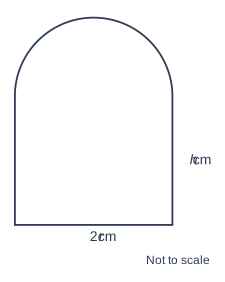
The diagram shows a shape made from a rectangle and a semicircle.

The rectangle is 2r cm wide and h cm high.
The diameter of the semicircle is the top side of the rectangle.

Write a formula for the perimeter, P cm, of the shape.

Geometry diagram, marked "Not to scale". A quadrilateral (its vertices are not labelled); side an unlabelled line going to the left is not drawn (the outline is open there). A semicircle on the straight line joining its ends as diameter, drawn above it. The unlabelled side going to the right is labelled 2r cm. The unlabelled side going upwards is labelled h cm.

Model answer

Curved edge = half the circumference of a circle of radius r \(= \dfrac{1}{2} \times 2\pi r = \pi r\)
Straight edges: two sides of h and the bottom of 2r, so \(2h + 2r\)
\(P = 2h + 2r + \pi r\)

Explanation

The perimeter is the distance all the way round the outside. The top of the rectangle is inside the shape, so it is not included. The semicircle has radius r (half of 2r), so its arc is half of \(2\pi r\).

Mark scheme
  1. 1 mark

    B1 for \(\pi r\) for the curved part

    Accept \(\dfrac{1}{2} \times 2\pi r\) or \(\dfrac{1}{2}\pi \times 2r\). \(2\pi r\) or \(\pi r^2\) scores B0; correct answer with no working scores full marks

  2. 1 mark

    B1 for \(2h + 2r\) for the straight sides

    \(2h + 4r\) (including the top of the rectangle) scores B0.

  3. 1 mark

    B1 for \(P = 2h + 2r + \pi r\) oe

    Accept \(P = 2h + r(2 + \pi)\). FT their two parts if both are attempted and 'P =' is given.

Question 4

4 marks

A car uses 6.5 litres of fuel for every 100 km it travels.
Fuel costs p pence per litre.

Write a formula for the cost, C pounds, of the fuel for a journey of d km.
Give your formula in its simplest form.

Model answer

Fuel used \(= \dfrac{6.5}{100} \times d = 0.065d\) litres
Cost in pence \(= 0.065d \times p = 0.065dp\)
Cost in pounds \(= 0.065dp \div 100\)
\(C = 0.00065dp\)

Explanation

Find the fuel used for d km (6.5 litres for each 100 km), multiply by the price per litre, then change pence into pounds. A check with numbers helps: 200 km uses 13 litres, which at 150p per litre costs £19.50, and \(0.00065 \times 200 \times 150 = 19.5\).

Mark scheme
  1. 1 mark

    M1 for fuel used \(= \dfrac{6.5d}{100}\) or \(0.065d\) litres

    Exact values from the question; correct answer with no working scores full marks

  2. 1 mark

    M1 for their fuel used \(\times p\), e.g. \(0.065dp\) (pence)

  3. 1 mark

    M1 for dividing their cost in pence by 100

  4. 1 mark

    A1 for \(C = 0.00065dp\) oe

    Exact. Accept \(C = \dfrac{6.5dp}{10000}\) or \(C = \dfrac{13dp}{20000}\). \(C = 0.065dp\) (pence not changed to pounds) scores M1 M1 M0 A0.

Ready to try the rest? Every answer you write is marked against the mark scheme, so you can see exactly where the marks are.

Study Helper Hints first, answers after you try

Stuck on this one? Ask for a hint and I’ll point you in the right direction, without giving the answer away. Once you’ve checked your answer, I’ll show you how the marks are awarded.