
Level:
Correct: 0
Incorrect: 0
Marks: 0/0
Exam Practice
Course:
Topics:
OCR GCSE Maths (Higher calculator) Smart practice A mixed round aimed at your weak spots
Unit 1
Number Operations and Integers
Unit 2
Fractions, Decimals and Percentages
Unit 3
Indices and Surds
Unit 4
Approximation and Estimation
Unit 5
Ratio, Proportion and Rates of Change
Unit 6
Algebra
Unit 7
Graphs of Equations and Functions
Unit 8
Basic Geometry
Unit 9
Congruence and Similarity
Unit 10
Mensuration
Unit 11
Probability
Unit 12
Statistics
Avg
score:
–
Topics
done:
0/121

Similar shapes

Practise 17 exam-style questions on Similar shapes for OCR GCSE Maths (Higher calculator). Write your answer as you would in the exam and get it marked in seconds against the mark scheme, point by point, with the Study Helper on hand if you get stuck.

  • 17 questions
  • 2–4 marks each
  • Instant marking
  • No sign-up needed
17 questions, marked as you go

Sample questions with model answers

Here are 4 of the questions in this topic, each with a model answer, an explanation of why it earns the marks and the mark scheme an examiner would use.

Question 1

2 marks

Theo is comparing two mathematically similar boxes.
The volume of the smaller box is 64 cm³ and the volume of the larger box is 216 cm³.

Theo says,

'The ratio of the heights of the boxes is 64 : 216, which simplifies to 8 : 27.'

Explain Theo's mistake and write down the correct ratio of the heights.

Model answer

64 : 216 compares volumes. For similar solids, the volume ratio is the cube of the length ratio, so Theo should take cube roots.
\(\sqrt[3]{64} = 4\) and \(\sqrt[3]{216} = 6\)
Ratio of heights = 4 : 6 = 2 : 3

Explanation

Lengths, areas and volumes of similar solids are in the ratios k, \(k^2\) and \(k^3\). To go from a volume ratio back to a length ratio, take the cube root of each part. Theo's 8 : 27 is itself the volume ratio in its simplest form.

Mark scheme
  1. 1 mark

    B1 for a correct explanation, e.g. 64 : 216 is the ratio of the volumes, and the ratio of lengths is the cube root of the volume ratio

    Accept 'he should have cube rooted the volumes'. Do not accept 'he should have square rooted'.

  2. 1 mark

    B1 for 2 : 3

    Accept 4 : 6 or 1 : 1.5.
Question 2

3 marks

Two solid statues are mathematically similar and are made of the same metal.
The smaller statue is 12 cm tall and has a mass of 640 g.
The larger statue is 21 cm tall.

Work out the mass of the larger statue.
Give your answer in kilograms.

Model answer

Length scale factor = \(21 \div 12 = 1.75\)
The statues are made of the same metal, so mass is proportional to volume.
Volume scale factor = \(1.75^3 = 5.359375\)
Mass = \(640 \times 5.359375 = 3430\) g
Mass = 3.43 kg

Explanation

Because both statues are made of the same metal, the mass scales in the same way as the volume, which is by the cube of the length scale factor. Remember to convert grams to kilograms by dividing by 1000.

Mark scheme
  1. 1 mark

    M1 for length scale factor \(21 \div 12\) or 1.75

    1.75 is exact; correct answer with no working scores full marks

  2. 1 mark

    M1 for \(640 \times 1.75^3\) oe

    Or 3430 (g) seen. \(640 \times 1.75^2 = 1960\) scores M1 M0 A0.

  3. 1 mark

    A1 for 3.43 (kg)

    Exact. 3430 with no conversion to kilograms scores M1 M1 A0.

Question 3

3 marks

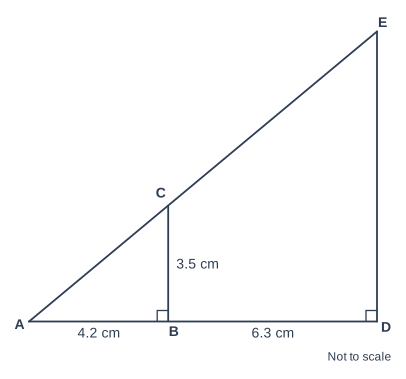
In the diagram, A, B and D lie on a straight line and A, C and E lie on a straight line.
Angle ABC = angle ADE = 90°.

AB = 4.2 cm, BC = 3.5 cm and BD = 6.3 cm.

Calculate the length of AE.
Give your answer correct to 3 significant figures.

Geometry diagram, marked "Not to scale". Triangle ADE. Line segment BC is drawn. B lies on side AD. C lies on side AE. Angle ABC is marked as a right angle (90°). Angle ADE is marked as a right angle (90°). Side AB is labelled 4.2 cm. BC is labelled 3.5 cm. Side BD is labelled 6.3 cm.

Model answer

Triangles ABC and ADE are similar (common angle at A and a right angle in each).
AD = 4.2 + 6.3 = 10.5 cm
Scale factor = \(10.5 \div 4.2 = 2.5\)
\(AC = \sqrt{4.2^2 + 3.5^2} = \sqrt{29.89} = 5.4671...\)
\(AE = 2.5 \times 5.4671... = 13.667...\)
AE = 13.7 cm (3 s.f.)

Explanation

BC and DE are both perpendicular to AD, so they are parallel and the triangles ABC and ADE are similar. The scale factor uses the whole of AD, not BD. Then either find AC with Pythagoras and enlarge it, or find DE = 8.75 cm and use Pythagoras in the large triangle.

Mark scheme
  1. 1 mark

    M1 for \(AC = \sqrt{4.2^2 + 3.5^2}\) (5.46...) or DE = \(3.5 \times 2.5\) (8.75)

    The decimals are exact values. Accept 5.46 to 5.47 for AC; correct answer with no working scores full marks

  2. 1 mark

    M1 for scale factor \(\dfrac{10.5}{4.2}\) or 2.5 used with their AC, or \(\sqrt{10.5^2 + 8.75^2}\)

    The decimals are exact values; accept 5.46 to 5.47 for their AC. AD = 4.2 + 6.3 = 10.5. Using \(\dfrac{6.3}{4.2} = 1.5\) scores M0 for this mark.

  3. 1 mark

    A1 for 13.7

    Accept 13.66 to 13.7 (13.667...). More accurate answers are accepted. Premature rounding of AC to 5.5 gives 13.8: M1 M1 A0.

Question 4

4 marks

A drinking glass is in the shape of an upside-down cone, 9 cm deep.
When it is full, it holds 250 ml.

Water is poured into the empty glass until it holds 125 ml.
The water forms a cone that is mathematically similar to the inside of the glass.

Calculate the depth of the water.
Give your answer correct to 3 significant figures.

Model answer

The water fills half the volume: volume scale factor = \(125 \div 250 = 0.5\)
Length scale factor = \(\sqrt[3]{0.5} = 0.7937...\)
Depth of water = \(9 \times 0.7937... = 7.1433...\)
Depth = 7.14 cm (3 s.f.)

Explanation

The water is a smaller cone similar to the glass, so its depth is the glass's depth times the cube root of the volume ratio. Half the volume needs far more than half the depth, because the glass is narrow at the bottom. Keep the full value of the cube root.

Mark scheme
  1. 1 mark

    M1 for volume scale factor \(\dfrac{125}{250}\) or 0.5

    0.5 is exact; correct answer with no working scores full marks

  2. 1 mark

    M1 for length scale factor \(\sqrt[3]{0.5}\) or 0.7937... oe

    Accept 0.79 to 0.794.

  3. 1 mark

    M1 for \(9 \times\) their 0.7937

    FT their length scale factor, provided it comes from a root of 0.5; accept 0.79 to 0.794 for their 0.7937.

  4. 1 mark

    A1 for 7.14 (cm)

    Accept 7.14 to 7.15 (7.1433...). More accurate answers are accepted. 4.5 (half the depth) scores M1 M0 M0 A0. 6.36 (square root used) scores M1 M0 M1 A0. Using 0.79 gives 7.11: M1 M1 M1 A0.

Ready to try the rest? Every answer you write is marked against the mark scheme, so you can see exactly where the marks are.

Study Helper Hints first, answers after you try

Stuck on this one? Ask for a hint and I’ll point you in the right direction, without giving the answer away. Once you’ve checked your answer, I’ll show you how the marks are awarded.