
Level:
Correct: 0
Incorrect: 0
Marks: 0/0
Exam Practice
Course:
Topics:
OCR GCSE Maths (Higher calculator) Smart practice A mixed round aimed at your weak spots
Unit 1
Number Operations and Integers
Unit 2
Fractions, Decimals and Percentages
Unit 3
Indices and Surds
Unit 4
Approximation and Estimation
Unit 5
Ratio, Proportion and Rates of Change
Unit 6
Algebra
Unit 7
Graphs of Equations and Functions
Unit 8
Basic Geometry
Unit 9
Congruence and Similarity
Unit 10
Mensuration
Unit 11
Probability
Unit 12
Statistics
Avg
score:
–
Topics
done:
0/121

Spheres, cones and composite solids

Practise 16 exam-style questions on Spheres, cones and composite solids for OCR GCSE Maths (Higher calculator). Write your answer as you would in the exam and get it marked in seconds against the mark scheme, point by point, with the Study Helper on hand if you get stuck.

  • 16 questions
  • 2–5 marks each
  • Instant marking
  • No sign-up needed
16 questions, marked as you go

Sample questions with model answers

Here are 4 of the questions in this topic, each with a model answer, an explanation of why it earns the marks and the mark scheme an examiner would use.

Question 1

2 marks

Sam works out the surface area of a sphere with diameter 15 cm.
Here is his working.

\(4 \times \pi \times 15^2 = 2827\) cm²

Sam has made an error.
Describe his error and work out the correct surface area.
Give your answer correct to 3 significant figures.

The surface area, \(A\), of a sphere with radius \(r\) is \(A = 4\pi r^2\).

Model answer

Sam used the diameter, 15 cm, in the formula instead of the radius.
Radius = 15 ÷ 2 = 7.5 cm
\(A = 4 \times \pi \times 7.5^2 = 706.85...\) cm²
= 707 cm² (3 s.f.)

Explanation

The formula uses the radius. Using the diameter doubles r, and because r is squared this makes the surface area four times too big: 2827 ÷ 4 ≈ 707.

Mark scheme
  1. 1 mark

    B1 for: he used the diameter (15) instead of the radius (7.5) oe

    Accept 'he should have halved 15', 'r is 7.5 not 15'. Do not accept 'he used the wrong formula' on its own.

  2. 1 mark

    B1 for 707

    Accept 706.8 to 707 (exact value 706.858...), from \(4 \times \pi \times 7.5^2\). This mark is independent of the first.
Question 2

3 marks

A ball is a sphere with diameter 24 cm.
The ball fits exactly inside a cube-shaped box, touching all six faces.

Show that more than 45% of the space inside the box is empty.

The volume, \(V\), of a sphere with radius \(r\) is \(V = \dfrac{4}{3}\pi r^3\).

Model answer

Radius of the ball = 12 cm
Volume of the ball = \(\dfrac{4}{3} \times \pi \times 12^3 = 7238.2...\) cm³
The edge of the box = diameter = 24 cm, so volume of the box = \(24^3 = 13 824\) cm³
Empty space = 13 824 − 7238.2... = 6585.7... cm³
Percentage empty = 6585.7... ÷ 13 824 × 100 = 47.6...%
47.6% is more than 45%.

Explanation

The ball touches all six faces, so the edge of the cube equals the diameter of the ball. Subtract the ball's volume from the cube's volume and write the empty space as a percentage of the cube. In fact the empty fraction is 1 − π/6 for any size, which is about 47.6%.

Mark scheme
  1. 1 mark

    M1 for \(\dfrac{4}{3} \times \pi \times 12^3\) or 7238.2...

    The ball; accept 7238 or better.

  2. 1 mark

    M1 for \(24^3\) or 13 824

    The cube has edges equal to the diameter of the ball; exact.

  3. 1 mark

    A1 for 47.6% (or 6585.8 compared with 6220.8) with a conclusion

    Accept 47.6 or better (47.64...%). E.g. 'empty space = 13 824 − 7238.2 = 6585.8, which is 47.6% of 13 824, more than 45%', or '45% of 13 824 = 6220.8 and 6585.8 > 6220.8'. Answer only scores 0.

Question 3

3 marks

A sphere and a cube have the same surface area.

Show that the volume of the sphere is about 1.38 times the volume of the cube.

The surface area, \(A\), of a sphere with radius \(r\) is \(A = 4\pi r^2\).
The volume, \(V\), of a sphere with radius \(r\) is \(V = \dfrac{4}{3}\pi r^3\).

Model answer

Take a cube with edges of 10 cm.
Surface area of the cube = 6 × 10² = 600 cm²
Sphere: \(4\pi r^2 = 600\), so \(r^2 = \dfrac{600}{4\pi} = 47.746...\) and \(r = 6.9098...\) cm
Volume of the sphere = \(\dfrac{4}{3} \times \pi \times 6.9098...^3 = 1381.97...\) cm³
Volume of the cube = 10³ = 1000 cm³
1381.97... ÷ 1000 = 1.38 (3 s.f.)
The volume of the sphere is about 1.38 times the volume of the cube.

Explanation

Choose any size of cube (or use letters), find the sphere with the same surface area, then compare the two volumes. The ratio is the same whatever size you choose, because both volumes scale in the same way. A sphere encloses more volume than any other shape with the same surface area.

Mark scheme
  1. 1 mark

    M1 for \(4\pi r^2 = 6s^2\) oe, or a particular cube, e.g. edge 10 cm, surface area 600 and \(r = \sqrt{600 \div 4\pi}\) = 6.909...

    Any letters, or any particular size used consistently. Accept r = 6.91 or better for a cube of edge 10.

  2. 1 mark

    M1 for the volume of the sphere using their r, e.g. \(\dfrac{4}{3} \times \pi \times 6.909...^3\) = 1381.97... and the volume of the cube 1000

    Accept 1381 to 1382 for a cube of edge 10 (exact values for the cube).

  3. 1 mark

    A1 for a ratio of 1.38 or better (1.3819...) with a conclusion

    E.g. '1381.97 ÷ 1000 = 1.38'. A particular size is acceptable because the ratio is the same for every size. Answer only scores 0.

Question 4

4 marks

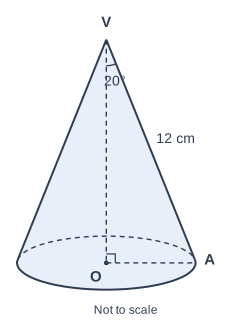
The diagram shows a cone.
The slant height of the cone is 12 cm.
The angle between the slant edge and the perpendicular height is 20°.

Calculate the volume of the cone.
Give your answer correct to 3 significant figures.

The volume, \(V\), of a cone with radius \(r\) and perpendicular height \(h\) is \(V = \dfrac{1}{3}\pi r^2 h\).

A cone drawn in 3D (hidden edges dashed). The slant height is labelled 12 cm (along the sloping side). Points marked: V is the apex, O is the centre of the base and A is a point on the edge of the base (at the end of the radius). Also drawn: a dashed line from V down to O (the height, with a right angle at O) and a radius from the centre to A. The angle OVA at V is marked 20°. The diagram is labelled "Not to scale".

Model answer

In the right-angled triangle formed by the slant edge, the radius and the height:
\(r = 12 \sin 20^\circ = 4.1042...\) cm
\(h = 12 \cos 20^\circ = 11.276...\) cm
\(V = \dfrac{1}{3} \times \pi \times 4.1042...^2 \times 11.276...\)
= 198.91... cm³
= 199 cm³ (3 s.f.)

Explanation

The slant edge is the hypotenuse of a right-angled triangle whose other sides are the radius and the height. The radius is opposite the 20° angle (sin) and the height is adjacent to it (cos). Then substitute into the volume formula.

Mark scheme
  1. 1 mark

    M1 for \(r = 12 \sin 20^\circ\)

    4.10... (accept 4.1 to 4.105); correct answer with no working scores full marks

  2. 1 mark

    M1 for \(h = 12 \cos 20^\circ\)

    11.27... (accept 11.27 to 11.3). Or Pythagoras with their r.

  3. 1 mark

    M1 for \(\dfrac{1}{3} \times \pi \times\) their \(r^2 \times\) their h

    Their r and h must come from trigonometry with 20° and 12.

  4. 1 mark

    A1 for 199

    Accept 198.5 to 199 (exact value 198.91...); more accurate answers are accepted. Using r = 4.1 and h = 11.3 or 11.28 is accepted. 547 (r and h swapped) scores M0 M0 M1 A0.

Ready to try the rest? Every answer you write is marked against the mark scheme, so you can see exactly where the marks are.

Study Helper Hints first, answers after you try

Stuck on this one? Ask for a hint and I’ll point you in the right direction, without giving the answer away. Once you’ve checked your answer, I’ll show you how the marks are awarded.