
Level:
Correct: 0
Incorrect: 0
Marks: 0/0
Exam Practice
Course:
Topics:
OCR GCSE Maths (Higher calculator) Smart practice A mixed round aimed at your weak spots
Unit 1
Number Operations and Integers
Unit 2
Fractions, Decimals and Percentages
Unit 3
Indices and Surds
Unit 4
Approximation and Estimation
Unit 5
Ratio, Proportion and Rates of Change
Unit 6
Algebra
Unit 7
Graphs of Equations and Functions
Unit 8
Basic Geometry
Unit 9
Congruence and Similarity
Unit 10
Mensuration
Unit 11
Probability
Unit 12
Statistics
Avg
score:
–
Topics
done:
0/121

Percentages of amounts

Practise 12 exam-style questions on Percentages of amounts for OCR GCSE Maths (Higher calculator). Write your answer as you would in the exam and get it marked in seconds against the mark scheme, point by point, with the Study Helper on hand if you get stuck.

  • 12 questions
  • 2–4 marks each
  • Instant marking
  • No sign-up needed
12 questions, marked as you go

Sample questions with model answers

Here are 4 of the questions in this topic, each with a model answer, an explanation of why it earns the marks and the mark scheme an examiner would use.

Question 1

2 marks

At the Paris 2024 Olympic Games, Team GB won 14 gold medals, 22 silver medals and 29 bronze medals.

What percentage of Team GB's medals were gold?
Give your answer correct to 1 decimal place.

Model answer

Total medals \(= 14 + 22 + 29 = 65\)
Percentage gold \(= \dfrac{14}{65} \times 100 = 21.538...\%\)
= 21.5% (1 d.p.)

Explanation

To write one quantity as a percentage of another, divide the part by the whole and multiply by 100. The whole is all 65 medals, not just the 51 silver and bronze. Round only at the end.

Mark scheme
  1. 1 mark

    M1 for \(\dfrac{14}{65}\) (\(\times 100\)) oe

    Exact values: the total number of medals is 65. Implied by 0.215... or 21.53... Accept 21.538 or better; correct answer with no working scores full marks

  2. 1 mark

    A1 for 21.5 (%)

    Accept 21.5 to 21.54 (full value 21.538...). 27.5 (from \(\dfrac{14}{51}\), gold compared with the other medals) scores 0. Correct answer with no working scores 2 marks.
Question 2

2 marks

There are 75 marks on a test.
The pass mark is 70%.

Sean scores 52 marks.

Sean says,

"I have passed the test."

Is Sean correct?
Show how you decide.

Model answer

\(\dfrac{52}{75} \times 100 = 69.33...\%\)
69.33...% is less than 70%.
No, Sean is not correct: he needed 70% of 75 = 52.5, so at least 53 marks.

Explanation

Write Sean's mark as a percentage of 75, or work out 70% of 75, and compare. Sean's 69.3% is just below the pass mark. Rounding 69.33...% up to 70% before comparing would give the wrong decision.

Mark scheme
  1. 1 mark

    M1 for \(\dfrac{52}{75} \times 100\) or 69.3...(%) or for \(0.7 \times 75\) or 52.5

    Accept 69.3 or better for 69.333...

  2. 1 mark

    A1 for No, with 69.3...% < 70% or 52 < 52.5

    Accept 69% with a clear comparison. 'No' with no correct values scores 0.

Question 3

3 marks

A 30 g serving of a breakfast cereal contains 1.2 g of salt.
The recommended maximum amount of salt for an adult is 6 g a day.

Nina eats a 45 g bowl of this cereal.

Nina says,

"My bowl of cereal gives me more than a quarter of the maximum amount of salt for a day."

Is Nina correct?
Show how you decide.

Model answer

Salt in 45 g of cereal \(= 1.2 \div 30 \times 45 = 1.8\) g
\(\dfrac{1.8}{6} \times 100 = 30\%\) of the daily maximum
30% is more than a quarter (25%), so Nina is correct.

Explanation

First scale the salt up from a 30 g serving to a 45 g bowl (1.5 times as much). Then write 1.8 g as a percentage of 6 g and compare with 25%. Using the salt for a 30 g serving (1.2 g) without scaling gives only 20%.

Mark scheme
  1. 1 mark

    M1 for \(1.2 \div 30 \times 45\) oe or 1.8 (g)

    Salt in a 45 g bowl. Exact values; e.g. \(1.2 \times 1.5\), or 4% salt seen.

  2. 1 mark

    M1 for their \(1.8 \div 6\) (\(\times 100\)) or \(\dfrac{1}{4} \times 6 = 1.5\)

    Comparing with the daily maximum. Implied by 30%.

  3. 1 mark

    A1 for Yes, with 30% (more than 25%), or 1.8 g (more than 1.5 g)

    Values needed with the conclusion. 'No' from using 1.2 g (20%) scores M0 M1 A0.

Question 4

4 marks

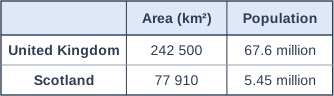
The table shows some information about the United Kingdom and Scotland.

Freya says,

"Scotland covers almost a third of the area of the UK, but it has less than a tenth of the UK's population."

Is Freya correct?
Show how you decide.

Table with columns (row headings), "Area (km²)", "Population". United Kingdom; Area (km²): 242 500; Population: 67.6 million | Scotland; Area (km²): 77 910; Population: 5.45 million.

Model answer

Area: \(\dfrac{77\,910}{242\,500} \times 100 = 32.1\%\), and a third is 33.3%, so Scotland covers almost a third of the area.
Population: \(\dfrac{5.45}{67.6} \times 100 = 8.06\%\), which is less than 10%.
Yes, Freya is correct.

Explanation

Freya makes two claims, so check both: write Scotland's area as a percentage of the UK's area, and Scotland's population as a percentage of the UK's population. 32.1% is close to \(33\dfrac{1}{3}\%\), and 8.1% is below 10%. Make sure you divide Scotland's figure by the UK's figure, not the other way round.

Mark scheme
  1. 1 mark

    M1 for \(\dfrac{77\,910}{242\,500}\) (\(\times 100\)) oe

    Exact values from the table. Or for \(\dfrac{1}{3} \times 242\,500 = 80\,833.3...\)

  2. 1 mark

    A1 for 32.1...% or 0.321... (compared with \(\dfrac{1}{3}\) or 33.3%)

    Accept 32.1 or 32.13 or better (full value 32.127...%), or 77 910 compared with 80 833.

  3. 1 mark

    M1 for \(\dfrac{5.45}{67.6}\) (\(\times 100\)) oe

    Or for \(0.1 \times 67.6 = 6.76\) (million).

  4. 1 mark

    A1 for Yes, with 8.06...% (or 0.0806...) less than 10%, or 5.45 million less than 6.76 million, and the area statement supported

    Accept 8.1 or 8.06 or better (full value 8.0621...%). Both parts of Freya's statement must be checked for this mark.

Ready to try the rest? Every answer you write is marked against the mark scheme, so you can see exactly where the marks are.

Study Helper Hints first, answers after you try

Stuck on this one? Ask for a hint and I’ll point you in the right direction, without giving the answer away. Once you’ve checked your answer, I’ll show you how the marks are awarded.