
Level:
Correct: 0
Incorrect: 0
Marks: 0/0
Exam Practice
Course:
Topics:
OCR GCSE Maths (Higher calculator) Smart practice A mixed round aimed at your weak spots
Unit 1
Number Operations and Integers
Unit 2
Fractions, Decimals and Percentages
Unit 3
Indices and Surds
Unit 4
Approximation and Estimation
Unit 5
Ratio, Proportion and Rates of Change
Unit 6
Algebra
Unit 7
Graphs of Equations and Functions
Unit 8
Basic Geometry
Unit 9
Congruence and Similarity
Unit 10
Mensuration
Unit 11
Probability
Unit 12
Statistics
Avg
score:
–
Topics
done:
0/121

Rotations

Practise 12 exam-style questions on Rotations for OCR GCSE Maths (Higher calculator). Write your answer as you would in the exam and get it marked in seconds against the mark scheme, point by point, with the Study Helper on hand if you get stuck.

  • 12 questions
  • 1–4 marks each
  • Instant marking
  • No sign-up needed
12 questions, marked as you go

Sample questions with model answers

Here are 4 of the questions in this topic, each with a model answer, an explanation of why it earns the marks and the mark scheme an examiner would use.

Question 1

1 mark

Kayla says,

'When you describe a rotation of 180°, you do not need to say whether it is clockwise or anticlockwise.'

Is Kayla correct?
Give a reason for your answer.

Model answer

Yes, Kayla is correct.
Turning 180° clockwise and turning 180° anticlockwise about the same centre both end in exactly the same position, so the image is the same either way.

Explanation

A rotation of 180° is a half turn, and half a turn one way lands in the same place as half a turn the other way. For 90° and 270° the direction matters, because 90° clockwise and 90° anticlockwise give different images. A full description of a 180° rotation still needs the angle and the centre.

Mark scheme
  1. 1 mark

    B1 for Yes, with a correct reason, e.g. a half turn clockwise ends in the same position as a half turn anticlockwise

    Accept 'yes, 180° clockwise and 180° anticlockwise give the same image' or 'yes, both directions end up in the same place'. 'Yes' with no reason, or with a wrong reason (e.g. 'because 180° is a straight line'), scores 0. 'No' scores 0.
Question 2

2 marks

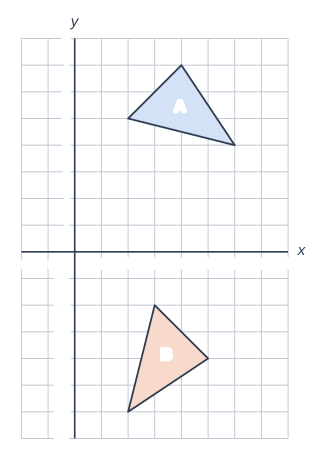
Triangle A is rotated 90° clockwise to give triangle B, as shown on the grid.

Ollie says that the centre of the rotation is the origin.

Show that Ollie is wrong.

A coordinate grid with x from −2 to 8 and y from −7 to 8; each grid square is 1 unit across, and the axes cross at the origin O. Shape A is a shaded triangle with vertices (2, 5), (6, 4) and (4, 7). Shape B is a shaded triangle with vertices (3, −2), (2, −6) and (5, −4).

Model answer

If the centre were O, the vertex \((2, 5)\) of A would map to \((5, -2)\) (90° clockwise about O maps \((x, y)\) to \((y, -x)\)).
\((5, -2)\) is not a vertex of B.
Also, \((2, 5)\) maps to \((3, -2)\) on B: its distance from O changes from \(\sqrt{29} = 5.38...\) to \(\sqrt{13} = 3.60...\), but a rotation about O would keep it the same.
So the origin is not the centre of rotation. Ollie is wrong.

Explanation

Every point stays the same distance from the centre during a rotation, so a quick test of a proposed centre is to compare the distances of a vertex and its image, or to rotate one vertex about it and see whether it lands on the image. Here neither works for the origin; the actual centre is \((-1, 1)\). Saying 'it does not look right' is not enough: you need a calculation or a correct image.

Mark scheme
  1. 1 mark

    M1 for a correct method that tests the origin as the centre

    e.g. rotating a vertex of A 90° clockwise about O: \((2, 5) \rightarrow (5, -2)\), \((6, 4) \rightarrow (4, -6)\) or \((4, 7) \rightarrow (7, -4)\); or finding the distance from O of a vertex of A and of its image, e.g. \(\sqrt{2^2 + 5^2} = 5.38...\) and \(\sqrt{3^2 + 2^2} = 3.60...\); or finding the correct centre \((-1, 1)\).

  2. 1 mark

    A1 for a correct conclusion with full supporting work

    e.g. '\((5, -2)\) is not a vertex of B, so O is not the centre'; or 'a rotation keeps every point the same distance from the centre, but these distances are different'; or 'the centre is \((-1, 1)\), not the origin'. A comparison of distances must use a vertex and its own image, or show that no vertex of B is as far from O as \((4, 7)\) (\(\sqrt{65}\) compared with at most \(\sqrt{41}\)).

Question 3

3 marks

The point \(P(5, 2)\) is rotated 90° anticlockwise about the point \(C(1, -1)\) to give the point Q.

Calculate the length of PQ.
Give your answer correct to 3 significant figures.

Model answer

From C to P: 4 right, 3 up.
Turned 90° anticlockwise: 3 left, 4 up.
Q = \((1 - 3, -1 + 4) = (-2, 3)\)
From P to Q: 7 left, 1 up
\(PQ = \sqrt{7^2 + 1^2} = \sqrt{50} = 7.0710...\)
PQ = 7.07 (3 s.f.)

Explanation

Find Q by turning the step from C to P through a quarter turn anticlockwise, then use Pythagoras. Alternatively, CP = CQ = 5 (a rotation keeps distances from the centre) and angle PCQ = 90°, so \(PQ = \sqrt{5^2 + 5^2}\). A common error is to rotate P about the origin instead of about C.

Mark scheme
  1. 1 mark

    B1 for \(Q(-2, 3)\)

    Or for CP = 5 (or CQ = 5) with the angle PCQ = 90° used; correct answer with no working scores full marks

  2. 1 mark

    M1 for \(\sqrt{7^2 + 1^2}\) oe

    FT their Q. Or \(\sqrt{5^2 + 5^2}\) or \(\sqrt{50}\) or \(5\sqrt{2}\).

  3. 1 mark

    A1 for 7.07

    Accept 7.07 to 7.071 (7.0710...). More accurate answers are accepted. \(\sqrt{50}\) or \(5\sqrt{2}\) as the final answer scores B1 M1 A0.

Question 4

4 marks

The point \(P(7, 3)\) is rotated 90° clockwise about the point \(C(2, 1)\) to give the point Q.
As it rotates, P moves along an arc of a circle with centre C.

Find the coordinates of Q.
Calculate the length of the arc from P to Q, giving your answer correct to 3 significant figures.

Model answer

From C to P: 5 right, 2 up.
Turned 90° clockwise: 2 right, 5 down.
Q = \((2 + 2, 1 - 5) = (4, -4)\)
Radius \(CP = \sqrt{5^2 + 2^2} = \sqrt{29} = 5.385...\)
Arc length = \(\dfrac{90}{360} \times 2\pi \times 5.385... = 8.4589...\)
Arc length = 8.46 units (3 s.f.)

Explanation

During a rotation every point moves on a circle round the centre, and a 90° rotation moves it a quarter of the way round. So the arc is a quarter of the circumference of a circle whose radius is the distance from C to P, found with Pythagoras. Keep the radius unrounded; the straight distance PQ is shorter than the arc and is not what is asked.

Mark scheme
  1. 1 mark

    B1 for \(Q(4, -4)\)

    Accept x = 4, y = -4; correct answer with no working scores full marks

  2. 1 mark

    M1 for radius CP = \(\sqrt{5^2 + 2^2}\) oe

    Or \(\sqrt{29}\) or 5.38 or 5.39 seen.

  3. 1 mark

    M1 for \(\dfrac{90}{360} \times 2 \times \pi \times\) their 5.385 oe

    Or \(\dfrac{1}{4} \times \pi \times 2\sqrt{29}\). Accept 5.38 to 5.39 for their 5.385. Their radius must be an attempt at CP, not 7 or 3 or the chord PQ.

  4. 1 mark

    A1 for 8.46

    Accept 8.45 to 8.46 (8.4589...). More accurate answers are accepted. Premature rounding of the radius to 5.4 gives 8.48 or to 5.39 gives 8.47: B1 M1 M1 A0. The straight-line distance PQ = 7.62 scores B1 M1 M0 A0 at most.

Ready to try the rest? Every answer you write is marked against the mark scheme, so you can see exactly where the marks are.

Study Helper Hints first, answers after you try

Stuck on this one? Ask for a hint and I’ll point you in the right direction, without giving the answer away. Once you’ve checked your answer, I’ll show you how the marks are awarded.