
Level:
Correct: 0
Incorrect: 0
Marks: 0/0
Exam Practice
Course:
Topics:
OCR GCSE Maths (Higher calculator) Smart practice A mixed round aimed at your weak spots
Unit 1
Number Operations and Integers
Unit 2
Fractions, Decimals and Percentages
Unit 3
Indices and Surds
Unit 4
Approximation and Estimation
Unit 5
Ratio, Proportion and Rates of Change
Unit 6
Algebra
Unit 7
Graphs of Equations and Functions
Unit 8
Basic Geometry
Unit 9
Congruence and Similarity
Unit 10
Mensuration
Unit 11
Probability
Unit 12
Statistics
Avg
score:
–
Topics
done:
0/121

Quadratic equations

Practise 19 exam-style questions on Quadratic equations for OCR GCSE Maths (Higher calculator). Write your answer as you would in the exam and get it marked in seconds against the mark scheme, point by point, with the Study Helper on hand if you get stuck.

  • 19 questions
  • 1–5 marks each
  • Instant marking
  • No sign-up needed
19 questions, marked as you go

Sample questions with model answers

Here are 4 of the questions in this topic, each with a model answer, an explanation of why it earns the marks and the mark scheme an examiner would use.

Question 1

3 marks

Solve.

\(x(x + 6) = 27\)

Model answer

\(x^2 + 6x = 27\)
\(x^2 + 6x - 27 = 0\)
\((x + 9)(x - 3) = 0\)
\(x = -9\) or \(x = 3\)

Explanation

Expand the bracket and rearrange so the quadratic equals 0 before factorising: a product equal to 27 does not tell you either factor. Find two numbers that multiply to −27 and add to 6: 9 and −3. Then each bracket equal to 0 gives one solution.

Mark scheme
  1. 1 mark

    B1 for \(x^2 + 6x - 27 = 0\) oe

    Accept \(x^2 + 6x = 27\) followed by a correct method; correct answer with no working scores full marks

  2. 1 mark

    M1 for \((x + 9)(x - 3)\) oe

    Or M1 for a correct substitution into the quadratic formula, \(\dfrac{-6 \pm \sqrt{6^2 - 4 \times 1 \times (-27)}}{2}\).

  3. 1 mark

    A1 for \(x = -9\) and \(x = 3\)

    Both needed. Correct answers with no working score 3 marks. \(x = 27\) or \(x = 21\) (from \(x + 6 = 27\)) scores 0.
Question 2

3 marks

A positive number is 2.4 more than its reciprocal.

Work out the number.
Give your answer correct to 3 significant figures.

Model answer

Let the number be \(x\). Its reciprocal is \(\dfrac{1}{x}\).
\(x = \dfrac{1}{x} + 2.4\)
\(x^2 = 1 + 2.4x\)
\(x^2 - 2.4x - 1 = 0\)
\(x = \dfrac{2.4 \pm \sqrt{5.76 + 4}}{2} = \dfrac{2.4 \pm \sqrt{9.76}}{2}\)
\(x = 2.7620...\) or \(x = -0.3620...\)
The number is positive, so it is 2.76.
Check: \(\dfrac{1}{2.7620...} = 0.3620...\) and \(0.3620... + 2.4 = 2.7620...\)

Explanation

The reciprocal of x is 1/x. Multiplying the equation by x turns it into a quadratic, which the formula solves. The question says the number is positive, so the negative solution is rejected.

Mark scheme
  1. 1 mark

    M1 for \(x = \dfrac{1}{x} + 2.4\) oe leading to \(x^2 - 2.4x - 1 = 0\) oe

    Any letter. e.g. \(x - \dfrac{1}{x} = 2.4\), \(5x^2 - 12x - 5 = 0\); correct answer with no working scores full marks

  2. 1 mark

    M1 for \(\dfrac{2.4 \pm \sqrt{2.4^2 + 4}}{2}\) oe

    FT their three-term quadratic. Accept as implied by \(\sqrt{9.76}\) or 3.124...

  3. 1 mark

    A1 for 2.76

    Value 2.7620... Accept 2.76 to 2.7621. The negative solution −0.362... must be rejected (the number is positive): 2.76 and −0.362 both given as the answer scores M1 M1 A0.

Question 3

4 marks

Solve.

\(\dfrac{x + 3}{2x - 1} = x - 2\)

Give your solutions correct to 3 significant figures.

Model answer

\(x + 3 = (x - 2)(2x - 1)\)
\(x + 3 = 2x^2 - 5x + 2\)
\(2x^2 - 6x - 1 = 0\)
\(x = \dfrac{6 \pm \sqrt{36 + 8}}{4} = \dfrac{6 \pm \sqrt{44}}{4}\)
\(x = \dfrac{6 + 6.6332...}{4} = 3.1583...\) or \(x = \dfrac{6 - 6.6332...}{4} = -0.15831...\)
\(x = 3.16\) or \(x = -0.158\)

Explanation

Multiply both sides by the denominator 2x − 1 to clear the fraction, then expand and rearrange into the form \(ax^2 + bx + c = 0\). The quadratic does not factorise, so use the formula. Neither solution makes 2x − 1 equal to 0, so both are valid.

Mark scheme
  1. 1 mark

    M1 for \(x + 3 = (x - 2)(2x - 1)\) oe

    Multiplying both sides by \(2x - 1\); correct answer with no working scores full marks

  2. 1 mark

    M1 for \(2x^2 - 6x - 1 = 0\) oe and a correct substitution into the quadratic formula

    FT their three-term quadratic = 0, e.g. \(\dfrac{6 \pm \sqrt{36 + 8}}{4}\). Expansion \(2x^2 - 5x + 2\) must be correct for the quadratic to be correct.

  3. 1 mark

    A1 for 3.16

    Value 3.1583... Accept 3.158 to 3.16.

  4. 1 mark

    A1 for \(-0.158\)

    Value −0.15831... Accept −0.1584 to −0.158.

Question 4

4 marks

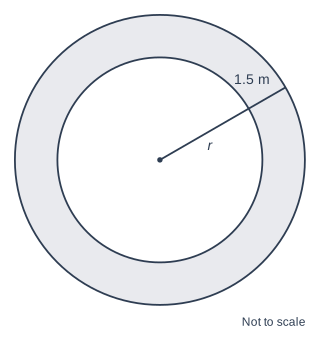
The diagram shows a circular pond of radius \(r\) metres.

A path of width 1.5 m is built all the way round the pond.

The area of the path is equal to the area of the pond.

Work out the radius of the pond.
Give your answer correct to 3 significant figures.

Geometry diagram, marked "Not to scale". A circle (shaded). Another circle (filled white, so the inside of the circle is not shaded). A sloping line with no labelled ends is drawn. A sloping line with no labelled ends is drawn. The line between the centre of circle c2 and an unlabelled point is labelled r. An unlabelled line going up and to the right is labelled 1.5 m.

Model answer

Area of pond and path \(= \pi(r + 1.5)^2\)
Area of path \(= \pi(r + 1.5)^2 - \pi r^2\)
\(\pi(r + 1.5)^2 - \pi r^2 = \pi r^2\)
\((r + 1.5)^2 = 2r^2\)
\(r^2 + 3r + 2.25 = 2r^2\)
\(r^2 - 3r - 2.25 = 0\)
\(r = \dfrac{3 \pm \sqrt{9 + 9}}{2} = \dfrac{3 \pm \sqrt{18}}{2}\)
\(r = 3.6213...\) (the other solution, \(-0.6213...\), is negative)
The radius of the pond is 3.62 m.

Explanation

The path is the large circle (radius r + 1.5) minus the pond. Setting its area equal to the pond's area, the π cancels and you get a quadratic in r. Only the positive solution is a possible radius.

Mark scheme
  1. 1 mark

    M1 for \(\pi(r + 1.5)^2 - \pi r^2 = \pi r^2\) oe

    Accept \(\pi(r + 1.5)^2 = 2\pi r^2\) oe, or \((r + 1.5)^2 = 2r^2\); correct answer with no working scores full marks

  2. 1 mark

    M1 for \(r^2 - 3r - 2.25 = 0\) oe

    e.g. \(4r^2 - 12r - 9 = 0\). Or M1 for \(r + 1.5 = \sqrt{2}r\) (square-rooting both sides).

  3. 1 mark

    M1 for \(\dfrac{3 \pm \sqrt{9 + 9}}{2}\) oe

    FT their three-term quadratic. Or M1 for \(r = \dfrac{1.5}{\sqrt{2} - 1}\).

  4. 1 mark

    A1 for 3.62 (m)

    Value 3.6213... Accept 3.62 to 3.6214. The negative solution (−0.621...) must be rejected or not given.

Ready to try the rest? Every answer you write is marked against the mark scheme, so you can see exactly where the marks are.

Study Helper Hints first, answers after you try

Stuck on this one? Ask for a hint and I’ll point you in the right direction, without giving the answer away. Once you’ve checked your answer, I’ll show you how the marks are awarded.