Level:
Correct: 0
Incorrect: 0
Marks: 0/0
Exam Practice
Course:
Topics:
OCR GCSE Maths (Higher calculator) Smart practice A mixed round aimed at your weak spots
Unit 1
Number Operations and Integers
Unit 2
Fractions, Decimals and Percentages
Unit 3
Indices and Surds
Unit 4
Approximation and Estimation
Unit 5
Ratio, Proportion and Rates of Change
Unit 6
Algebra
Unit 7
Graphs of Equations and Functions
Unit 8
Basic Geometry
Unit 9
Congruence and Similarity
Unit 10
Mensuration
Unit 11
Probability
Unit 12
Statistics
Avg
score:
–
Topics
done:
0/121

Area of composite shapes

Practise 14 exam-style questions on Area of composite shapes for OCR GCSE Maths (Higher calculator). Write your answer as you would in the exam and get it marked in seconds against the mark scheme, point by point, with the Study Helper on hand if you get stuck.

  • 14 questions
  • 2–5 marks each
  • Instant marking
  • No sign-up needed
14 questions, marked as you go

Sample questions with model answers

Here are 4 of the questions in this topic, each with a model answer, an explanation of why it earns the marks and the mark scheme an examiner would use.

Question 1

3 marks

The diagram shows the floor plan of a hall.
All the corners are right angles.

Work out the area of the floor.
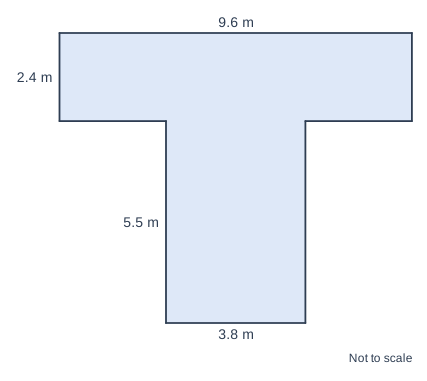
Geometry diagram, marked "Not to scale". An octagon (its vertices are not labelled) (shaded). The unlabelled side going to the left is labelled 9.6 m. The unlabelled side going downwards is labelled 2.4 m. The unlabelled side going to the right is labelled 3.8 m. The unlabelled side going downwards is labelled 5.5 m.

Model answer

Split the shape into two rectangles.
Top rectangle = 9.6 × 2.4 = 23.04 m²
Lower rectangle = 3.8 × 5.5 = 20.9 m²
Total area = 23.04 + 20.9 = 43.94 m²

Explanation

Split the T-shape into two rectangles that do not overlap, find the area of each, and add. Check that each rectangle's sides are lengths you know: the lower rectangle is 3.8 m wide and 5.5 m tall.

Mark scheme
  1. 1 mark

    M1 for \(9.6 \times 2.4\) or 23.04

    The top rectangle; exact values from the question; correct answer with no working scores full marks

  2. 1 mark

    M1 for \(3.8 \times 5.5\) or 20.9

    The lower rectangle; exact values from the question. Other correct ways of splitting the shape score equivalent marks.

  3. 1 mark

    A1 for 43.94

    Accept 43.94 m² or 43.9 (exact value 43.94). 75.84 (\(9.6 \times 7.9\), a whole rectangle) scores M0 M0 A0.
Question 2

3 marks

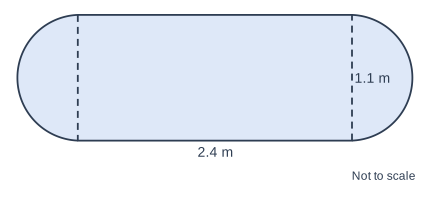
The diagram shows the top of a table.
The table top is made from a rectangle and two semicircles.
The rectangle is 2.4 m long and 1.1 m wide.

Jo is going to give the table top two coats of varnish.
One tin of varnish covers 7 m².

Jo says,
"One tin of varnish will be enough."

Is Jo correct?
Show how you decide.

Geometry diagram, marked "Not to scale". A quadrilateral (its vertices are not labelled) (shaded); sides an unlabelled line going upwards and an unlabelled line going downwards are not drawn (the outline is open there). A semicircle on the straight line joining its ends as diameter, drawn to the right of it (the region between the arc and the straight line joining its ends is shaded). A semicircle on the straight line joining its ends as diameter, drawn to the left of it (the region between the arc and the straight line joining its ends is shaded). A dashed vertical line with no labelled ends is drawn. A dashed vertical line with no labelled ends is drawn. The unlabelled side going to the right is labelled 2.4 m. The unlabelled side going upwards is labelled 1.1 m.

Model answer

The two semicircles make one circle with diameter 1.1 m, so radius 0.55 m.
Area of circle = \(\pi \times 0.55^2 = 0.9503...\) m²
Area of the table top = 2.4 × 1.1 + 0.9503... = 3.5903... m²
Two coats: 2 × 3.5903... = 7.18 m²
7.18 m² is more than 7 m², so one tin is not enough. Jo is not correct.

Explanation

The table top is a rectangle with a semicircle at each end, and the two semicircles together make one circle with diameter 1.1 m. Two coats means covering twice the area. The answer is close to 7 m², so work accurately before comparing.

Mark scheme
  1. 1 mark

    M1 for \(\pi \times 0.55^2\) or \(2 \times \dfrac{1}{2} \times \pi \times 0.55^2\) oe

    The two semicircles make one circle of diameter 1.1 m: 0.950... (accept 0.95 or better).

  2. 1 mark

    M1 for 2.4 × 1.1 + their 0.950...

    The area of the table top, 3.59... (accept 3.59 or better); 2.64 is exact.

  3. 1 mark

    A1 for No, with 7.18 compared with 7 (or 3.59 compared with 3.5)

    Accept 7.18 or better (7.1806...) for two coats. E.g. 'No, two coats need 7.18 m² but one tin only covers 7 m²'. 'No' with no working scores 0. Only one semicircle used (3.12, 6.23, 'Yes') scores M0 M1 A0.

Question 3

4 marks

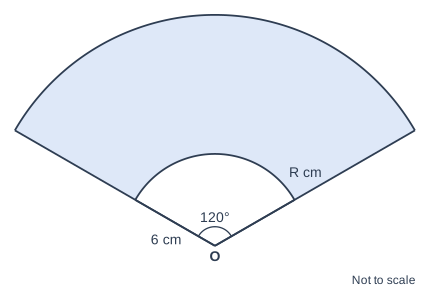
The diagram shows the paper part of a hand fan.
It is the region between two sectors with the same centre O and the same angle, 120°.
The smaller sector has radius 6 cm.
The larger sector has radius \(R\) cm.

The area of the paper is 200 cm².

Work out the value of \(R\).
Give your answer correct to 3 significant figures.

Geometry diagram, marked "Not to scale". A shaded sector with centre O, bounded by the radii the line going up and to the right from O and the line going up and to the left from O and the minor arc from an unlabelled point to an unlabelled point. A white sector with centre O, bounded by the radii the line going up and to the right from O and the line going up and to the left from O and the minor arc from an unlabelled point to an unlabelled point. The angle at O between the line going up and to the right from O and the line going up and to the left from O is marked 120°. The line going up and to the left from O is labelled 6 cm. The line going up and to the right from O is labelled R cm.

Model answer

Area of paper = large sector − small sector
\(\dfrac{120}{360} \times \pi R^2 - \dfrac{120}{360} \times \pi \times 6^2 = 200\)
\(\dfrac{1}{3}\pi (R^2 - 36) = 200\)
\(R^2 - 36 = \dfrac{600}{\pi} = 190.98...\)
\(R^2 = 226.98...\)
\(R = 15.066...\)
\(R = 15.1\) (3 s.f.)

Explanation

The paper is the large sector with the small sector removed, and both sectors are one third of a circle (120° out of 360°). Form an equation for the area, then undo it step by step: multiply by 3, divide by π, add 36 and take the square root.

Mark scheme
  1. 1 mark

    M1 for \(\dfrac{120}{360} \times \pi \times 6^2\) or \(12\pi\) or 37.69...

    The smaller sector; accept 37.6 to 37.7; correct answer with no working scores full marks

  2. 1 mark

    M1 for \(\dfrac{120}{360} \times \pi R^2 - \) their \(12\pi = 200\) oe

    Or \(\dfrac{1}{3}\pi(R^2 - 36) = 200\); 200 is exact.

  3. 1 mark

    M1 for \(R^2 = \dfrac{600}{\pi} + 36\) oe, or \(R = \sqrt{226.98...}\)

    Accept 226.9 to 227 for \(R^2\). Their equation must be correctly rearranged.

  4. 1 mark

    A1 for 15.1

    Accept 15.06 to 15.1 (exact value 15.066...); more accurate answers are accepted. 13.8 (the inner sector forgotten, \(R = \sqrt{600 \div \pi}\)) scores M0 M0 M0 A0, or M1 if 37.7 is seen.

Question 4

5 marks

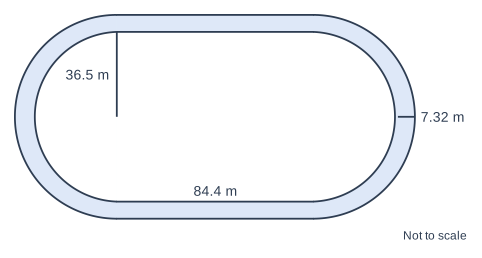
The diagram shows a running track.
The inside edge of the track is made from two straight lines, each 84.4 m long, and two semicircles of radius 36.5 m.
The track is 7.32 m wide all the way round.

The track is to be resurfaced.
Resurfacing costs £26.50 per square metre.

Work out the cost of resurfacing the track.
Give your answer correct to 3 significant figures.

Geometry diagram, marked "Not to scale". A quadrilateral (its vertices are not labelled) (shaded); sides an unlabelled line going upwards and an unlabelled line going downwards are not drawn (the outline is open there). A semicircle on the straight line joining its ends as diameter, drawn to the right of it (the region between the arc and the straight line joining its ends is shaded). A semicircle on the straight line joining its ends as diameter, drawn to the left of it (the region between the arc and the straight line joining its ends is shaded). A quadrilateral (its vertices are not labelled) (filled white); sides an unlabelled line going upwards and an unlabelled line going downwards are not drawn (the outline is open there). A semicircle on the straight line joining its ends as diameter, drawn to the right of it (the region between the arc and the straight line joining its ends is filled white). A semicircle on the straight line joining its ends as diameter, drawn to the left of it (the region between the arc and the straight line joining its ends is filled white). A vertical line with no labelled ends is drawn. A horizontal line with no labelled ends is drawn. The unlabelled side going to the right is labelled 84.4 m. The unlabelled side going upwards is labelled 36.5 m. The text "7.32 m" is written.

Model answer

Outer radius = 36.5 + 7.32 = 43.82 m
Straight sections: 2 × 84.4 × 7.32 = 1235.616 m²
Curved sections: the two ends together make a ring
\(\pi \times 43.82^2 - \pi \times 36.5^2 = 1847.07...\) m²
Total area = 1235.616 + 1847.07... = 3082.69... m²
Cost = 3082.69... × £26.50 = £81 691.3...
= £81 700 (3 s.f.)

Explanation

Split the track into the two straight strips (rectangles 84.4 m by 7.32 m) and the two curved ends. The two curved ends fit together to make a ring between circles of radius 43.82 m and 36.5 m. Multiply the total area by the cost per square metre.

Mark scheme
  1. 1 mark

    B1 for outer radius 36.5 + 7.32 or 43.82

    Exact values from the question; correct answer with no working scores full marks

  2. 1 mark

    M1 for \(2 \times 84.4 \times 7.32\) or 1235.616

    The two straight sections; exact values.

  3. 1 mark

    M1 for \(\pi \times 43.82^2 - \pi \times 36.5^2\) oe

    The two curved ends together make a ring: 1847.07... (accept 1847 to 1847.1). FT their outer radius.

  4. 1 mark

    M1 for (their 1235.6 + their 1847.1) × 26.50

    Total area 3082.69... (accept 3082 to 3083); 26.50 is exact.

  5. 1 mark

    A1 for 81 700

    Accept £81 700; accept 81 690 to 81 700 (exact value 81 691.3...); more accurate answers are accepted. Using only one straight section gives 65 300: B1 M0 M1 M1 A0. Using only one semicircular end gives 57 200: B1 M1 M0 M1 A0.

Ready to try the rest? Every answer you write is marked against the mark scheme, so you can see exactly where the marks are.

Study Helper Hints first, answers after you try

Stuck on this one? Ask for a hint and I’ll point you in the right direction, without giving the answer away. Once you’ve checked your answer, I’ll show you how the marks are awarded.