
Level:
Correct: 0
Incorrect: 0
Marks: 0/0
Exam Practice
Course:
Topics:
OCR GCSE Maths (Higher calculator) Smart practice A mixed round aimed at your weak spots
Unit 1
Number Operations and Integers
Unit 2
Fractions, Decimals and Percentages
Unit 3
Indices and Surds
Unit 4
Approximation and Estimation
Unit 5
Ratio, Proportion and Rates of Change
Unit 6
Algebra
Unit 7
Graphs of Equations and Functions
Unit 8
Basic Geometry
Unit 9
Congruence and Similarity
Unit 10
Mensuration
Unit 11
Probability
Unit 12
Statistics
Avg
score:
–
Topics
done:
0/121

Simplifying ratios

Practise 13 exam-style questions on Simplifying ratios for OCR GCSE Maths (Higher calculator). Write your answer as you would in the exam and get it marked in seconds against the mark scheme, point by point, with the Study Helper on hand if you get stuck.

  • 13 questions
  • 2–4 marks each
  • Instant marking
  • No sign-up needed
13 questions, marked as you go

Sample questions with model answers

Here are 4 of the questions in this topic, each with a model answer, an explanation of why it earns the marks and the mark scheme an examiner would use.

Question 1

2 marks

A tin contains 2.5 litres of paint.
Ola uses 375 ml of the paint.

Write the ratio paint used : paint left in the tin in its simplest form.

Model answer

2.5 litres = 2500 ml
Paint left = 2500 − 375 = 2125 ml
used : left = 375 : 2125
Divide both parts by 125: 375 : 2125 = 3 : 17

Explanation

First convert to the same units (2.5 litres = 2500 ml) and work out how much paint is left. The ratio compares the paint used with the paint left, not with the whole tin. 375 and 2125 are both multiples of 125, which gives 3 : 17.

Mark scheme
  1. 1 mark

    M1 for 2125 ml or 2.125 litres left, or 375 : 2125 oe

    Both parts must be in the same units, e.g. 0.375 : 2.125; correct answer with no working scores full marks

  2. 1 mark

    A1 for 3 : 17

    cao. 3 : 20 (paint used : whole tin, 375 : 2500) scores M0 A0. 375 : 2.5 (mixed units) scores M0. A correct answer with no working scores 2 marks.
Question 2

2 marks

Three bags of flour have masses 2.25 kg, 750 g and 1.5 kg.

Write the ratio of the three masses in its simplest form.

Model answer

Write all three masses in grams:
2250 g : 750 g : 1500 g
Divide each part by 750:
2250 : 750 : 1500 = 3 : 1 : 2

Explanation

A ratio can only be simplified when every part is in the same units, so convert the kilograms to grams first (or 750 g to 0.75 kg). The highest common factor of 2250, 750 and 1500 is 750. The order of the answer must match the order of the bags in the question.

Mark scheme
  1. 1 mark

    M1 for 2250 : 750 : 1500 or 2.25 : 0.75 : 1.5 oe

    All three parts in the same units, or a correct partly simplified ratio, e.g. 225 : 75 : 150 or 9 : 3 : 6; correct answer with no working scores full marks

  2. 1 mark

    A1 for 3 : 1 : 2

    cao. 2.25 : 750 : 1.5 (mixed units) scores M0 A0. A correct answer with no working scores 2 marks.

Question 3

3 marks

Leo makes a fruit punch with 1.2 litres of orange juice and 450 ml of pineapple juice.
He then adds another 300 ml of pineapple juice.

Write the ratio orange juice : pineapple juice in the final punch in its simplest form.

Model answer

Pineapple juice = 450 + 300 = 750 ml
Orange juice = 1.2 litres = 1200 ml
orange : pineapple = 1200 : 750
Divide both parts by 150: 1200 : 750 = 8 : 5

Explanation

Find the final amount of pineapple juice first, then write both amounts in millilitres. The highest common factor of 1200 and 750 is 150, which gives 8 : 5. Keep the order the question gives: orange juice first.

Mark scheme
  1. 1 mark

    B1 for 750 ml or 0.75 litres of pineapple juice

    From 450 + 300; correct answer with no working scores full marks

  2. 1 mark

    M1 for 1200 : their 750 oe

    Both parts in the same units, e.g. 1.2 : 0.75, or a correct partly simplified ratio such as 120 : 75 or 24 : 15. FT their total of pineapple juice.

  3. 1 mark

    A1 for 8 : 5

    cao. 5 : 8 (reversed) scores B1 M1 A0. 8 : 3 (1200 : 450, ignoring the extra juice) scores B0 M1 A0. 1.2 : 750 (mixed units) scores B1 M0 A0.

Question 4

4 marks

A local council says that a school should have no more than 16 students for each teacher.

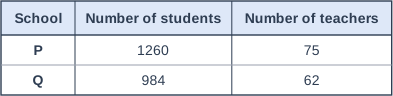
The table shows the numbers of students and teachers at two schools, P and Q.

By writing the ratio teachers : students for each school in the form 1 : \(n\), decide which of these schools meet the council's target.

Table with columns "School", "Number of students", "Number of teachers". School: P; Number of students: 1260; Number of teachers: 75 | School: Q; Number of students: 984; Number of teachers: 62.

Model answer

School P: teachers : students = 75 : 1260
\(1260 \div 75 = 16.8\), so 75 : 1260 = 1 : 16.8
School Q: teachers : students = 62 : 984
\(984 \div 62 = 15.870...\), so 62 : 984 = 1 : 15.9 (1 d.p.)
School P has 16.8 students for each teacher, which is more than 16.
School Q has 15.9 students for each teacher, which is less than 16.
Only School Q meets the target.

Explanation

Writing both ratios in the form 1 : n shows the number of students for each teacher, so the schools can be compared directly with the target of 16. Divide the number of students by the number of teachers. School P is above 16 and School Q is below it, so only Q meets the target.

Mark scheme
  1. 1 mark

    M1 for \(1260 \div 75\) or 16.8

    Or 75 : 1260 with both parts divided by 75. Or \(75 \times 16 = 1200\) compared with 1260 (see the last mark point); correct answer with no working scores full marks

  2. 1 mark

    M1 for \(984 \div 62\) or 15.87...

    Or 62 : 984 with both parts divided by 62. Or \(62 \times 16 = 992\) compared with 984 (see the last mark point).

  3. 1 mark

    A1 for 1 : 16.8 and 1 : 15.9 or better

    Accept 1 : 15.87, 1 : 15.870... or 1 : 15.9 for school Q (\(984 \div 62 = 15.870...\)). Accept 1 : 16 rounded from 15.87 only if 15.87... is seen.

  4. 1 mark

    A1 for School Q meets the target and School P does not

    Must follow correct values for both schools: 1 : 16.8 and 1 : 15.9 (or better), or the comparison method below. Accept 'only Q'. Comparing \(75 \times 16 = 1200 < 1260\) and \(62 \times 16 = 992 > 984\) is a correct alternative method, but the question asks for the ratios: award M1 M1 A0 A1 for this method with a correct conclusion. A correct conclusion with no correct values or comparison scores A0.

Ready to try the rest? Every answer you write is marked against the mark scheme, so you can see exactly where the marks are.

Study Helper Hints first, answers after you try

Stuck on this one? Ask for a hint and I’ll point you in the right direction, without giving the answer away. Once you’ve checked your answer, I’ll show you how the marks are awarded.