
Level:
Correct: 0
Incorrect: 0
Marks: 0/0
Exam Practice
Course:
Topics:
OCR GCSE Maths (Higher calculator) Smart practice A mixed round aimed at your weak spots
Unit 1
Number Operations and Integers
Unit 2
Fractions, Decimals and Percentages
Unit 3
Indices and Surds
Unit 4
Approximation and Estimation
Unit 5
Ratio, Proportion and Rates of Change
Unit 6
Algebra
Unit 7
Graphs of Equations and Functions
Unit 8
Basic Geometry
Unit 9
Congruence and Similarity
Unit 10
Mensuration
Unit 11
Probability
Unit 12
Statistics
Avg
score:
–
Topics
done:
0/121

Angles and parallel lines

Practise 14 exam-style questions on Angles and parallel lines for OCR GCSE Maths (Higher calculator). Write your answer as you would in the exam and get it marked in seconds against the mark scheme, point by point, with the Study Helper on hand if you get stuck.

  • 14 questions
  • 1–5 marks each
  • Instant marking
  • No sign-up needed
14 questions, marked as you go

Sample questions with model answers

Here are 4 of the questions in this topic, each with a model answer, an explanation of why it earns the marks and the mark scheme an examiner would use.

Question 1

1 mark

The diagram shows two straight lines, AB and CD.
A third straight line crosses AB at E and CD at F.

Ollie says
'x = 71°, because corresponding angles are equal.'

Explain why Ollie may be wrong.
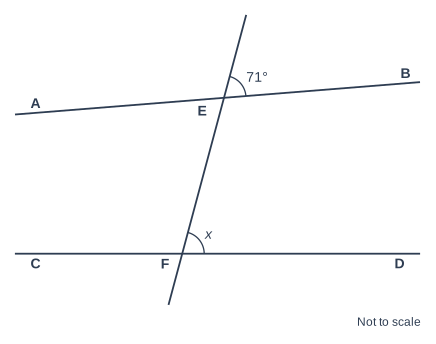
Geometry diagram, marked "Not to scale". A straight line is drawn through A, E and B (in that order), extending beyond A and B. A straight line is drawn through C, F and D (in that order), extending beyond C and D. A sloping line with no labelled ends is drawn; it crosses AB and crosses CD. F lies on an unlabelled line going upwards. E lies on an unlabelled line going upwards. The angle at E between EB and the extension of FE beyond E is marked 71°. Angle DFE is marked x.

Model answer

Corresponding angles are equal only when the two lines are parallel.
The diagram and the question do not say that AB is parallel to CD (there are no arrows on the lines), so we cannot say that x = 71°.

Explanation

The angle facts for alternate, corresponding and co-interior angles only work for parallel lines. Diagrams are not drawn to scale, so lines that look parallel may not be: they must be marked with arrows or stated to be parallel.

Mark scheme
  1. 1 mark

    B1 for: we do not know that AB is parallel to CD, and corresponding angles are only equal when the lines are parallel

    Accept 'the lines are not marked as parallel' or 'AB and CD might not be parallel'. Must refer to the lines not being (known to be) parallel. 'The diagram is not to scale' alone scores 0.
Question 2

3 marks

A boat sails from A to B on a bearing of 072.5°.
It then sails from B to C on a bearing of 154.8°.

Work out the size of angle ABC.

Model answer

The north lines at A and B are parallel.
Angle between north at B and BA = 180° − 72.5° = 107.5° (co-interior angles add up to 180°)
So the bearing of A from B is 180° + 72.5° = 252.5°.
Angle ABC = 252.5° − 154.8° = 97.7°

Explanation

Draw north lines at A and B: they are parallel, so the angle at B between the north line and BA is 180° − 72.5° (co-interior angles). The angles at B then add up to 360°. A common error is simply to subtract the two bearings.

Mark scheme
  1. 1 mark

    M1 for \(180 - 72.5\) or 107.5, or the bearing of A from B = 252.5

    Exact values. The north lines at A and B are parallel, so the angle between north at B and BA is 107.5° (co-interior angles add up to 180°); correct answer with no working scores full marks

  2. 1 mark

    M1 for \(360 - \text{their } 107.5 - 154.8\) or \(\text{their } 252.5 - 154.8\)

    Exact values. Angles at a point add up to 360°.

  3. 1 mark

    A1 for 97.7

    Exact answer. Accept 97.7°. 82.3 (from 154.8 − 72.5) scores M0 M0 A0. 262.3 (the reflex angle) scores M1 M1 A0.

Question 3

4 marks

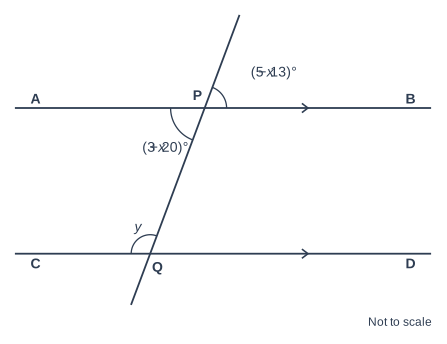
In the diagram, AB is parallel to CD.
A straight line crosses AB at P and CD at Q.

Work out the value of y.

Geometry diagram, marked "Not to scale". A straight line is drawn through A, P and B (in that order), extending beyond A and B. A straight line is drawn through C, Q and D (in that order), extending beyond C and D. A sloping line with no labelled ends is drawn; it crosses AB and crosses CD. Q lies on an unlabelled line going upwards. P lies on an unlabelled line going upwards. The angle at P between the extension of QP beyond P and PB is marked (5x − 13)°. Angle APQ is marked (3x + 20)°. Angle PQC is marked y. AB and CD are each marked with an arrowhead (parallel lines).

Model answer

The two marked angles at P are vertically opposite, so they are equal:
\(5x - 13 = 3x + 20\)
\(2x = 33\)
\(x = 16.5\)
Angle APQ = \(3 \times 16.5 + 20 = 69.5^\circ\)
Angles APQ and PQC are co-interior, so they add up to 180°:
y = 180 − 69.5 = 110.5

Explanation

First use vertically opposite angles to form and solve an equation for x. Then substitute to find the angle at P and use co-interior angles (which add up to 180°) to find y. A common error is to stop at 69.5°.

Mark scheme
  1. 1 mark

    M1 for \(5x - 13 = 3x + 20\)

    Vertically opposite angles are equal. Exact values from the question; correct answer with no working scores full marks

  2. 1 mark

    A1 for x = 16.5

    Exact value.

  3. 1 mark

    M1 for \(180 - (3 \times \text{their } 16.5 + 20)\) oe

    Exact values. Co-interior angles add up to 180°. FT their x. Implied by 180 − 69.5.

  4. 1 mark

    A1 for 110.5

    Exact answer. Accept 110.5°. 69.5 as the final answer scores M1 A1 M0 A0.

Question 4

4 marks

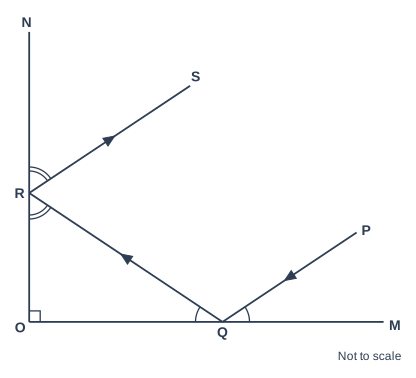
The diagram shows two flat mirrors, OM and ON, that meet at right angles at O.
A ray of light travels along PQ and reflects off mirror OM at Q. It travels to R on mirror ON and reflects off ON along RS.

When a ray reflects off a mirror, the two parts of the ray make equal angles with the mirror. So angle PQM = angle OQR and angle ORQ = angle SRN.

Prove that RS is parallel to PQ.

Geometry diagram, marked "Not to scale". Line segments OM, ON, PQ, QR and RS are drawn. Q lies on OM. R lies on ON. Angle MON is marked as a right angle (90°). PQ has an arrow pointing from P to Q. QR has an arrow pointing from Q to R. RS has an arrow pointing from R to S. Angle PQM and angle OQR are each marked with a single arc (equal angles). Angle ORQ and angle SRN are each marked with a double arc (equal angles).

Model answer

Let angle OQR = a. Then angle PQM = a (equal angles with the mirror).
In triangle OQR, angle QOR = 90°, so angle ORQ = 180° − 90° − a = 90° − a (angles in a triangle add up to 180°).
Then angle SRN = 90° − a (equal angles with the mirror).
At Q: angle PQR = 180° − a − a = 180° − 2a (angles on a straight line add up to 180°).
At R: angle QRS = 180° − (90° − a) − (90° − a) = 2a (angles on a straight line add up to 180°).
Angle PQR + angle QRS = 180° − 2a + 2a = 180°.
Angles PQR and QRS are co-interior angles between PQ and RS, and they add up to 180°, so PQ is parallel to RS.

Explanation

Use a letter for one angle and express every other angle in terms of it, giving a reason each time. The key step is the converse of the co-interior angle fact: if co-interior angles add up to 180°, the lines are parallel. This is why a corner reflector sends light straight back the way it came.

Mark scheme
  1. 1 mark

    M1 for angle OQR = a and angle ORQ = 90° − a (angles in triangle OQR add up to 180°)

    Any letter. Reason needed.

  2. 1 mark

    M1 for angle PQR = 180° − 2a (angles on a straight line add up to 180°)

    Using angle PQM = angle OQR = a.

  3. 1 mark

    M1 for angle QRS = 180° − 2(90° − a) = 2a (angles on a straight line add up to 180°)

    Using angle SRN = angle ORQ = 90° − a. FT their angle ORQ.

  4. 1 mark

    A1 for angle PQR + angle QRS = 180°, and these are co-interior angles, so PQ is parallel to RS

    The conclusion must state that co-interior angles adding up to 180° means the lines are parallel. Alternative complete proofs (e.g. extending PQ and using alternate angles) score full marks. Numerical examples only (e.g. a = 30) score 0.

Ready to try the rest? Every answer you write is marked against the mark scheme, so you can see exactly where the marks are.

Study Helper Hints first, answers after you try

Stuck on this one? Ask for a hint and I’ll point you in the right direction, without giving the answer away. Once you’ve checked your answer, I’ll show you how the marks are awarded.