
Level:
Correct: 0
Incorrect: 0
Marks: 0/0
Exam Practice
Course:
Topics:
OCR GCSE Maths (Higher calculator) Smart practice A mixed round aimed at your weak spots
Unit 1
Number Operations and Integers
Unit 2
Fractions, Decimals and Percentages
Unit 3
Indices and Surds
Unit 4
Approximation and Estimation
Unit 5
Ratio, Proportion and Rates of Change
Unit 6
Algebra
Unit 7
Graphs of Equations and Functions
Unit 8
Basic Geometry
Unit 9
Congruence and Similarity
Unit 10
Mensuration
Unit 11
Probability
Unit 12
Statistics
Avg
score:
–
Topics
done:
0/121

Venn diagrams and sets

Practise 16 exam-style questions on Venn diagrams and sets for OCR GCSE Maths (Higher calculator). Write your answer as you would in the exam and get it marked in seconds against the mark scheme, point by point, with the Study Helper on hand if you get stuck.

  • 16 questions
  • 1–4 marks each
  • Instant marking
  • No sign-up needed
16 questions, marked as you go

Sample questions with model answers

Here are 4 of the questions in this topic, each with a model answer, an explanation of why it earns the marks and the mark scheme an examiner would use.

Question 1

2 marks

\(\xi = \{x : x \text{ is an integer}, 1 \leqslant x \leqslant 15\}\)

Ravi draws a Venn diagram to show which members of ξ are multiples of 3 and which are factors of 24.
Here is his Venn diagram.

Ravi has put two numbers in the wrong regions.

Write down these two numbers.
For each one, describe the region it should be in.
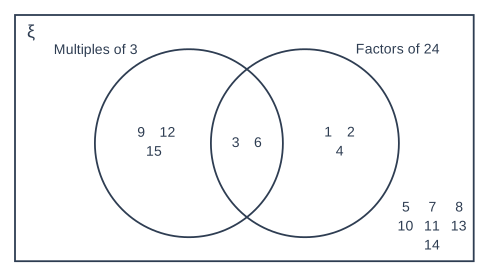
A Venn diagram: a rectangle labelled ξ (the universal set) containing two overlapping circles labelled "Multiples of 3" and "Factors of 24". The elements written in each region are: in "Multiples of 3" only: 9, 12, 15; in both "Multiples of 3" and "Factors of 24": 3, 6; in "Factors of 24" only: 1, 2, 4; outside both circles: 5, 7, 8, 10, 11, 13, 14.

Model answer

12 is a multiple of 3 and also a factor of 24 (24 = 12 × 2), so 12 should be in the overlap of the two circles, not in 'Multiples of 3' only.
8 is a factor of 24 but not a multiple of 3, so 8 should be inside the 'Factors of 24' circle only, not outside both circles.

Explanation

Check every number against both properties. The multiples of 3 in ξ are 3, 6, 9, 12, 15 and the factors of 24 in ξ are 1, 2, 3, 4, 6, 8, 12. The numbers in both lists (3, 6, 12) go in the overlap.

Mark scheme
  1. 1 mark

    B1 for 12, which should be in both circles (the overlap)

    12 is a multiple of 3 and a factor of 24. 1 mark for each number with its correct region, max 2.

  2. 1 mark

    B1 for 8, which should be in the Factors of 24 circle only

    8 is a factor of 24 but not a multiple of 3. If neither region is described but both numbers are correct, award 1 mark.

Question 2

3 marks

In a survey of adults in a town:

62% own a car
35% own a bike
18% own a car and a bike.

An adult who owns a bike is chosen at random.

Work out the probability that this adult does not own a car.
Give your answer correct to 3 decimal places.

Model answer

Percentage who own a bike but not a car = 35% − 18% = 17%
The adult is chosen from the bike owners (35%), so
P(no car, given owns a bike) = \(\dfrac{17}{35}\) = 0.485714...
= 0.486 (3 d.p.)

Explanation

A Venn diagram of percentages helps: the bike circle is 35%, split into 18% (both) and 17% (bike only). Because the adult is chosen from the bike owners, divide by 35, not by 100. A common error is to give 0.17.

Mark scheme
  1. 1 mark

    M1 for 35 − 18 or 17% or 0.17 (bike but no car)

    May be seen in a Venn diagram: car only 44, both 18, bike only 17, neither 21 (percentages; exact values); correct answer with no working scores full marks

  2. 1 mark

    M1 for their 0.17 ÷ 0.35 oe

    Or \(\dfrac{17}{35}\) (0.17 and 0.35 are exact values). The denominator must be the bike total.

  3. 1 mark

    A1 for 0.486

    Accept 0.4857 to 0.486 (exact value 0.485714...); more accurate answers are accepted. 0.17 as the final answer scores M1 M0 A0. 0.514 (\(\dfrac{18}{35}\), owns a car) scores M0 M0 A0.

Question 3

3 marks

\(\xi = \{x : x \text{ is an integer}, 1 \leqslant x \leqslant 200\}\)
\(S = \{x : x \text{ is a square number}\}\)
\(C = \{x : x \text{ is a cube number}\}\)

A number is chosen at random from ξ.

Work out the probability that the number is in S or in C or in both.
Give your answer as a decimal.

Model answer

Square numbers in ξ: 1, 4, 9, ..., 196, which is 14 numbers (\(14^2 = 196\) and \(15^2 = 225\) is too big).
Cube numbers in ξ: 1, 8, 27, 64, 125, which is 5 numbers (\(6^3 = 216\) is too big).
In both: 1 and 64 (1 = \(1^2 = 1^3\), 64 = \(8^2 = 4^3\)), which is 2 numbers.
In S or C or both: 14 + 5 − 2 = 17
P = \(\dfrac{17}{200}\) = 0.085

Explanation

Count each set, then find the numbers that are in both, which are both square and cube. Subtract the overlap once so that these numbers are not counted twice. A calculator helps to check the squares and cubes, but the reasoning is the key step.

Mark scheme
  1. 1 mark

    M1 for 14 square numbers and 5 cube numbers

    Squares 1 to 196 (\(14^2 = 196\), \(15^2 = 225\)); cubes 1, 8, 27, 64, 125; correct answer with no working scores full marks

  2. 1 mark

    M1 for 1 and 64 in both, or 14 + 5 − 2 or 17

    FT their counts.

  3. 1 mark

    A1 for 0.085

    This is an exact value. 0.095 (from 19, the overlap counted twice) scores M1 M0 A0. \(\dfrac{17}{200}\) as the final answer scores M1 M1 A0.

Question 4

4 marks

500 people were asked which of three apps they use: a music app, a maps app and a fitness app.

210 use the music app.
190 use the maps app.
160 use the fitness app.
70 use the music app and the maps app.
55 use the music app and the fitness app.
48 use the maps app and the fitness app.
25 use all three apps.

(Each of the numbers for two apps includes the people who use all three.)

One of the 500 people is chosen at random.

Work out the probability that this person uses exactly one of the three apps.

Model answer

All three: 25
Music and maps only: 70 − 25 = 45
Music and fitness only: 55 − 25 = 30
Maps and fitness only: 48 − 25 = 23
Music only: 210 − 45 − 30 − 25 = 110
Maps only: 190 − 45 − 23 − 25 = 97
Fitness only: 160 − 30 − 23 − 25 = 82
(Check: 110 + 97 + 82 + 45 + 30 + 23 + 25 = 412, so 88 use none.)
Exactly one app: 110 + 97 + 82 = 289
P(exactly one) = \(\dfrac{289}{500}\) = 0.578

Explanation

Build a three-circle Venn diagram from the centre outwards: all three first, then the 'two apps only' regions, then the 'one app only' regions. Each total already includes the regions inside it, so subtract them. Starting from the outside is the most common way to go wrong.

Mark scheme
  1. 1 mark

    M1 for 25 in the centre and at least two of 45, 30, 23

    Music and maps only 45, music and fitness only 30, maps and fitness only 23. May be in a Venn diagram; correct answer with no working scores full marks

  2. 1 mark

    M1 for at least two of 110, 97, 82

    Music only, maps only, fitness only. FT their two-app regions, e.g. 210 − 45 − 30 − 25.

  3. 1 mark

    M1 for their 110 + 97 + 82 or 289

  4. 1 mark

    A1 for \(\dfrac{289}{500}\) oe

    Accept 0.578 or 57.8%. Subtracting the two-app totals without first removing the 25 (e.g. music only = 210 − 70 − 55 = 85) leads to wrong regions and scores at most M0 M0 M1 A0.

Ready to try the rest? Every answer you write is marked against the mark scheme, so you can see exactly where the marks are.

Study Helper Hints first, answers after you try

Stuck on this one? Ask for a hint and I’ll point you in the right direction, without giving the answer away. Once you’ve checked your answer, I’ll show you how the marks are awarded.