
Level:
Correct: 0
Incorrect: 0
Marks: 0/0
Exam Practice
Course:
Topics:
OCR GCSE Maths (Higher calculator) Smart practice A mixed round aimed at your weak spots
Unit 1
Number Operations and Integers
Unit 2
Fractions, Decimals and Percentages
Unit 3
Indices and Surds
Unit 4
Approximation and Estimation
Unit 5
Ratio, Proportion and Rates of Change
Unit 6
Algebra
Unit 7
Graphs of Equations and Functions
Unit 8
Basic Geometry
Unit 9
Congruence and Similarity
Unit 10
Mensuration
Unit 11
Probability
Unit 12
Statistics
Avg
score:
–
Topics
done:
0/121

Trigonometry in right-angled triangles

Practise 20 exam-style questions on Trigonometry in right-angled triangles for OCR GCSE Maths (Higher calculator). Write your answer as you would in the exam and get it marked in seconds against the mark scheme, point by point, with the Study Helper on hand if you get stuck.

  • 20 questions
  • 1–5 marks each
  • Instant marking
  • No sign-up needed
20 questions, marked as you go

Sample questions with model answers

Here are 4 of the questions in this topic, each with a model answer, an explanation of why it earns the marks and the mark scheme an examiner would use.

Question 1

2 marks

The diagram shows a right-angled triangle ABC.
AB = 8.3 cm and AC = 12.5 cm.

Calculate the size of angle \(\theta\).
Give your answer correct to 1 decimal place.
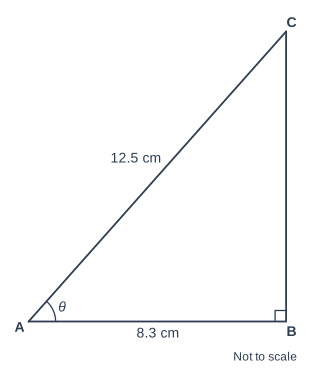
Geometry diagram, marked "Not to scale". Triangle ABC. Angle ABC is marked as a right angle (90°). Side AB is labelled 8.3 cm. Side AC is labelled 12.5 cm. Angle BAC is marked θ.

Model answer

AB is adjacent to \(\theta\) and AC is the hypotenuse, so use cos.
\(\cos\theta = \dfrac{8.3}{12.5} = 0.664\)
\(\theta = \cos^{-1}(0.664) = 48.394...^\circ\)
\(\theta = 48.4^\circ\) (to 1 d.p.)

Explanation

AC is opposite the right angle, so it is the hypotenuse; AB is next to θ, so it is the adjacent side. Adjacent and hypotenuse give cosine, and the inverse cosine function finds the angle. A common error is to use sine because the sides are 'given'.

Mark scheme
  1. 1 mark

    M1 for \(\cos\theta = \dfrac{8.3}{12.5}\) oe

    Exact values from the question; accept \(\cos^{-1}(0.664)\). Or a complete method via BC (Pythagoras, 9.34...) and sin or tan; correct answer with no working scores full marks

  2. 1 mark

    A1 for 48.4

    Accept 48.39 to 48.4 (48.394...); more accurate answers are accepted. 41.6 (using sin) or 33.6 (using tan) scores M0 A0.
Question 2

3 marks

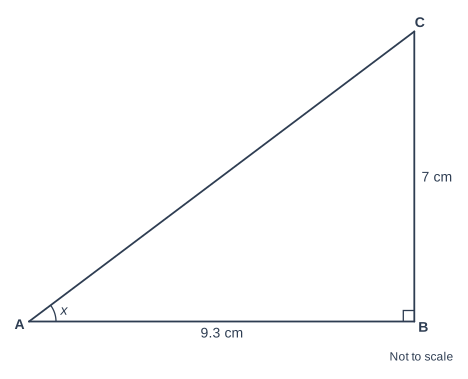
The diagram shows a right-angled triangle.

Mo works out the size of angle \(x\), correct to 1 decimal place.
Here is his working.

\(\tan x = \dfrac{7}{9.3} = 0.75\)
\(x = \tan^{-1}(0.75) = 36.9^\circ\)

Mo's answer is wrong.
Explain the mistake Mo has made.
Work out the correct size of angle \(x\), correct to 1 decimal place.

Geometry diagram, marked "Not to scale". Triangle ABC. Angle ABC is marked as a right angle (90°). Side AB is labelled 9.3 cm. Side BC is labelled 7 cm. Angle BAC is marked x.

Model answer

Mo rounded \(\dfrac{7}{9.3}\) to 0.75 too early. In fact \(\dfrac{7}{9.3} = 0.75268...\), and this small difference changes the angle to 1 decimal place.
\(x = \tan^{-1}\left(\dfrac{7}{9.3}\right) = \tan^{-1}(0.75268...) = 36.968...^\circ\)
\(x = 37.0^\circ\) (to 1 d.p.)

Explanation

Mo chose the right ratio, but rounding the value of tan x to 2 decimal places changed the answer from 36.97° to 36.87°. Keep the full calculator value (or type the fraction straight into the inverse tan) and round only the final answer.

Mark scheme
  1. 1 mark

    B1 for: he rounded \(\dfrac{7}{9.3}\) (= 0.7526...) to 0.75 before using inverse tan / he rounded too early

    Accept 'premature rounding' or '7 ÷ 9.3 is not 0.75, it is 0.7526...'. Do not accept 'he should have used sin or cos' (tan is correct here).

  2. 1 mark

    M1 for \(\tan^{-1}\left(\dfrac{7}{9.3}\right)\)

    Exact values from the question; or \(\tan^{-1}(0.7526...)\) with at least 3 decimal places (accept 0.753 or 0.7527).

  3. 1 mark

    A1 for 37.0

    Accept 36.96 to 37.0 (36.968...); more accurate answers are accepted. 37 alone is accepted. 36.9 scores M0 A0.

Question 3

4 marks

A flagpole stands on the flat roof of a building, at the edge of the roof.
The point P is on horizontal ground, 40 m from the foot of the building.

From P, the angle of elevation of the bottom of the flagpole is 32°.
From P, the angle of elevation of the top of the flagpole is 38°.

Calculate the height of the flagpole.
Give your answer correct to 3 significant figures.

Model answer

Let B be the foot of the building, R the bottom of the flagpole and F the top.
Triangle PBF: \(BF = 40 \tan 38^\circ = 31.251...\) m
Triangle PBR: \(BR = 40 \tan 32^\circ = 24.994...\) m
Height of flagpole \(= 31.251... - 24.994... = 6.2566...\)
Height = 6.26 m (to 3 s.f.)

Explanation

Both angles of elevation are measured from the horizontal ground at P, and both right-angled triangles share the 40 m side. Find the height of the top of the flagpole and the height of the building, then subtract. You cannot use the 6° difference directly, because the flagpole is not part of a right-angled triangle with that angle.

Mark scheme
  1. 1 mark

    M1 for \(40 \tan 38^\circ\)

    Exact values from the question; height of the top of the flagpole = 31.25... (accept 31.25 to 31.26); correct answer with no working scores full marks

  2. 1 mark

    M1 for \(40 \tan 32^\circ\)

    Exact values from the question; height of the building = 24.99... (accept 24.99 to 25.0).

  3. 1 mark

    M1 for their 31.25 − their 24.99

    Both heights must come from tan of the correct angle with 40; accept them rounded or truncated to 4 s.f. or better (31.25 and 24.99).

  4. 1 mark

    A1 for 6.26

    Accept 6.256 to 6.26 (6.2566...); more accurate answers are accepted. Premature rounding: 31.3 − 25.0 gives 6.3, which scores M1 M1 M1 A0. 4.20 (from \(40 \tan 6^\circ\)) scores 0.

Question 4

4 marks

TF is a vertical mast standing on horizontal ground.
A and B are points on the ground, and angle AFB = 90°.
AF = 40 m.

The angle of elevation of T from A is 28°.
The angle of elevation of T from B is 35°.

Calculate the distance AB.
Give your answer correct to 3 significant figures.

Model answer

Triangle TFA has a right angle at F:
TF \(= 40 \tan 28^\circ = 21.268...\) m
Triangle TFB has a right angle at F:
\(\tan 35^\circ = \dfrac{TF}{FB}\), so FB \(= \dfrac{21.268...}{\tan 35^\circ} = 30.374...\) m
Triangle AFB is horizontal with a right angle at F:
\(AB^2 = 40^2 + 30.374...^2 = 1600 + 922.60... = 2522.6...\)
AB \(= 50.225...\)
AB = 50.2 m (to 3 s.f.)

Explanation

This is a 3D problem with three right-angled triangles: two vertical ones (TFA and TFB) sharing the mast TF, and one horizontal one (AFB) on the ground. Use the first angle of elevation to find the height of the mast, the second to find FB, then Pythagoras on the ground. Sketching the three triangles separately helps.

Mark scheme
  1. 1 mark

    M1 for TF \(= 40 \tan 28^\circ\)

    Exact values from the question; TF = 21.268... (accept 21.26 to 21.27); correct answer with no working scores full marks

  2. 1 mark

    M1 for FB \(= \dfrac{\text{their } 21.268}{\tan 35^\circ}\) oe

    FB = 30.374... (accept 30.37 to 30.38). Or their 21.268 × tan 55°.

  3. 1 mark

    M1 for \(AB^2 = 40^2 +\) their \(30.37^2\)

    Triangle AFB is right-angled at F. Their FB must come from trigonometry; accept it rounded or truncated to 3 s.f. or better.

  4. 1 mark

    A1 for 50.2

    Accept 50.2 to 50.23 (50.225...); more accurate answers are accepted. Premature rounding: TF = 21.3 gives 50.3 (50.25), which scores M1 M1 M1 A0. 70.4 (40 + 30.37, treating A, F and B as in a straight line) scores M1 M1 M0 A0.

Ready to try the rest? Every answer you write is marked against the mark scheme, so you can see exactly where the marks are.

Study Helper Hints first, answers after you try

Stuck on this one? Ask for a hint and I’ll point you in the right direction, without giving the answer away. Once you’ve checked your answer, I’ll show you how the marks are awarded.