Question 1
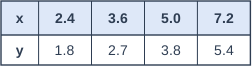
2 marksThe table shows some pairs of values of \(x\) and \(y\).
Ben says,
"The ratio \(y : x\) is the same for every pair of values in the table, so the points all lie on one straight line through the origin."
Is Ben correct?
Give a reason for your answer.
Model answer
\(1.8 \div 2.4 = 0.75\)
\(2.7 \div 3.6 = 0.75\)
\(3.8 \div 5.0 = 0.76\)
\(5.4 \div 7.2 = 0.75\)
The ratio \(y : x\) is not the same for the pair \(x = 5.0\), \(y = 3.8\) (for a ratio of 0.75, \(y\) would be 3.75).
No, Ben is not correct.
Explanation
Points lie on one straight line through the origin exactly when \(y \div x\) is the same for every point (here the line would be \(y = 0.75x\)). Three of the pairs give 0.75, but \(3.8 \div 5.0 = 0.76\). Checking only the first two pairs is not enough.
Mark scheme
-
1 mark
M1 for at least two values of \(y \div x\) (or \(x \div y\)) worked out, including the pair 5.0 and 3.8
\(y \div x\): 0.75, 0.75, 0.76, 0.75. \(x \div y\): 1.333..., 1.333..., 1.315..., 1.333... (accept 1.31 to 1.32 for \(5.0 \div 3.8\)). Or scaling, e.g. \(5.0 \times 0.75 = 3.75\), not 3.8. The table values are exact.
-
1 mark
A1 for No, because \(3.8 \div 5.0 = 0.76\) but the other pairs give 0.75 oe
Accept 'the point (5, 3.8) does not fit: \(y\) should be 3.75'. 'No' with no correct supporting values scores 0.