
Level:
Correct: 0
Incorrect: 0
Marks: 0/0
Exam Practice
Course:
Topics:
OCR GCSE Maths (Higher calculator) Smart practice A mixed round aimed at your weak spots
Unit 1
Number Operations and Integers
Unit 2
Fractions, Decimals and Percentages
Unit 3
Indices and Surds
Unit 4
Approximation and Estimation
Unit 5
Ratio, Proportion and Rates of Change
Unit 6
Algebra
Unit 7
Graphs of Equations and Functions
Unit 8
Basic Geometry
Unit 9
Congruence and Similarity
Unit 10
Mensuration
Unit 11
Probability
Unit 12
Statistics
Avg
score:
–
Topics
done:
0/121

Sine rule

Practise 16 exam-style questions on Sine rule for OCR GCSE Maths (Higher calculator). Write your answer as you would in the exam and get it marked in seconds against the mark scheme, point by point, with the Study Helper on hand if you get stuck.

  • 16 questions
  • 2–5 marks each
  • Instant marking
  • No sign-up needed
16 questions, marked as you go

Sample questions with model answers

Here are 4 of the questions in this topic, each with a model answer, an explanation of why it earns the marks and the mark scheme an examiner would use.

Question 1

3 marks

The diagram shows triangle ABC.
AC = 12.5 cm, angle BAC = 47° and angle ACB = 68°.

Calculate the length of AB.
Give your answer correct to 3 significant figures.
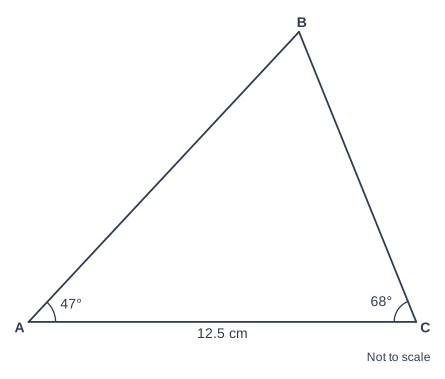
Geometry diagram, marked "Not to scale". Triangle ABC. Side AC is labelled 12.5 cm. Angle CAB is marked 47°. Angle ACB is marked 68°.

Model answer

Angle ABC \(= 180^\circ - 47^\circ - 68^\circ = 65^\circ\)
AB is opposite angle ACB = 68° and AC is opposite angle ABC = 65°.
\(\dfrac{AB}{\sin 68^\circ} = \dfrac{12.5}{\sin 65^\circ}\)
\(AB = \dfrac{12.5 \sin 68^\circ}{\sin 65^\circ} = 12.787...\)
AB = 12.8 cm (to 3 s.f.)

Explanation

The sine rule pairs each side with the sine of the angle opposite it. The given side AC is opposite angle B, which is not given, so find it first using the angle sum of a triangle. A common error is to pair AC with angle A, which is at one end of AC.

Mark scheme
  1. 1 mark

    B1 for angle ABC = 65°

    Exact value: 180 − 47 − 68. May be seen in their sine rule; correct answer with no working scores full marks

  2. 1 mark

    M1 for \(\dfrac{AB}{\sin 68^\circ} = \dfrac{12.5}{\sin 65^\circ}\) oe

    FT their angle ABC. Exact values; or \(AB = \dfrac{12.5 \sin 68^\circ}{\sin 65^\circ}\).

  3. 1 mark

    A1 for 12.8

    Accept 12.78 to 12.8 (12.787...); more accurate answers are accepted. 15.8 (using \(\sin 47^\circ\) as the angle opposite AC) scores B0 M0 A0.
Question 2

3 marks

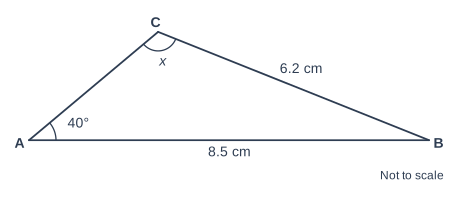
The diagram shows triangle ABC.
AB = 8.5 cm, BC = 6.2 cm and angle BAC = 40°.
Angle ACB = \(x\), where \(x\) is an obtuse angle.

Mira works out the value of \(x\).
Here is her working.

\(\dfrac{\sin x}{8.5} = \dfrac{\sin 40^\circ}{6.2}\)
\(\sin x = 0.8812...\)
\(x = 61.8^\circ\)

Explain why Mira's answer is wrong.
Work out the correct value of \(x\).
Give your answer correct to 1 decimal place.

Geometry diagram, marked "Not to scale". Triangle ABC. Side AB is labelled 8.5 cm. Side BC is labelled 6.2 cm. Angle CAB is marked 40°. Angle ACB is marked x.

Model answer

Mira's sine rule is correct, but \(\sin^{-1}\) on a calculator only gives the acute angle. The diagram shows that \(x\) is obtuse, and 61.8° is acute.
Since \(\sin x = \sin(180^\circ - x)\), the obtuse angle with \(\sin x = 0.8812...\) is
\(x = 180^\circ - 61.792...^\circ = 118.207...^\circ\)
\(x = 118.2^\circ\) (to 1 d.p.)

Explanation

This is the ambiguous case of the sine rule: an acute angle and the obtuse angle 180° minus it have the same sine. Always check whether the angle you want is acute or obtuse (from the diagram or the information given) before accepting the calculator's value.

Mark scheme
  1. 1 mark

    B1 for: x is obtuse but 61.8° is acute; there are two angles with sin x = 0.8812..., and the calculator only gives the acute one

    Accept 'she should have used 180 − 61.8 because x is obtuse' or 'sin x = sin(180° − x)'. Do not accept 'she used the wrong rule' (her sine rule is correct).

  2. 1 mark

    M1 for 180 − 61.79...

    Accept 180 − 61.8. The acute angle is 61.792...°

  3. 1 mark

    A1 for 118.2

    Accept 118.2 to 118.21 (118.207...); more accurate answers are accepted.

Question 3

4 marks

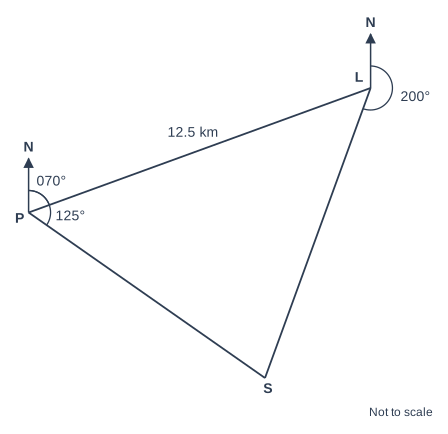
A lighthouse L is 12.5 km from a port P on a bearing of 070°.
A ship S is on a bearing of 125° from P and on a bearing of 200° from L.

The diagram shows this information.

Calculate the distance PS.
Give your answer correct to 3 significant figures.

Geometry diagram, marked "Not to scale". Line segments PL, PS and LS are drawn. A north line (an arrow pointing straight up, labelled N) is drawn at P. At P, the angle measured clockwise from north round to PL is marked 070° (the bearing of L from P). A north line (an arrow pointing straight up, labelled N) is drawn at P. At P, the angle measured clockwise from north round to PS is marked 125° (the bearing of S from P). A north line (an arrow pointing straight up, labelled N) is drawn at L. At L, the angle measured clockwise from north round to LS is marked 200° (the bearing of S from L). PL is labelled 12.5 km.

Model answer

Angle LPS \(= 125^\circ - 70^\circ = 55^\circ\)
The bearing of P from L is \(070^\circ + 180^\circ = 250^\circ\), so angle PLS \(= 250^\circ - 200^\circ = 50^\circ\)
Angle PSL \(= 180^\circ - 55^\circ - 50^\circ = 75^\circ\)
PS is opposite angle PLS = 50° and PL is opposite angle PSL = 75°.
\(PS = \dfrac{12.5 \sin 50^\circ}{\sin 75^\circ} = 9.9133...\)
PS = 9.91 km (to 3 s.f.)

Explanation

Turn the bearings into angles inside triangle PLS. At P the angle is the difference of the two bearings. At L you need the back bearing of P (add 180°) and compare it with the bearing of S. Then the angle sum gives the third angle and the sine rule finds PS.

Mark scheme
  1. 1 mark

    B1 for angle LPS = 55°

    Exact value: 125 − 70; correct answer with no working scores full marks

  2. 1 mark

    B1 for angle PLS = 50°

    Exact value: the bearing of P from L is 070 + 180 = 250°, and 250 − 200 = 50. Then angle PSL = 75°.

  3. 1 mark

    M1 for \(\dfrac{PS}{\sin 50^\circ} = \dfrac{12.5}{\sin 75^\circ}\) oe

    Exact values. FT their angles, provided their angle PSL = 180 − their 55 − their 50.

  4. 1 mark

    A1 for 9.91

    Accept 9.91 to 9.914 (9.9133...); more accurate answers are accepted. 10.6 (LS, using sin 55°) scores B1 B1 M0 A0.

Question 4

5 marks

In triangle ABC, AB = 11 cm, BC = 8 cm and angle BAC = 40°.

There are two different triangles that fit this information.

Calculate the two possible lengths of AC.
Give your answers correct to 3 significant figures.

Model answer

BC = 8 cm is opposite angle A = 40°, and AB = 11 cm is opposite angle C.
\(\sin C = \dfrac{11 \sin 40^\circ}{8} = 0.88383...\)
\(C = 62.108...^\circ\) or \(C = 180^\circ - 62.108...^\circ = 117.89...^\circ\)
Case 1: \(C = 62.108...^\circ\), so \(B = 180^\circ - 40^\circ - 62.108...^\circ = 77.891...^\circ\)
\(AC = \dfrac{8 \sin 77.891...^\circ}{\sin 40^\circ} = 12.168...\)
Case 2: \(C = 117.89...^\circ\), so \(B = 22.108...^\circ\)
\(AC = \dfrac{8 \sin 22.108...^\circ}{\sin 40^\circ} = 4.6840...\)
AC = 12.2 cm or 4.68 cm (to 3 s.f.)

Explanation

This is the ambiguous case: the given angle is not between the two given sides, and the side opposite it (8 cm) is shorter than the other (11 cm), so the 8 cm side can swing to meet the third side in two places. Find both possible angles C, then angle B in each case, then AC. The cosine rule gives the same two answers as the roots of a quadratic.

Mark scheme
  1. 1 mark

    M1 for \(\sin C = \dfrac{11 \sin 40^\circ}{8}\) or 0.8838... oe

    Exact values from the question; correct answer with no working scores full marks

  2. 1 mark

    A1 for angle ACB = 62.1 and 117.9

    62.108...° and 117.89...°; both needed for this mark.

  3. 1 mark

    M1 for \(AC = \dfrac{8 \sin B}{\sin 40^\circ}\) with B = 180 − 40 − their C, for at least one of their angles

    B = 77.89...° or 22.10...°. Alternative: M1 for the cosine rule equation \(8^2 = 11^2 + x^2 - 2 \times 11 \times x \cos 40^\circ\), i.e. \(x^2 - 16.85x + 57 = 0\) (accept 16.85 to 16.86), which with a correct method to solve it (e.g. the quadratic formula) scores M1 A1 M1.

  4. 1 mark

    A1 for 12.2

    Accept 12.16 to 12.2 (12.168...); more accurate answers are accepted.

  5. 1 mark

    A1 for 4.68

    Requires the M1 above. Accept 4.68 to 4.685 (4.6840...). Premature rounding: angle C = 62° gives 4.66, which scores A0 for this mark.

Ready to try the rest? Every answer you write is marked against the mark scheme, so you can see exactly where the marks are.

Study Helper Hints first, answers after you try

Stuck on this one? Ask for a hint and I’ll point you in the right direction, without giving the answer away. Once you’ve checked your answer, I’ll show you how the marks are awarded.