Practise 12 exam-style questions on Properties of 3D solids for OCR GCSE Maths (Higher calculator). Write your answer as you would in the exam and get it marked in seconds against the mark scheme, point by point, with the Study Helper on hand if you get stuck.
12 questions
1–4 marks each
Instant marking
No sign-up needed
12 questions, marked as you go
Sample questions with model answers
Here are 4 of the questions in this topic, each with a model answer, an explanation of why it earns the marks and the mark scheme an examiner would use.
Question 1
1 mark
Ana says 'Every cuboid is a prism.'
Is Ana correct? Give a reason for your answer.
Model answer
Yes, Ana is correct. A prism is a solid with the same cross-section all the way along its length. A cuboid has a rectangular cross-section that is the same all the way through, so it is a prism (a rectangular prism).
Explanation
A prism has a constant cross-section, with two identical, parallel end faces. Cutting a cuboid parallel to an end always gives the same rectangle, so a cuboid is a rectangular prism (and a cube is a square prism).
Mark scheme
1 mark
B1 for Yes, because a cuboid has the same cross-section (a rectangle) all the way through
Accept 'yes, it has a constant rectangular cross-section' or 'yes, its two ends are identical rectangles joined by rectangles'. 'Yes' with no reason scores 0.
Question 2
3 marks
A prism has a cross-section that is an octagon.
Write down the number of faces, the number of edges and the number of vertices of the prism.
Model answer
Faces: 2 octagonal ends and 8 rectangular faces joining them: 10 faces. Edges: 8 round each end (16) and 8 along the length: 24 edges. Vertices: 8 on each end: 16 vertices.
Explanation
A prism has two identical end faces (the cross-section) joined by rectangles, one for each side of the cross-section. With n sides there are n + 2 faces, 3n edges and 2n vertices; here n = 8.
Mark scheme
1 mark
B1 for 10 faces
2 octagonal ends + 8 rectangles; correct answer with no working scores full marks
1 mark
B1 for 24 edges
8 on each end + 8 along the length.
1 mark
B1 for 16 vertices
8 on each end.
Question 3
3 marks
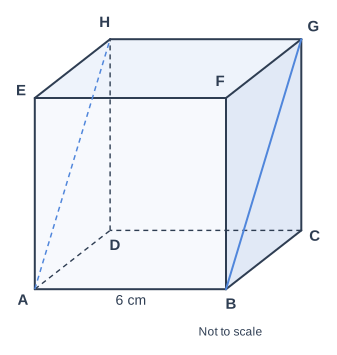
The diagram shows a cube ABCDEFGH with edges of length 6 cm.
The cube is cut along the flat plane that contains the edges AB and HG. The cut makes the rectangle ABGH.
Calculate the area of rectangle ABGH. Give your answer correct to 3 significant figures.
Model answer
AB is an edge of the cube, so AB = 6 cm. BG is a diagonal of the square face BCGF: \(BG = \sqrt{6^2 + 6^2} = \sqrt{72} = 8.4852...\) cm Area of rectangle ABGH = \(6 \times 8.4852... = 50.911...\) Area = 50.9 cm²
Explanation
The cut runs diagonally through the cube, so the rectangle has one side equal to an edge (6 cm) and the other equal to a face diagonal. Each face of a cube is a square, so Pythagoras gives the face diagonal 6√2 cm.
Mark scheme
1 mark
M1 for \(BG = \sqrt{6^2 + 6^2}\) oe
Exact values. BG is a diagonal of the square face BCGF. Implied by 8.48 or 8.49 (8.485...) or \(\sqrt{72}\); correct answer with no working scores full marks
1 mark
M1 for \(6 \times \text{their } BG\)
Accept BG as 8.48 or better.
1 mark
A1 for 50.9
Accept 50.9 to 50.94 (calculator value 50.911...) or \(36\sqrt{2}\); more accurate answers are accepted. 36 (a face of the cube) scores M0 M0 A0.
Question 4
4 marks
A prism and a pyramid both have bases that are polygons with the same number of sides. Together, the prism and the pyramid have 45 edges.
Work out the number of sides of the base. Work out the total number of vertices of the prism and the pyramid together.
Model answer
Let the base have n sides. Prism: n edges on each end and n along the length, so 3n edges. Pyramid: n edges round the base and n up to the apex, so 2n edges. \(3n + 2n = 45\), so \(5n = 45\) and \(n = 9\). The base has 9 sides. Vertices: prism \(2 \times 9 = 18\), pyramid 9 + 1 = 10. Total = 18 + 10 = 28 vertices.
Explanation
Write the number of edges of each solid in terms of the number of sides of the base, n: a prism has 3n edges and a pyramid 2n. Then the vertices are 2n for the prism and n + 1 for the pyramid (the apex counts).
Mark scheme
1 mark
M1 for \(3n + 2n = 45\) oe
Prism 3n edges, pyramid 2n edges. Exact values; correct answer with no working scores full marks
Ready to try the rest? Every answer you write is marked against the mark scheme, so you can see exactly where the marks are.
Ctrl + Enter to check
Study HelperHints first, answers after you try
Stuck on this one? Ask for a hint and I’ll point you in the right direction, without giving the answer away. Once you’ve checked your answer, I’ll show you how the marks are awarded.