
Level:
Correct: 0
Incorrect: 0
Marks: 0/0
Exam Practice
Course:
Topics:
OCR GCSE Maths (Higher calculator) Smart practice A mixed round aimed at your weak spots
Unit 1
Number Operations and Integers
Unit 2
Fractions, Decimals and Percentages
Unit 3
Indices and Surds
Unit 4
Approximation and Estimation
Unit 5
Ratio, Proportion and Rates of Change
Unit 6
Algebra
Unit 7
Graphs of Equations and Functions
Unit 8
Basic Geometry
Unit 9
Congruence and Similarity
Unit 10
Mensuration
Unit 11
Probability
Unit 12
Statistics
Avg
score:
–
Topics
done:
0/121

Quadratic, cubic and reciprocal graphs

Practise 17 exam-style questions on Quadratic, cubic and reciprocal graphs for OCR GCSE Maths (Higher calculator). Write your answer as you would in the exam and get it marked in seconds against the mark scheme, point by point, with the Study Helper on hand if you get stuck.

  • 17 questions
  • 1–5 marks each
  • Instant marking
  • No sign-up needed
17 questions, marked as you go

Sample questions with model answers

Here are 4 of the questions in this topic, each with a model answer, an explanation of why it earns the marks and the mark scheme an examiner would use.

Question 1

2 marks

Leo says,
"The graphs of \(y = x^2\) and \(y = x^3\) meet at exactly two points, \((0, 0)\) and \((1, 1)\)."

Is Leo correct?
Show how you decide.

Model answer

The graphs meet where \(x^3 = x^2\).
\(x^3 - x^2 = 0\)
\(x^2(x - 1) = 0\)
So \(x = 0\) or \(x = 1\), and there are no other solutions.
When \(x = 0\), \(y = 0\); when \(x = 1\), \(y = 1\).
Yes, Leo is correct: the graphs meet only at \((0, 0)\) and \((1, 1)\).

Explanation

Two graphs meet where their y-values are equal, so solve x³ = x². Factorise rather than dividing by x², which would lose the solution x = 0. Thinking about the shapes agrees: for negative x the cubic is below the x-axis and the quadratic is above it.

Mark scheme
  1. 1 mark

    M1 for \(x^3 = x^2\) and a correct method to solve, e.g. \(x^2(x - 1) = 0\) oe

    Or for a correct argument about the shapes, e.g. for negative x, \(x^3\) is negative but \(x^2\) is positive, so they cannot meet there.

  2. 1 mark

    A1 for Yes, with \(x = 0\) or \(x = 1\) as the only solutions, or a complete argument covering negative x, \(0 < x < 1\) and \(x > 1\)

    Checking that \((0, 0)\) and \((1, 1)\) lie on both graphs is not enough on its own: the answer must show there are no other points. 'Yes' with only that check scores M0 A0.
Question 2

3 marks

The graph of \(y = \dfrac{5}{x}\) crosses the line \(y = x\) at two points.

Find the coordinates of the two points.
Give your answers correct to 3 significant figures.

Model answer

At the crossing points, y = x and \(y = \dfrac{5}{x}\), so
\(x = \dfrac{5}{x}\)
\(x^2 = 5\)
\(x = \sqrt{5} = 2.2360...\) or \(x = -\sqrt{5} = -2.2360...\)
Since \(y = x\), the points are \((2.24, 2.24)\) and \((-2.24, -2.24)\).

Explanation

The reciprocal graph y = 5/x is symmetrical about the line y = x, and it has one branch in the first quadrant and one in the third, so it crosses y = x twice. Set the two expressions for y equal and solve; remember the negative square root as well as the positive one.

Mark scheme
  1. 1 mark

    M1 for \(x = \dfrac{5}{x}\) or \(x^2 = 5\)

    Exact values from the equations; correct answer with no working scores full marks

  2. 1 mark

    A1 for \(x = 2.24\) and \(x = -2.24\)

    Accept \(\pm\sqrt{5}\) or 2.236 to 2.24 (calculator value 2.23606...). Only the positive value scores A0.

  3. 1 mark

    A1 for \((2.24, 2.24)\) and \((-2.24, -2.24)\)

    Accept coordinates in the range 2.236 to 2.24 (with the correct signs), or \((\sqrt{5}, \sqrt{5})\) and \((-\sqrt{5}, -\sqrt{5})\). More accurate answers are accepted.

Question 3

3 marks

A and B are two points on the graph of \(y = \dfrac{6}{x}\).

A has x-coordinate 0.8.
B has y-coordinate 0.8.

Calculate the length of AB.
Give your answer correct to 3 significant figures.

Model answer

A: \(y = \dfrac{6}{0.8} = 7.5\), so A = \((0.8, 7.5)\)
B: \(0.8 = \dfrac{6}{x}\), so \(x = \dfrac{6}{0.8} = 7.5\), and B = \((7.5, 0.8)\)
Horizontal distance = \(7.5 - 0.8 = 6.7\); vertical distance = \(7.5 - 0.8 = 6.7\)
\(AB = \sqrt{6.7^2 + 6.7^2} = \sqrt{89.78} = 9.4752...\)
AB = 9.48 (3 s.f.)

Explanation

Use the equation to find the missing coordinate of each point: for B, rearrange 0.8 = 6/x to x = 6 ÷ 0.8. Because y = 6/x is symmetrical about the line y = x, A and B are reflections of each other in that line, so their coordinates are swapped. Then use Pythagoras for the distance.

Mark scheme
  1. 1 mark

    B1 for A = \((0.8, 7.5)\) and B = \((7.5, 0.8)\)

    cao (exact values). Both points needed, or 7.5 used for both missing coordinates; correct answer with no working scores full marks

  2. 1 mark

    M1 for \(\sqrt{6.7^2 + 6.7^2}\) oe

    Exact values. FT their points. Implied by 89.78 (exact) or 9.47...

  3. 1 mark

    A1 for 9.48

    Accept 9.475 to 9.48 (calculator value 9.4752...). Accept \(6.7\sqrt{2}\). More accurate answers are accepted.

Question 4

4 marks

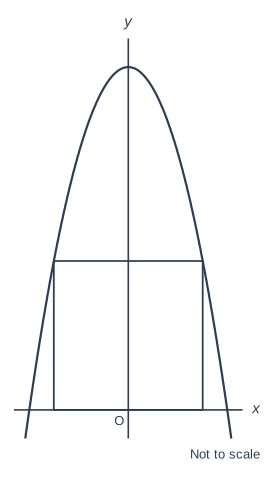
The diagram shows a sketch of the curve \(y = 12 - x^2\) and a square PQRS.

P and Q lie on the x-axis.
R and S lie on the curve.
The square is symmetrical about the y-axis.

Work out the side length of the square.
Give your answer correct to 3 significant figures.

A sketch on a pair of axes (x across, y up) with no scale marked, the axes crossing at the origin O. It is marked "Not to scale". Quadrilateral PQRS (unshaded) is drawn; its vertices cannot be read off, as the sketch has no scale. The curve is an upside-down U-shaped (∩-shaped) parabola: it meets the x-axis twice; these points cannot be read off, as the sketch has no scale; it crosses the y-axis at a point that cannot be read off, as the sketch has no scale; it has a maximum point, which cannot be read off, as the sketch has no scale.

Model answer

Let R be the point \((a, 12 - a^2)\), with \(a > 0\).
By symmetry, S is \((-a, 12 - a^2)\), so the side SR = 2a.
The side QR is the height of R: \(12 - a^2\).
It is a square, so \(12 - a^2 = 2a\)
\(a^2 + 2a - 12 = 0\)
\(a = \dfrac{-2 + \sqrt{4 + 48}}{2} = \dfrac{-2 + \sqrt{52}}{2} = 2.6055...\) (the negative solution is not possible)
Side length = \(2a = 5.2111...\)
Side length = 5.21 (3 s.f.)

Explanation

Use a letter for the x-coordinate of the corner on the curve. Symmetry about the y-axis makes the width of the square twice that x-coordinate, and the height is the y-coordinate from the curve's equation. Setting width equal to height gives a quadratic; reject the negative root and remember to double a.

Mark scheme
  1. 1 mark

    M1 for R = \((a, 12 - a^2)\) and side length = 2a oe

    Any letter. Or for a correct statement that the height of R equals twice its x-coordinate; correct answer with no working scores full marks

  2. 1 mark

    M1 for \(12 - a^2 = 2a\) oe

    Implied by \(a^2 + 2a - 12 = 0\).

  3. 1 mark

    M1 for a correct method to solve their 3-term quadratic, e.g. \(\dfrac{-2 + \sqrt{4 + 48}}{2}\) oe

    Implied by \(a = 2.605...\) (accept 2.6 or better) or \(-1 + \sqrt{13}\). Trials with \(12 - a^2\) and \(2a\) compared for at least two values of a, one between 2.6 and 2.61, score M1 M1 M1.

  4. 1 mark

    A1 for 5.21

    Accept 5.21 to 5.212 (calculator value 5.2111...). Accept \(-2 + 2\sqrt{13}\). More accurate answers are accepted. Using \(a = 2.6\) gives 5.2, and \(a = 2.61\) gives 5.22, each scoring M1 M1 M1 A0. An answer of 2.61 (half the side) scores M1 M1 M1 A0.

Ready to try the rest? Every answer you write is marked against the mark scheme, so you can see exactly where the marks are.

Study Helper Hints first, answers after you try

Stuck on this one? Ask for a hint and I’ll point you in the right direction, without giving the answer away. Once you’ve checked your answer, I’ll show you how the marks are awarded.