
Level:
Correct: 0
Incorrect: 0
Marks: 0/0
Exam Practice
Course:
Topics:
OCR GCSE Maths (Higher calculator) Smart practice A mixed round aimed at your weak spots
Unit 1
Number Operations and Integers
Unit 2
Fractions, Decimals and Percentages
Unit 3
Indices and Surds
Unit 4
Approximation and Estimation
Unit 5
Ratio, Proportion and Rates of Change
Unit 6
Algebra
Unit 7
Graphs of Equations and Functions
Unit 8
Basic Geometry
Unit 9
Congruence and Similarity
Unit 10
Mensuration
Unit 11
Probability
Unit 12
Statistics
Avg
score:
–
Topics
done:
0/121

Transformations of graphs

Practise 18 exam-style questions on Transformations of graphs for OCR GCSE Maths (Higher calculator). Write your answer as you would in the exam and get it marked in seconds against the mark scheme, point by point, with the Study Helper on hand if you get stuck.

  • 18 questions
  • 1–4 marks each
  • Instant marking
  • No sign-up needed
18 questions, marked as you go

Sample questions with model answers

Here are 4 of the questions in this topic, each with a model answer, an explanation of why it earns the marks and the mark scheme an examiner would use.

Question 1

2 marks

The point P lies on the graph of \(y = \sin x\) and has x-coordinate 25.

The graph of \(y = \sin x\) is translated by the vector \(\begin{pmatrix} -60 \\ 0.5 \end{pmatrix}\).

Find the coordinates of the image of P.
Give the y-coordinate correct to 3 significant figures.

Model answer

P is \((25, \sin 25) = (25, 0.42261...)\)
The translation adds \(-60\) to the x-coordinate and 0.5 to the y-coordinate:
\(x = 25 - 60 = -35\)
\(y = 0.42261... + 0.5 = 0.92261...\)
The image of P is \((-35, 0.923)\)

Explanation

A translation moves every point of the graph by the same vector, so add the vector to the coordinates of P. First find the y-coordinate of P with the calculator in degree mode: \(\sin 25 = 0.4226...\). A common error is to leave the calculator in radian mode.

Mark scheme
  1. 1 mark

    B1 for x-coordinate \(-35\)

    From \(25 - 60\); correct answer with no working scores full marks

  2. 1 mark

    B1 for y-coordinate 0.923

    Accept 0.9226 to 0.923 (0.92261...), from \(\sin 25 + 0.5 = 0.4226... + 0.5\). More accurate answers are accepted. 0.368 (calculator in radian mode) scores B0 for this mark. 0.4226... (no translation applied) scores B0.
Question 2

3 marks

The graph of \(y = \cos x\) is translated by the vector \(\begin{pmatrix} 40 \\ 0 \end{pmatrix}\).

Write down the coordinates of the minimum point of the translated graph for \(0 \leqslant x \leqslant 360\).

Find the y-coordinate of the point where the translated graph crosses the y-axis.
Give your answer correct to 3 significant figures.

Model answer

The translated graph is \(y = \cos(x - 40)\).
\(y = \cos x\) has a minimum point at (180, −1), so the translated graph has a minimum point at \((180 + 40, -1) = (220, -1)\).
When \(x = 0\): \(y = \cos(0 - 40) = \cos(-40) = 0.76604...\)
The y-coordinate is 0.766 (3 s.f.).

Explanation

A translation of 40 in the positive x-direction moves every point 40 to the right, so the minimum point (180, −1) moves to (220, −1), and the equation becomes \(y = \cos(x - 40)\). Substituting \(x = 0\) gives \(\cos(-40)\), which equals \(\cos 40\) because the cosine graph is symmetrical about the y-axis. Make sure the calculator is in degree mode.

Mark scheme
  1. 1 mark

    B1 for \((220, -1)\)

    From the minimum point (180, −1) of \(y = \cos x\) moved 40 to the right. \((140, -1)\) scores B0; correct answer with no working scores full marks

  2. 1 mark

    M1 for \(\cos(0 - 40)\) or \(\cos(-40)\) or \(\cos 40\)

    May be implied by 0.766. Or M1 for the equation \(y = \cos(x - 40)\) with \(x = 0\) substituted.

  3. 1 mark

    A1 for 0.766

    Accept 0.766 to 0.7661 (0.76604...). More accurate answers are accepted. Accept (0, 0.766). Using \(\cos(0 + 40)\) also gives 0.766 and scores M1 A1. −0.667 (radian mode) scores M1 A0.

Question 3

3 marks

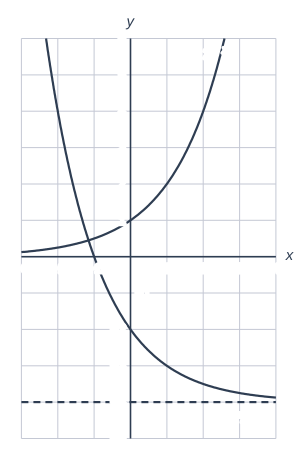
The diagram shows the graph of \(y = 2^x\) and curve C.
The dashed line \(y = -4\) is an asymptote to curve C.

Curve C is the graph of \(y = 2^x\) after a reflection in the y-axis followed by a translation.

Find the equation of curve C.

A coordinate grid with x from −3 to 4 and y from −5 to 6; each grid square is 1 unit across, and the axes cross at the origin O. The curve labelled "y = 2^x" is an exponential curve, increasing more and more steeply from left to right: it crosses the y-axis at (0, 1); it gets closer and closer to the line y = 0 (the x-axis) as x goes further left without reaching it. Curve C is an exponential curve, decreasing and levelling off from left to right: it crosses the x-axis at (−1, 0); it crosses the y-axis at (0, −2); it gets closer and closer to the line y = −4 as x goes further right without reaching it. The line labelled "y = −4" is a horizontal straight line crossing the y-axis at (0, −4). The curve labelled "y = 2^x" and curve C cross at about (−1.2, 0.4).

Model answer

Reflecting \(y = 2^x\) in the y-axis gives \(y = 2^{-x}\), which passes through (0, 1) and has asymptote \(y = 0\).
The asymptote of C is \(y = -4\), so the translation moves the graph down 4.
\(y = 2^{-x} - 4\) would pass through (0, −3), but C passes through (1, −3), so the graph has also moved 1 to the right.
The translation is by \(\begin{pmatrix} 1 \\ -4 \end{pmatrix}\), so C is \(y = 2^{-(x - 1)} - 4\)
\(y = 2^{1 - x} - 4\)
(Check: when \(x = -1\), \(y = 2^2 - 4 = 0\); when \(x = 0\), \(y = 2 - 4 = -2\).)

Explanation

After the reflection, the asymptote is still \(y = 0\), so the asymptote \(y = -4\) tells you the vertical part of the translation. Then follow one point, such as (0, 1) on \(y = 2^{-x}\), to find the horizontal part: it has moved to (1, −3). A common error is \(y = 2^{-x} - 4\), which misses the horizontal shift and crosses the y-axis at \(-3\), not \(-2\).

Mark scheme
  1. 1 mark

    B1 for \(y = 2^{-x}\) or \(y = 0.5^x\) as the equation after the reflection

    May be implied by \(2^{-x}\) or \(2^{-(x - p)}\) or \(0.5^x\) in their final equation; correct answer with no working scores full marks

  2. 1 mark

    M1 for a translation by \(\begin{pmatrix} 1 \\ -4 \end{pmatrix}\) identified, or for \(y = 2^{-(x - p)} - 4\) with p ≠ 1, or for \(y = 2^{-(x - 1)} + q\) with q ≠ −4

    For example, using the point (0, −2) and the asymptote: the reflected graph passes through (0, 1), and (0, 1) has moved to (1, −3). \(y = 2^{-x} - 4\) scores B1 M1 A0.

  3. 1 mark

    A1 for \(y = 2^{1 - x} - 4\) oe

    Accept \(y = 2^{-(x - 1)} - 4\) or \(y = 2 \times 0.5^x - 4\) or \(y = 0.5^{x - 1} - 4\) or \(y = 2 \times 2^{-x} - 4\). Check with points on C: (−1, 0), (0, −2), (1, −3), (−2, 4).

Question 4

4 marks

The graph of \(y = x^2\) is translated by the vector \(\begin{pmatrix} a \\ b \end{pmatrix}\).
The translated graph passes through the points (1, 9.25) and (5, 5.25).

Find the value of \(a\) and the value of \(b\).

Model answer

The translated graph is \(y = (x - a)^2 + b\).
Through (1, 9.25): \((1 - a)^2 + b = 9.25\)
Through (5, 5.25): \((5 - a)^2 + b = 5.25\)
Subtract the first equation from the second:
\((25 - 10a + a^2) - (1 - 2a + a^2) = 5.25 - 9.25\)
\(24 - 8a = -4\)
\(a = 3.5\)
\((1 - 3.5)^2 + b = 9.25\), so \(6.25 + b = 9.25\) and \(b = 3\)
\(a = 3.5\), \(b = 3\)

Explanation

The translation by \(\begin{pmatrix} a \\ b \end{pmatrix}\) gives \(y = (x - a)^2 + b\), with turning point \((a, b)\). Each point gives an equation, and subtracting them cancels both \(a^2\) and \(b\), leaving a linear equation in \(a\). A common error is to write \((x + a)^2\), which gives the sign of \(a\) wrong.

Mark scheme
  1. 1 mark

    M1 for \(y = (x - a)^2 + b\)

    Allow \(y = (x + a)^2 + b\) for this mark only; correct answer with no working scores full marks

  2. 1 mark

    M1 for \((1 - a)^2 + b = 9.25\) and \((5 - a)^2 + b = 5.25\)

    FT their equation of the translated graph.

  3. 1 mark

    M1 for eliminating \(b\), e.g. \((5 - a)^2 - (1 - a)^2 = -4\) or \(24 - 8a = -4\)

    Or a correct linear equation in \(a\) from their equations.

  4. 1 mark

    A1 for \(a = 3.5\) and \(b = 3\)

    Both values needed. \(a = -3.5\) and \(b = 3\) (from \(y = (x + a)^2 + b\)) scores M1 M1 M1 A0. A correct pair with no working scores 4 marks.

Ready to try the rest? Every answer you write is marked against the mark scheme, so you can see exactly where the marks are.

Study Helper Hints first, answers after you try

Stuck on this one? Ask for a hint and I’ll point you in the right direction, without giving the answer away. Once you’ve checked your answer, I’ll show you how the marks are awarded.