Practise 12 exam-style questions on Using congruent triangles in proofs for OCR GCSE Maths (Higher calculator). Write your answer as you would in the exam and get it marked in seconds against the mark scheme, point by point, with the Study Helper on hand if you get stuck.
12 questions
3–6 marks each
Instant marking
No sign-up needed
12 questions, marked as you go
Sample questions with model answers
Here are 4 of the questions in this topic, each with a model answer, an explanation of why it earns the marks and the mark scheme an examiner would use.
Question 1
3 marks
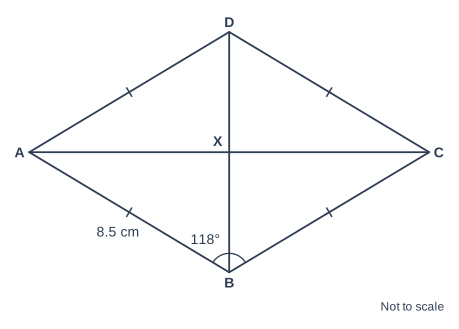
The diagram shows a rhombus ABCD with sides of length 8.5 cm. The diagonals AC and BD meet at X. The four triangles ABX, CBX, CDX and ADX are congruent.
Angle ABC = 118°.
Calculate the length of the diagonal AC. Give your answer correct to 3 significant figures.
Model answer
Triangles ABX and CBX are congruent, so angle ABX = angle CBX = 118° ÷ 2 = 59°, and angle AXB = angle CXB = 90° (equal angles on a straight line). In the right-angled triangle ABX, AX is opposite angle ABX: AX = \(8.5 \times \sin 59^\circ = 7.2859...\) cm AC = 2 × AX = 14.571... (AX = CX from the congruent triangles) AC = 14.6 cm (3 s.f.)
Explanation
The congruent triangles show that the diagonals of a rhombus bisect its angles and cross at right angles, cutting each other in half. So half of AC is the side opposite 59° in a right-angled triangle with hypotenuse 8.5 cm. AC is the longer diagonal because it is opposite the obtuse angle.
Mark scheme
1 mark
B1 for angle ABX = 59° and angle AXB = 90° soi
From the congruent triangles: angle ABX = angle CBX, so BD bisects angle ABC; angles AXB and CXB are equal and on a straight line, so each is 90°. Or B1 for using the cosine rule in triangle ABC, which needs no congruence; correct answer with no working scores full marks
Exact values. Accept any equivalent method. May be implied by AX = 7.29 (accept 7.28 to 7.29).
1 mark
A1 for 14.6
Accept 14.57 to 14.6 (cm). The full value is 14.571... More accurate answers are accepted. 8.76 (the diagonal BD) scores B1 M0 A0. A correct answer with no working scores 3 marks.
Question 2
4 marks
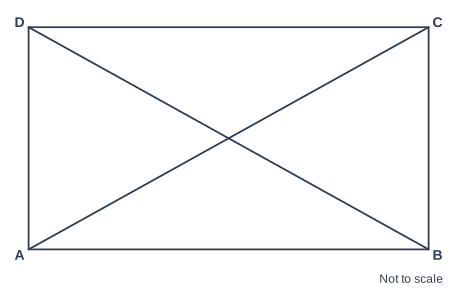
The diagram shows a rectangle ABCD and its diagonals AC and BD.
Use congruent triangles to prove that the diagonals of the rectangle are equal in length.
Model answer
In triangles DAB and CBA: AD = BC (opposite sides of a rectangle are equal) angle DAB = angle CBA = 90° (all angles of a rectangle are right angles) AB = BA (common side) So triangle DAB is congruent to triangle CBA (SAS). So the corresponding sides BD and AC are equal: the diagonals are equal in length.
Explanation
Pick two triangles that each contain one diagonal: DAB contains BD and CBA contains AC. They share AB, have equal sides AD and BC, and right angles between them, so they are congruent by SAS. Corresponding sides of congruent triangles are equal, so the diagonals are equal.
Mark scheme
3 marks
M3 for three correct statements with reasons for triangles DAB and CBA (or ABC and DCB): AD = BC (opposite sides of a rectangle are equal), angle DAB = angle CBA = 90° (angles of a rectangle), AB is common
M2 for two correct statements with reasons, or three correct statements with missing or incorrect reasons. M1 for one correct statement with a reason, or two correct statements without reasons. Statements must be clear equalities of named sides or angles.
1 mark
A1 for the triangles are congruent (SAS), so BD = AC
Dependent on M3. Both the condition and the conclusion about the diagonals are needed. Answer only scores 0.
Question 3
4 marks
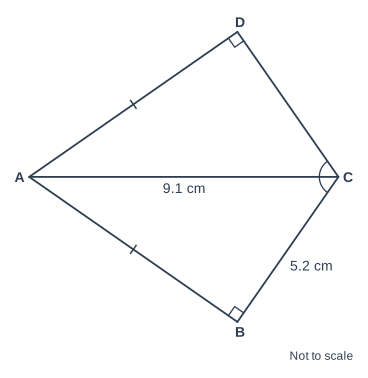
The diagram shows a quadrilateral ABCD with diagonal AC. AB = AD and angle ABC = angle ADC = 90°. BC = 5.2 cm and AC = 9.1 cm.
Use congruent triangles to calculate the size of angle BCD. Give your answer correct to 1 decimal place.
Model answer
In triangles ABC and ADC: angle ABC = angle ADC = 90°, the hypotenuse AC is common, and AB = AD. So triangles ABC and ADC are congruent (RHS), and angle BCA = angle DCA. In the right-angled triangle ABC: \(\cos BCA = \dfrac{5.2}{9.1}\), so angle BCA = 55.150...° Angle BCD = \(2 \times 55.150...\)° = 110.300...° Angle BCD = 110.3° (1 d.p.)
Explanation
RHS congruence shows that the diagonal AC splits angle BCD into two equal parts. In triangle ABC the side BC is adjacent to angle BCA and AC is the hypotenuse, so use cosine, then double the angle.
Mark scheme
1 mark
B1 for triangles ABC and ADC are congruent (RHS), because angle ABC = angle ADC = 90°, AC is common (the hypotenuse) and AB = AD
The three facts and the condition RHS are needed; correct answer with no working scores full marks
1 mark
M1 for \(\cos BCA = \dfrac{5.2}{9.1}\) oe
Exact values. Accept any equivalent method. May be implied by 55.2 (accept 55.15 to 55.2).
1 mark
M1 for angle BCD = 2 × their angle BCA
Angle BCA = angle DCA, from the congruent triangles.
1 mark
A1 for 110.3
Accept 110.3 to 110.31. The full value is 110.300... More accurate answers are accepted. 55.2 (angle BCA) as the final answer scores B1 M1 M0 A0. 69.7 (from sin) scores B1 M0 M1 A0.
Question 4
5 marks
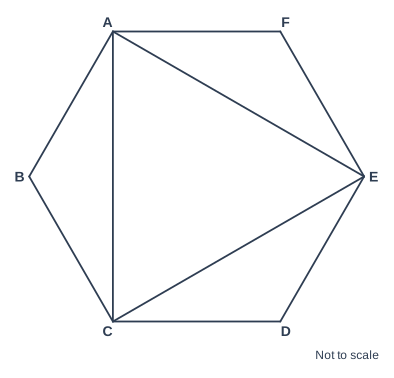
The diagram shows a regular hexagon ABCDEF.
Use congruent triangles to prove that triangle ACE is equilateral.
Model answer
In triangles ABC and CDE: AB = CD (the sides of a regular hexagon are equal) angle ABC = angle CDE = 120° (the interior angles of a regular hexagon are equal) BC = DE (the sides of a regular hexagon are equal) So triangle ABC is congruent to triangle CDE (SAS), and AC = CE. In the same way, triangle EFA has EF = AB, FA = BC and angle EFA = 120°, so it is congruent to triangle ABC (SAS), and EA = AC. So AC = CE = EA, and triangle ACE is equilateral.
Explanation
Each side of triangle ACE is the third side of a small triangle made of two sides of the hexagon with a 120° angle between them. All three small triangles are congruent by SAS, so their third sides are equal. Three equal sides make ACE equilateral.
Mark scheme
3 marks
M3 for three correct statements with reasons for two of the triangles ABC, CDE and EFA, e.g. AB = CD (sides of a regular hexagon), BC = DE (sides of a regular hexagon), angle ABC = angle CDE (interior angles of a regular hexagon, 120°)
M2 for two correct statements with reasons, or three correct statements with missing or incorrect reasons. M1 for one correct statement with a reason, or two correct statements without reasons.
1 mark
A1 for triangles ABC and CDE are congruent (SAS), so AC = CE
Dependent on M3. Both the condition and the conclusion are needed.
1 mark
B1 for showing that triangle EFA is also congruent (in the same way), so AC = CE = EA, and concluding that triangle ACE is equilateral
Accept 'similarly' for the third triangle if the reasoning is clearly the same. The conclusion that all three sides of ACE are equal is needed. Answer only scores 0.
Ready to try the rest? Every answer you write is marked against the mark scheme, so you can see exactly where the marks are.
Ctrl + Enter to check
Study HelperHints first, answers after you try
Stuck on this one? Ask for a hint and I’ll point you in the right direction, without giving the answer away. Once you’ve checked your answer, I’ll show you how the marks are awarded.