Practise 16 exam-style questions on Circumference and arc length for OCR GCSE Maths (Higher calculator). Write your answer as you would in the exam and get it marked in seconds against the mark scheme, point by point, with the Study Helper on hand if you get stuck.
16 questions
1–4 marks each
Instant marking
No sign-up needed
16 questions, marked as you go
Sample questions with model answers
Here are 4 of the questions in this topic, each with a model answer, an explanation of why it earns the marks and the mark scheme an examiner would use.
Question 1
2 marks
The circumference of a circular table top is 4.2 m.
Work out the diameter of the table top. Give your answer in centimetres, correct to the nearest centimetre.
Model answer
\(\pi d = 4.2\) \(d = 4.2 \div \pi = 1.3369...\) m = 133.69... cm = 134 cm (to the nearest centimetre)
Explanation
Circumference = π × diameter, so the diameter is the circumference divided by π. Change metres to centimetres by multiplying by 100 before rounding. A common error is to divide by 2π, which gives the radius.
Mark scheme
1 mark
M1 for \(4.2 \div \pi\) or \(420 \div \pi\)
Implied by 1.336... or 133.6... (accept 1.33 to 1.34 m, or 133 to 134 cm, or better). Or M1 for \(\pi d = 4.2\) oe; correct answer with no working scores full marks
1 mark
A1 for 134
Accept 134 cm, or 1.34 m; accept 133.7 to 134 (exact value 133.690...). 67 (the radius, from \(420 \div 2\pi\)) scores M0 A0. 1319.5 or 13.2 (multiplying by \(\pi\)) scores M0 A0.
Question 2
3 marks
The wheels of a car each turn 850 times while the car travels 1.6 km.
Ben says, "The diameter of each wheel is more than 60 cm."
Is Ben correct? Show how you decide.
Model answer
Distance = 1.6 km = 160 000 cm Circumference of a wheel = 160 000 ÷ 850 = 188.235... cm Diameter = 188.235... ÷ \(\pi\) = 59.917... cm 59.9 cm is less than 60 cm, so Ben is not correct.
Explanation
In one turn a wheel moves forward one circumference, so the circumference is the total distance divided by the number of turns. Then diameter = circumference ÷ π. The answer is very close to 60 cm, so keep the full calculator value: rounding the circumference to 1.9 m first gives the wrong conclusion.
Mark scheme
1 mark
M1 for \(1600 \div 850\) or \(160\,000 \div 850\)
The circumference of a wheel; implied by 1.88... m or 188.2... cm (accept 188 to 188.24 cm).
1 mark
M1 for their circumference \(\div \pi\)
1 mark
A1 for No, with 59.9 cm or 0.599 m
Accept 59.9 to 59.92 cm (exact value 59.917...). Alternative: M1 for \(\pi \times 0.6 = 1.884...\) m (the circumference of a 60 cm wheel), M1 for \(850 \times 1.884...\) = 1602 m, A1 for No, because a 60 cm wheel would travel more than 1.6 km. Premature rounding: a circumference of 1.9 m gives 60.5 cm and the conclusion Yes, which scores M1 M1 A0. 'No' with no working scores 0.
Question 3
3 marks
The perimeter of a sector of a circle is 4 times the radius of the sector.
Show that the angle of the sector is 114.6°, correct to 1 decimal place.
Model answer
Let the radius be \(r\) and the angle be \(\theta\). Perimeter = \(2r + \dfrac{\theta}{360} \times 2\pi r = 4r\) So the arc length is \(2r\): \(\dfrac{\theta}{360} \times 2\pi r = 2r\) \(\dfrac{\theta}{360} \times 2\pi = 2\) \(\theta = \dfrac{720}{2\pi} = \dfrac{360}{\pi} = 114.591...\) \(\theta = 114.6^\circ\) (1 d.p.)
Explanation
The perimeter of a sector is the two radii plus the arc, so if the perimeter is 4r the arc must be 2r. Writing the arc as θ/360 × 2πr and dividing by r removes the radius, so the angle is the same whatever the size of the sector. Show the unrounded value 114.59... before giving 114.6.
Mark scheme
1 mark
M1 for \(2r + \dfrac{\theta}{360} \times 2\pi r = 4r\) oe
Any letter for the radius, or a particular value of the radius (e.g. r = 1 or r = 10) used consistently.
1 mark
M1 for \(\dfrac{\theta}{360} \times 2\pi = 2\) or \(\theta = \dfrac{720}{2\pi}\) or \(\theta = \dfrac{360}{\pi}\) oe
The arc length equals 2r, then the radius is cancelled (or the value of their r used).
1 mark
A1 for 114.59... seen, leading to 114.6
A value to more than 1 d.p. must be seen: accept 114.59 or better (114.591...). This is a 'show that' question: 114.6 with no method scores 0. Substituting 114.6 to show the perimeter is 4.000... times the radius scores M1 only.
Question 4
4 marks
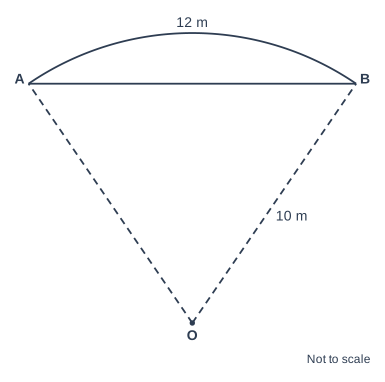
The diagram shows the curved top of a bridge. The curve is an arc AB of a circle with centre O and radius 10 m. The length of the arc AB is 12 m.
Calculate the length of the straight line AB. Give your answer correct to 3 significant figures.
Model answer
\(\dfrac{\theta}{360} \times 2 \times \pi \times 10 = 12\) \(\theta = 12 \div (20\pi) \times 360 = 68.754...^\circ\) Triangle AOB is isosceles with OA = OB = 10 m. \(AB = 2 \times 10 \sin(68.754... \div 2) = 2 \times 10 \sin 34.377...^\circ\) = 11.292... m = 11.3 m (3 s.f.)
Explanation
First use the arc length to find the angle at the centre: the arc is θ/360 of the circumference 20π m. Then AB is the base of the isosceles triangle AOB, so use the cosine rule or split the triangle into two right-angled triangles. The straight line must be shorter than the 12 m arc, which is a useful check.
A correct trigonometric method for the chord with their angle AOB (less than 180°).
1 mark
A1 for 11.3
Accept 11.28 to 11.3 (exact value 11.292...); more accurate answers are accepted. Using the angle rounded to 68.8 or 69 still gives 11.3, accepted. 12 (the arc length) as the answer scores 0.
Ready to try the rest? Every answer you write is marked against the mark scheme, so you can see exactly where the marks are.
Ctrl + Enter to check
Study HelperHints first, answers after you try
Stuck on this one? Ask for a hint and I’ll point you in the right direction, without giving the answer away. Once you’ve checked your answer, I’ll show you how the marks are awarded.