
Level:
Correct: 0
Incorrect: 0
Marks: 0/0
Exam Practice
Course:
Topics:
OCR GCSE Maths (Higher calculator) Smart practice A mixed round aimed at your weak spots
Unit 1
Number Operations and Integers
Unit 2
Fractions, Decimals and Percentages
Unit 3
Indices and Surds
Unit 4
Approximation and Estimation
Unit 5
Ratio, Proportion and Rates of Change
Unit 6
Algebra
Unit 7
Graphs of Equations and Functions
Unit 8
Basic Geometry
Unit 9
Congruence and Similarity
Unit 10
Mensuration
Unit 11
Probability
Unit 12
Statistics
Avg
score:
–
Topics
done:
0/121

Tree diagrams

Practise 18 exam-style questions on Tree diagrams for OCR GCSE Maths (Higher calculator). Write your answer as you would in the exam and get it marked in seconds against the mark scheme, point by point, with the Study Helper on hand if you get stuck.

  • 18 questions
  • 2–5 marks each
  • Instant marking
  • No sign-up needed
18 questions, marked as you go

Sample questions with model answers

Here are 4 of the questions in this topic, each with a model answer, an explanation of why it earns the marks and the mark scheme an examiner would use.

Question 1

2 marks

A biased coin is flipped three times.
The probability that it lands on heads is 0.55 each time.

Work out the probability that the coin lands the same way all three times.

Model answer

All heads: 0.55 × 0.55 × 0.55 = 0.166375
All tails: 0.45 × 0.45 × 0.45 = 0.091125
P(all the same) = 0.166375 + 0.091125 = 0.2575

Explanation

A three-stage tree diagram has 8 paths. Two of them, HHH and TTT, have all three flips the same. Multiply along each path and add. Remember that 'the same way' includes three tails as well as three heads.

Mark scheme
  1. 1 mark

    M1 for \(0.55^3\) or \(0.45^3\) oe

    May be implied by 0.166375 or 0.091125 (exact values); correct answer with no working scores full marks

  2. 1 mark

    A1 for 0.2575 oe

    This is an exact value; accept 0.258 or 0.26 with 0.2575 seen. 0.166375 (all heads only) scores M1 A0. Correct answer with no working scores 2 marks.
Question 2

3 marks

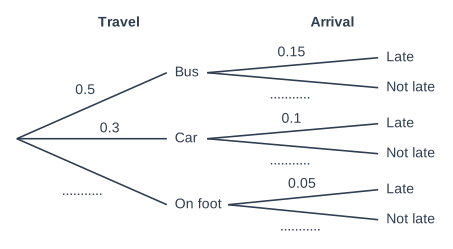
Ola goes to work by bus, by car or on foot.
The tree diagram shows the probabilities of how she travels, and the probabilities that she is late.

Ola goes to work on 200 days in a year.

Work out an estimate for the number of days in the year that Ola is late for work.

A probability tree diagram drawn from left to right with 2 stages of branches, headed "Travel" and "Arrival". Each branch has its outcome written at its end and its probability written beside it. First stage, 3 branches: "Bus" with probability 0.5, "Car" with probability 0.3, "On foot" with probability left blank (a dotted line to fill in). After "Bus", the second stage branches are "Late" with probability 0.15, "Not late" with probability left blank (a dotted line to fill in). After "Car", the second stage branches are "Late" with probability 0.1, "Not late" with probability left blank (a dotted line to fill in). After "On foot", the second stage branches are "Late" with probability 0.05, "Not late" with probability left blank (a dotted line to fill in).

Model answer

P(walks) = 1 − 0.5 − 0.3 = 0.2
P(late) = 0.5 × 0.15 + 0.3 × 0.1 + 0.2 × 0.05
= 0.075 + 0.03 + 0.01 = 0.115
Estimate = 0.115 × 200 = 23 days

Explanation

Ola can be late in three ways, one for each way of travelling. Multiply along each 'late' path and add them to get the total probability of being late. Then multiply by the number of days. The late probabilities 0.15, 0.1 and 0.05 must not simply be added, because each applies to only part of the time.

Mark scheme
  1. 1 mark

    M1 for one of \(0.5 \times 0.15\), \(0.3 \times 0.1\), \(0.2 \times 0.05\)

    0.075, 0.03 or 0.01 (exact values). P(walks) = 1 − 0.5 − 0.3 = 0.2.

  2. 1 mark

    M1 for 0.075 + 0.03 + 0.01 or 0.115 and \(\times 200\)

    Or 200 × each path and add (15 + 6 + 2). FT their 0.2 for walking.

  3. 1 mark

    A1 for 23

    0.115 as the final answer scores M1 M0 A0. 0.15 + 0.1 + 0.05 = 0.3, giving 60, scores M0 M0 A0. Correct answer with no working scores 3 marks.

Question 3

3 marks

In a town, the weather on one day affects the weather on the next day.

If it rains on one day, the probability that it rains on the next day is 0.6.
If it does not rain on one day, the probability that it rains on the next day is 0.25.

It rains on Monday.

Work out the probability that it rains on exactly one of Tuesday and Wednesday.

Model answer

Monday is rainy, so P(rain on Tuesday) = 0.6 and P(no rain on Tuesday) = 0.4.
Rain Tuesday, no rain Wednesday: 0.6 × (1 − 0.6) = 0.6 × 0.4 = 0.24
No rain Tuesday, rain Wednesday: 0.4 × 0.25 = 0.1
P(rain on exactly one of the two days) = 0.24 + 0.1 = 0.34

Explanation

Draw a tree diagram starting from a rainy Monday. The probabilities on Wednesday's branches depend on what happened on Tuesday: after rain use 0.6 and 0.4, after a dry day use 0.25 and 0.75. Two paths have rain on exactly one day; multiply along each and add.

Mark scheme
  1. 1 mark

    M1 for \(0.6 \times 0.4\) or 0.24

    Rain on Tuesday, no rain on Wednesday. Exact value; correct answer with no working scores full marks

  2. 1 mark

    M1 for \(0.4 \times 0.25\) or 0.1

    No rain on Tuesday, rain on Wednesday. Exact value.

  3. 1 mark

    A1 for 0.34 oe

    From 0.24 + 0.1. Using 0.6 × 0.4 + 0.4 × 0.6 = 0.48 (the same probabilities on both days) scores M1 M0 A0. Correct answer with no working scores 3 marks.

Question 4

4 marks

Ann and Bo take turns to throw a ball at a target. Ann throws first.
The first person to hit the target wins, and the game then stops.
Each person has at most two throws.

The probability that Ann hits the target with any throw is 0.3.
The probability that Bo hits the target with any throw is 0.4.
The throws are independent.

Work out the probability that Bo wins the game.

Model answer

Order of throws: Ann, Bo, Ann, Bo. The game stops at the first hit.
Bo wins on his first throw: Ann misses, Bo hits: 0.7 × 0.4 = 0.28
Bo wins on his second throw: Ann misses, Bo misses, Ann misses, Bo hits: 0.7 × 0.6 × 0.7 × 0.4 = 0.1176
P(Bo wins) = 0.28 + 0.1176 = 0.3976

Explanation

Draw a tree diagram in which each path stops as soon as someone hits. Bo can only win on two paths, and on each of them every earlier throw must be a miss. Multiply along each path and add.

Mark scheme
  1. 1 mark

    M1 for \(0.7 \times 0.4\) oe or 0.28

    Ann misses, then Bo hits with his first throw. Exact value; correct answer with no working scores full marks

  2. 1 mark

    M1 for \(0.7 \times 0.6 \times 0.7\) oe or 0.294

    Ann misses, Bo misses, Ann misses (before Bo's second throw). Exact value.

  3. 1 mark

    M1 for their 0.28 + their \(0.294 \times 0.4\) oe

    Or 0.28 + 0.1176. Both of Bo's winning paths needed.

  4. 1 mark

    A1 for 0.3976 oe

    Exact value; accept 0.398 or 0.40 with 0.3976 seen. 0.28 (Bo's first throw only) scores M1 M0 M0 A0. \(0.6 \times 0.4\) + ... (starting with Bo) scores 0. Correct answer with no working scores 4 marks.

Ready to try the rest? Every answer you write is marked against the mark scheme, so you can see exactly where the marks are.

Study Helper Hints first, answers after you try

Stuck on this one? Ask for a hint and I’ll point you in the right direction, without giving the answer away. Once you’ve checked your answer, I’ll show you how the marks are awarded.