
Level:
Correct: 0
Incorrect: 0
Marks: 0/0
Exam Practice
Course:
Topics:
OCR GCSE Maths (Higher calculator) Smart practice A mixed round aimed at your weak spots
Unit 1
Number Operations and Integers
Unit 2
Fractions, Decimals and Percentages
Unit 3
Indices and Surds
Unit 4
Approximation and Estimation
Unit 5
Ratio, Proportion and Rates of Change
Unit 6
Algebra
Unit 7
Graphs of Equations and Functions
Unit 8
Basic Geometry
Unit 9
Congruence and Similarity
Unit 10
Mensuration
Unit 11
Probability
Unit 12
Statistics
Avg
score:
–
Topics
done:
0/121

Tables of values and plotting graphs

Practise 14 exam-style questions on Tables of values and plotting graphs for OCR GCSE Maths (Higher calculator). Write your answer as you would in the exam and get it marked in seconds against the mark scheme, point by point, with the Study Helper on hand if you get stuck.

  • 14 questions
  • 1–5 marks each
  • Instant marking
  • No sign-up needed
14 questions, marked as you go

Sample questions with model answers

Here are 4 of the questions in this topic, each with a model answer, an explanation of why it earns the marks and the mark scheme an examiner would use.

Question 1

2 marks

An open box is made from a rectangular sheet of card measuring 8 cm by 5 cm.
A square of side x cm is cut from each corner and the sides are folded up.

The volume, V cm³, of the box is given by
\(V = x(8 - 2x)(5 - 2x)\).

The table shows some values of x and V.

Work out the value of p and the value of q.
Give your answers correct to 1 decimal place.

Table with columns "x", "0.25", "0.5", "0.75", "1", "1.25", "1.5". x: V; 0.25: 8.4; 0.5: 14; 0.75: p; 1: 18; 1.25: q; 1.5: 15.

Model answer

When \(x = 0.75\): \(V = 0.75 \times (8 - 1.5) \times (5 - 1.5) = 0.75 \times 6.5 \times 3.5 = 17.0625\), so \(p = 17.1\)
When \(x = 1.25\): \(V = 1.25 \times (8 - 2.5) \times (5 - 2.5) = 1.25 \times 5.5 \times 2.5 = 17.1875\), so \(q = 17.2\)

Explanation

Work out each bracket first, then multiply the three values together. The brackets are the length and width of the base of the box after the corners are cut out, and x is its height. A common error is to work out 8 − 2 × 0.75 as 6 × 0.75; use the order of operations or brackets on the calculator.

Mark scheme
  1. 1 mark

    B1 for \(p = 17.1\)

    Accept 17.06 to 17.1 (exact value 17.0625). From \(0.75 \times 6.5 \times 3.5\). More accurate answers are accepted; correct answer with no working scores full marks

  2. 1 mark

    B1 for \(q = 17.2\)

    Accept 17.18 to 17.2 (exact value 17.1875). From \(1.25 \times 5.5 \times 2.5\). More accurate answers are accepted. If 0 scored, SC1 for both values correct but not rounded or rounded incorrectly, e.g. 17.0 and 17.1.
Question 2

2 marks

Ruby makes a table of values for \(y = \dfrac{2}{x}\).

x: −4, −2, −1, 1, 2, 4
y: −0.5, −1, −2, 2, 1, 0.5

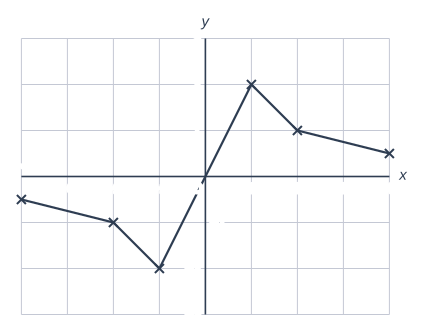
The diagram shows the graph she makes from her table.

Ruby's graph is not correct.
Describe two mistakes Ruby has made in her graph.

A coordinate grid with x from −4 to 4 and y from −3 to 3; each grid square is 1 unit across, and the axes cross at the origin O. The graph is made of straight-line sections joining (−4, −0.5), (−2, −1), (−1, −2), (1, 2), (2, 1) and (4, 0.5). A cross is marked at (−4, −0.5). A cross is marked at (−2, −1). A cross is marked at (−1, −2). A cross is marked at (1, 2). A cross is marked at (2, 1). A cross is marked at (4, 0.5).

Model answer

Mistake 1: she has joined (−1, −2) to (1, 2), so her graph goes through the origin. There is no value of y when x = 0 (you cannot divide by 0), so the graph of \(y = \dfrac{2}{x}\) is in two separate parts and never crosses the y-axis.
Mistake 2: she has joined the points with straight lines. The graph should be a smooth curve through the points.

Explanation

When you draw a graph from a table of values, join the points with a smooth curve, not ruled lines, unless the graph is a straight line. A reciprocal graph has two separate branches: as x gets close to 0 the y-values get very large (positive or negative), so the curve never meets the y-axis. Using extra x-values such as ±0.5 shows this.

Mark scheme
  1. 1 mark

    B1 for she has joined the points across \(x = 0\) / the graph should not cross the y-axis / the graph should be in two separate parts oe

    Accept 'there is no value of y when x = 0 so she should not join (−1, −2) to (1, 2)', 'the graph should not go through the origin'. Max 2 marks in total.

  2. 1 mark

    B1 for she has joined the points with straight lines instead of a smooth curve oe

    Also accept as a mistake: she has not used enough points / she needs more values of x between −1 and 1 (e.g. x = 0.5, y = 4) so the shape near the y-axis is missing. Do not accept 'she has plotted the points wrongly' (the points are plotted correctly).

Question 3

3 marks

Here are three points.

P\((0.8, 4.2)\)   Q\((-2.5, 0.9)\)   R\((1.6, 1.1)\)

Which of these points lie on the curve \(y = \dfrac{4}{x} - x\)?
Show how you decide.

Model answer

Substitute each x-coordinate into \(y = \dfrac{4}{x} - x\).
P: \(\dfrac{4}{0.8} - 0.8 = 5 - 0.8 = 4.2\), which is the y-coordinate of P, so P lies on the curve.
Q: \(\dfrac{4}{-2.5} - (-2.5) = -1.6 + 2.5 = 0.9\), which is the y-coordinate of Q, so Q lies on the curve.
R: \(\dfrac{4}{1.6} - 1.6 = 2.5 - 1.6 = 0.9\), but the y-coordinate of R is 1.1, so R does not lie on the curve.
P and Q lie on the curve.

Explanation

A point lies on a curve when its coordinates fit the equation: put in the x-coordinate and see if you get the y-coordinate. Take care with the negative x-value: 4 ÷ (−2.5) is negative and subtracting −2.5 means adding 2.5. Every point needs its own calculation.

Mark scheme
  1. 1 mark

    B1 for P lies on the curve, with \(\dfrac{4}{0.8} - 0.8 = 4.2\) shown

    Accept \(5 - 0.8 = 4.2\).

  2. 1 mark

    B1 for Q lies on the curve, with \(\dfrac{4}{-2.5} - (-2.5) = 0.9\) shown

    Accept \(-1.6 + 2.5 = 0.9\).

  3. 1 mark

    B1 for R does not lie on the curve, with \(\dfrac{4}{1.6} - 1.6 = 0.9\) shown and 0.9 ≠ 1.1

    Accept \(2.5 - 1.6 = 0.9\) so R is not on the curve. A decision with no calculation scores 0 for that point. If 0 scored, SC1 for all three y-values 4.2, 0.9 and 0.9 correct with no or wrong decisions.

Question 4

4 marks

Ayesha grows two plants for a science project.
At the start, both plants are 2 cm tall.

She uses these formulae to model the height, h cm, of each plant after w weeks.

Plant A: \(h = 2 + 1.5w\)
Plant B: \(h = 2 \times 1.3^w\)

According to the models, after how many whole weeks is plant B first taller than plant A?
Show how you decide.

Model answer

Plant A: \(h = 2 + 1.5w\) Plant B: \(h = 2 \times 1.3^w\)
w = 5: A = 9.5, B = \(2 \times 1.3^5 = 7.4258...\)
w = 6: A = 11, B = \(2 \times 1.3^6 = 9.6536...\) (B is still shorter)
w = 7: A = 12.5, B = \(2 \times 1.3^7 = 12.5497...\) (B is taller)
Plant B is first taller than plant A after 7 weeks.

Explanation

Make a table of values for both models for whole numbers of weeks and compare the heights. Plant A grows by the same amount each week (linear), while plant B is multiplied by 1.3 each week (exponential), so B eventually overtakes A. At 7 weeks the heights are very close, so you need enough decimal places to see which is bigger.

Mark scheme
  1. 1 mark

    M1 for \(2 \times 1.3^w\) correctly evaluated for at least two whole numbers \(w \geqslant 2\)

    Values: w = 2: 3.38, w = 3: 4.394, w = 4: 5.7122, w = 5: 7.42586, w = 6: 9.6536..., w = 7: 12.5497...

  2. 1 mark

    M1 for comparing the heights of A and B for the same w

    A: w = 5: 9.5, w = 6: 11, w = 7: 12.5.

  3. 1 mark

    M1 for \(w = 6\): A = 11 and B = 9.65 oe (B shorter)

    Accept B = 9.6 to 9.66.

  4. 1 mark

    A1 for 7 weeks, with A = 12.5 and B = 12.55 oe

    B must be given to at least 2 decimal places (12.54 to 12.55, exact 12.549...) to show it is greater than 12.5. 'B = 12.5' leading to 'equal at 7 weeks so 8 weeks' scores M1 M1 M1 A0.

Ready to try the rest? Every answer you write is marked against the mark scheme, so you can see exactly where the marks are.

Study Helper Hints first, answers after you try

Stuck on this one? Ask for a hint and I’ll point you in the right direction, without giving the answer away. Once you’ve checked your answer, I’ll show you how the marks are awarded.