Question 1
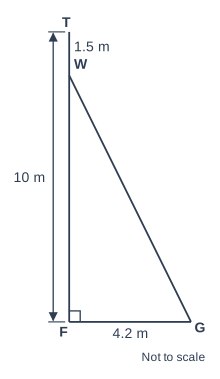
3 marksThe diagram shows a vertical flagpole FT standing on horizontal ground.
The flagpole is 10 m tall.
A straight wire joins a point W on the flagpole to a point G on the ground.
W is 1.5 m below the top of the flagpole.
G is 4.2 m from F, the foot of the flagpole.
Calculate the length of the wire WG.
Give your answer correct to 3 significant figures.
Model answer
FW = 10 − 1.5 = 8.5 m
Triangle WFG has a right angle at F, and WG is the hypotenuse.
\(WG^2 = 8.5^2 + 4.2^2 = 72.25 + 17.64 = 89.89\)
\(WG = \sqrt{89.89} = 9.4810...\)
WG = 9.48 m (to 3 s.f.)
Explanation
The flagpole is vertical and the ground is horizontal, so triangle WFG is right-angled at F. The wire is fixed 1.5 m below the top, so the vertical side is 8.5 m, not 10 m. Then use Pythagoras to find the hypotenuse.
Mark scheme
-
1 mark
B1 for FW = 8.5 (m)
Exact value from 10 − 1.5; may be seen in their Pythagoras; correct answer with no working scores full marks
-
1 mark
M1 for their \(8.5^2 + 4.2^2\) oe
Exact values from the question; implied by 89.89. FT their FW. Using 10 gives \(10^2 + 4.2^2\) = 117.64, which scores B0 M1 A0 (answer 10.8).
-
1 mark
A1 for 9.48
Accept 9.48 to 9.482 (9.4810...); more accurate answers are accepted.