Practise 14 exam-style questions on Trigonometric graphs for OCR GCSE Maths (Higher calculator). Write your answer as you would in the exam and get it marked in seconds against the mark scheme, point by point, with the Study Helper on hand if you get stuck.
14 questions
2–5 marks each
Instant marking
No sign-up needed
14 questions, marked as you go
Sample questions with model answers
Here are 4 of the questions in this topic, each with a model answer, an explanation of why it earns the marks and the mark scheme an examiner would use.
Question 1
2 marks
Write down the greatest value of \(5 - 2\cos x\) for \(0^\circ \leqslant x \leqslant 360^\circ\), and the value of x where it occurs.
Model answer
\(\cos x\) takes values from −1 to 1. \(5 - 2\cos x\) is greatest when \(\cos x\) is as small as possible, \(\cos x = -1\). This happens when \(x = 180^\circ\). Greatest value = \(5 - 2 \times (-1) = 7\), when \(x = 180^\circ\).
Explanation
Because 2 cos x is being subtracted, the expression is largest when cos x is smallest. The minimum of the cosine graph for 0° to 360° is −1, at 180°. A common error is to use cos x = 1, which gives the least value, 3.
Mark scheme
1 mark
B1 for 7
cao; correct answer with no working scores full marks
1 mark
B1 for \(x = 180\)
Accept 180°. Answers 3 and 0 (or 360), the least value, score B0 B0. If 0 scored, SC1 for 3 with \(x = 0\) or 360 (least value given).
Question 2
3 marks
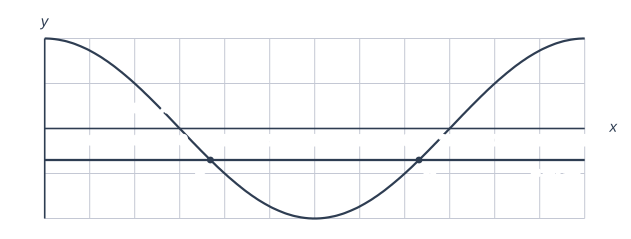
The diagram shows the graph of \(y = \cos x\) for \(0^\circ \leqslant x \leqslant 360^\circ\) and the line \(y = -0.35\).
The line meets the graph at P and Q.
Calculate the x-coordinates of P and Q. Give your answers correct to 1 decimal place.
Model answer
At P and Q, \(\cos x = -0.35\). \(x = \cos^{-1}(-0.35) = 110.487...^\circ\), which is P. The cosine graph is symmetrical about \(x = 180^\circ\), so Q is at \(x = 360^\circ - 110.487...^\circ = 249.512...^\circ\). P: \(x = 110.5\) Q: \(x = 249.5\)
Explanation
The calculator's inverse cosine gives one solution between 0° and 180°. The cosine graph from 0° to 360° is symmetrical about x = 180°, so the other solution is 360° minus the first. Check with the diagram: both points are where the graph is below the x-axis, between 90° and 270°.
Mark scheme
1 mark
B1 for P: 110.5
Accept 110.48 to 110.5 (calculator value 110.487...). From \(\cos^{-1}(-0.35)\); correct answer with no working scores full marks
1 mark
M1 for 360 − their 110.5
Or for a correct use of the symmetry of the cosine graph about \(x = 180^\circ\), e.g. \(180 + (180 - 110.48...)\).
1 mark
A1 for Q: 249.5
Accept 249.5 to 249.52 (calculator value 249.512...). Answers read from the graph without calculation, e.g. 110 and 250, score B0 M1 A0 at most.
Question 3
3 marks
Solve \(3\tan x + 4 = 0\) for \(0^\circ \leqslant x \leqslant 360^\circ\). Give your answers correct to 1 decimal place.
Model answer
\(3\tan x = -4\) \(\tan x = -\dfrac{4}{3}\) \(\tan^{-1}\left(-\dfrac{4}{3}\right) = -53.130...^\circ\), which is not in the range. The tan graph repeats every \(180^\circ\): \(x = -53.130... + 180 = 126.869...^\circ\) \(x = -53.130... + 360 = 306.869...^\circ\) \(x = 126.9^\circ\) or \(x = 306.9^\circ\)
Explanation
Rearrange to get tan x on its own first. Tan x is negative between 90° and 180° and between 270° and 360°, so the solutions lie there. Add multiples of 180° to the calculator's negative answer until the values are in the range.
Mark scheme
1 mark
M1 for \(\tan x = -\dfrac{4}{3}\) oe
Exact value. Implied by −53.1 (calculator value −53.130...); correct answer with no working scores full marks
1 mark
A1 for 126.9
Accept 126.86 to 126.9 (calculator value 126.869...).
1 mark
A1 for 306.9
Accept 306.86 to 306.9 (calculator value 306.869...). FT their 126.9 + 180 if their first answer came from a correct method. −53.1 given as an answer scores A0 for that value. Extra values in the range score A0 for this mark.
Question 4
4 marks
Solve \(5\cos^2 x = 2\) for \(0^\circ \leqslant x \leqslant 360^\circ\). Give your answers correct to 1 decimal place.
Model answer
\(\cos^2 x = \dfrac{2}{5} = 0.4\) \(\cos x = \sqrt{0.4} = 0.63245...\) or \(\cos x = -\sqrt{0.4} = -0.63245...\) \(\cos x = 0.63245...\): \(x = 50.768...^\circ\) or \(x = 360 - 50.768... = 309.231...^\circ\) \(\cos x = -0.63245...\): \(x = 129.231...^\circ\) or \(x = 360 - 129.231... = 230.768...^\circ\) \(x = 50.8^\circ, 129.2^\circ, 230.8^\circ\) or \(309.2^\circ\)
Explanation
cos²x means (cos x)², so after dividing by 5, take the square root and remember the negative root as well. Each value of cos x gives two angles, using the symmetry of the cosine graph about 180°, so there are four solutions. They are symmetrical: 50.8 + 129.2 = 180 and 50.8 + 309.2 = 360.
Mark scheme
1 mark
M1 for \(\cos^2 x = 0.4\) and \(\cos x = \pm\sqrt{0.4}\) oe
Implied by \(\cos x = \pm 0.632...\) (accept 0.632 or better, calculator value 0.63245...). Only the positive root can score this M1 but limits the answers to 50.8 and 309.2; correct answer with no working scores full marks
1 mark
A1 for 50.8 and 309.2
Accept 50.76 to 50.8 and 309.2 to 309.24 (calculator values 50.768... and 309.231...).
1 mark
M1 for \(\cos^{-1}(-0.632...)\) or 180 − their 50.8 seen
Accept −0.632 or better inside the inverse cosine. Implied by 129.2 or 230.8 (accept 129.2 to 129.24 or 230.76 to 230.8).
1 mark
A1 for 129.2 and 230.8
Accept 129.2 to 129.24 and 230.76 to 230.8 (calculator values 129.231... and 230.768...). Extra values in the range score A0 for this mark. More accurate answers are accepted.
Ready to try the rest? Every answer you write is marked against the mark scheme, so you can see exactly where the marks are.
Ctrl + Enter to check
Study HelperHints first, answers after you try
Stuck on this one? Ask for a hint and I’ll point you in the right direction, without giving the answer away. Once you’ve checked your answer, I’ll show you how the marks are awarded.