Practise 16 exam-style questions on Area of circles and sectors for OCR GCSE Maths (Higher calculator). Write your answer as you would in the exam and get it marked in seconds against the mark scheme, point by point, with the Study Helper on hand if you get stuck.
16 questions
1–5 marks each
Instant marking
No sign-up needed
16 questions, marked as you go
Sample questions with model answers
Here are 4 of the questions in this topic, each with a model answer, an explanation of why it earns the marks and the mark scheme an examiner would use.
Question 1
2 marks
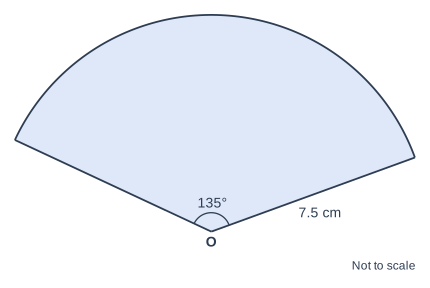
The diagram shows a sector of a circle, centre O. The radius is 7.5 cm and the angle of the sector is 135°.
Calculate the area of the sector. Give your answer correct to 3 significant figures.
Model answer
Area of sector = \(\dfrac{135}{360} \times \pi \times 7.5^2\) = 66.267... cm² = 66.3 cm² (3 s.f.)
Explanation
A sector is a fraction of a circle: the fraction is the angle divided by 360. Multiply this fraction by the area of the whole circle, πr². Using 2πr instead gives the arc length, not the area.
Mark scheme
1 mark
M1 for \(\dfrac{135}{360} \times \pi \times 7.5^2\) oe
Exact values from the question. Or \(0.375 \times \pi \times 56.25\); correct answer with no working scores full marks
1 mark
A1 for 66.3
Accept 66.26 to 66.3 (exact value 66.267...); more accurate answers are accepted. Using \(\pi = 3.14\) gives 66.23, which is outside the range: M1 A0. 17.7 (the arc length) scores M0 A0.
Question 2
3 marks
A security light lights up a region in the shape of a sector of a circle. The radius of the sector is 14 m. The area of the region is 120 m².
Work out the angle of the sector. Give your answer correct to 1 decimal place.
Model answer
Area of the whole circle = \(\pi \times 14^2 = 615.75...\) m² \(\dfrac{\theta}{360} \times 615.75... = 120\) \(\theta = 120 \div 615.75... \times 360 = 70.158...\) \(\theta = 70.2^\circ\) (1 d.p.)
Explanation
The sector's area is the fraction θ/360 of the area of the whole circle. So θ/360 = 120 ÷ (π × 14²); multiply by 360 to get the angle. Check: an angle of about 70° is roughly a fifth of a circle, and 120 m² is roughly a fifth of 616 m².
Mark scheme
1 mark
M1 for \(\pi \times 14^2\) or \(\dfrac{\theta}{360} \times \pi \times 14^2 = 120\) oe
The area of the whole circle is 615.75... (accept 615 to 616); correct answer with no working scores full marks
1 mark
M1 for \(120 \div\) their 615.75... \(\times 360\) oe
120 and 360 are exact. Using \(2 \times \pi \times 14\) (circumference) gives 491.1: M0 M1 A0.
1 mark
A1 for 70.2
Accept 70.15 to 70.2 (exact value 70.158...°); more accurate answers are accepted. A correct answer with no working scores 3 marks.
Question 3
3 marks
A sector of a circle has radius \((x + 2)\) cm and angle 60°. The area of the sector is 30 cm².
Show that \(x = 5.57\), correct to 3 significant figures.
Substitute the radius x + 2 into the sector area formula and set it equal to 30. Undo each step in turn: multiply by 6, divide by π, square root, then subtract 2. Show the unrounded value 5.569... before giving 5.57.
M1 for \((x + 2)^2 = \dfrac{180}{\pi}\) and \(x + 2 = \sqrt{\dfrac{180}{\pi}}\) oe
Implied by \((x + 2)^2 = 57.29...\) (accept 57.3 or better) or \(x + 2 = 7.569...\)
1 mark
A1 for \(x = 5.569...\) seen, leading to 5.57
Accept 5.569 or better (5.5693...). Alternative: showing that x = 5.565 gives an area of 29.97 (less than 30) and x = 5.575 gives 30.04 (more than 30) scores 3 marks. Substituting 5.57 only (area 30.00...) scores M1 M0 A0. This is a 'show that' question: 5.57 with no method scores 0.
Question 4
4 marks
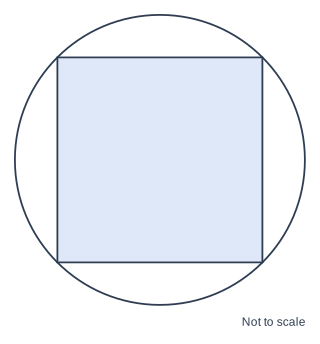
A square is drawn inside a circle so that its four vertices lie on the circle, as shown in the diagram. The area of the circle is 50 cm².
Work out the area of the square. Give your answer correct to 3 significant figures.
Model answer
\(\pi r^2 = 50\), so \(r^2 = \dfrac{50}{\pi} = 15.915...\) The diagonals of the square are diameters of the circle, so each diagonal = \(2r\). The square is made of four right-angled isosceles triangles, each with two sides \(r\): Area of the square = \(4 \times \dfrac{1}{2} r^2 = 2r^2 = 2 \times 15.915...\) = 31.830... cm² = 31.8 cm² (3 s.f.)
Explanation
The diagonals of the square pass through the centre of the circle, so each diagonal is a diameter, 2r. The diagonals split the square into four right-angled triangles with legs r, so the area is 2r². You never need r itself: r² = 50/π is enough.
Mark scheme
1 mark
M1 for \(r = \sqrt{50 \div \pi}\) or \(r^2 = \dfrac{50}{\pi}\)
r = 3.989... (accept 3.98 to 3.99); \(r^2 = 15.91...\) (accept 15.9 or better); correct answer with no working scores full marks
1 mark
M1 for the diagonal of the square = 2r (the diameter), or side = \(r\sqrt{2}\)
The diagonal of the square is a diameter of the circle. Side = 5.64... (accept 5.64 or better).
1 mark
M1 for \((r\sqrt{2})^2\) or \(\dfrac{1}{2} \times (2r)^2\) or \(2r^2\) oe
Or four right-angled triangles, each \(\dfrac{1}{2} \times r \times r\).
1 mark
A1 for 31.8
Accept 31.8 to 31.84 (exact value \(\dfrac{100}{\pi}\) = 31.830...); more accurate answers are accepted. 63.7 (the side taken as the diameter) scores M1 M0 M0 A0. 15.9 (the side taken as the radius) scores M1 M0 M0 A0.
Ready to try the rest? Every answer you write is marked against the mark scheme, so you can see exactly where the marks are.
Ctrl + Enter to check
Study HelperHints first, answers after you try
Stuck on this one? Ask for a hint and I’ll point you in the right direction, without giving the answer away. Once you’ve checked your answer, I’ll show you how the marks are awarded.