
Level:
Correct: 0
Incorrect: 0
Marks: 0/0
Exam Practice
Course:
Topics:
OCR GCSE Maths (Higher calculator) Smart practice A mixed round aimed at your weak spots
Unit 1
Number Operations and Integers
Unit 2
Fractions, Decimals and Percentages
Unit 3
Indices and Surds
Unit 4
Approximation and Estimation
Unit 5
Ratio, Proportion and Rates of Change
Unit 6
Algebra
Unit 7
Graphs of Equations and Functions
Unit 8
Basic Geometry
Unit 9
Congruence and Similarity
Unit 10
Mensuration
Unit 11
Probability
Unit 12
Statistics
Avg
score:
–
Topics
done:
0/121

Approximate solutions by iteration

Practise 14 exam-style questions on Approximate solutions by iteration for OCR GCSE Maths (Higher calculator). Write your answer as you would in the exam and get it marked in seconds against the mark scheme, point by point, with the Study Helper on hand if you get stuck.

  • 14 questions
  • 1–6 marks each
  • Instant marking
  • No sign-up needed
14 questions, marked as you go

Sample questions with model answers

Here are 4 of the questions in this topic, each with a model answer, an explanation of why it earns the marks and the mark scheme an examiner would use.

Question 1

3 marks

Show that the equation \(2^x = 3x + 1\) has a solution between \(x = 3\) and \(x = 4\).

Model answer

Rearrange: \(2^x - 3x - 1 = 0\)
When \(x = 3\): \(2^3 - 9 - 1 = 8 - 10 = -2\) (negative)
When \(x = 4\): \(2^4 - 12 - 1 = 16 - 13 = 3\) (positive)
The value changes sign between \(x = 3\) and \(x = 4\), so the equation has a solution between \(x = 3\) and \(x = 4\).

Explanation

Put the equation in the form 'expression = 0' and evaluate the expression at both ends of the interval. A change of sign means the graph of the expression crosses the x-axis in between, because it is continuous there. Alternatively compare the two sides: \(2^x\) is smaller than 3x + 1 at x = 3 and larger at x = 4.

Mark scheme
  1. 1 mark

    M1 for \(2^3 - 3 \times 3 - 1 = -2\), or \(2^3 = 8\) and \(3 \times 3 + 1 = 10\)

    Substitution and evaluation must be seen (exact values).

  2. 1 mark

    M1 for \(2^4 - 3 \times 4 - 1 = 3\), or \(2^4 = 16\) and \(3 \times 4 + 1 = 13\)

    Exact values.

  3. 1 mark

    A1 for a correct conclusion, e.g. 'sign change (−2 to 3), so there is a solution between 3 and 4' or '8 < 10 but 16 > 13'

    Dependent on both M marks. The conclusion must refer to the change of sign or to which side is larger. 'So x is between 3 and 4' with no reason scores A0.
Question 2

3 marks

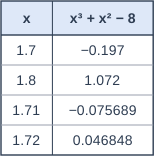
Ravi is solving the equation \(x^3 + x^2 - 8 = 0\).

The table shows some of his results.

Use the table and one further calculation to find the solution correct to 2 decimal places.
You must show your calculation.

Table with columns "x", "x³ + x² − 8". x: 1.7; x³ + x² − 8: −0.197 | x: 1.8; x³ + x² − 8: 1.072 | x: 1.71; x³ + x² − 8: −0.075689 | x: 1.72; x³ + x² − 8: 0.046848.

Model answer

From the table, the sign changes between 1.71 and 1.72, so the solution is between 1.71 and 1.72.
Check the half-way value:
\(x = 1.715\): \(1.715^3 + 1.715^2 - 8 = -0.0145...\) (negative)
The sign changes between 1.715 and 1.72, so the solution is between 1.715 and 1.72.
The solution is 1.72 correct to 2 decimal places.

Explanation

The table narrows the solution to between 1.71 and 1.72, but numbers in that interval could round to either. The value at the half-way point, 1.715, is negative, so the solution is above 1.715 and rounds to 1.72. Always use the half-way value to decide the rounding.

Mark scheme
  1. 1 mark

    M1 for substituting \(x = 1.715\) into \(x^3 + x^2 - 8\)

    e.g. \(1.715^3 + 1.715^2 - 8\).

  2. 1 mark

    A1 for \(-0.0146\) (−0.014574...)

    Accept −0.015 to −0.014.

  3. 1 mark

    A1 for 1.72, with the reason that there is a sign change between 1.715 and 1.72

    Value 1.7161... An answer of 1.71, or 1.72 with no evaluation at the half-way value, scores 0 for this mark. A correct negative evaluation at a value between 1.715 and 1.716 instead of 1.715 is equally valid and can earn all 3 marks.

Question 3

4 marks

The equation \(x^3 - 8x + 5 = 0\) has exactly one negative solution.

Find this negative solution correct to 1 decimal place.
You must show calculations to support your answer.

Model answer

\(x = -3\): \(-27 + 24 + 5 = 2\) (positive)
\(x = -4\): \(-64 + 32 + 5 = -27\) (negative)
So the solution is between \(-4\) and \(-3\).
\(x = -3.1\): \(-29.791 + 24.8 + 5 = 0.009\) (positive)
\(x = -3.2\): \(-32.768 + 25.6 + 5 = -2.168\) (negative)
\(x = -3.15\): \(-31.255875 + 25.2 + 5 = -1.055875\) (negative)
The sign changes between \(-3.15\) and \(-3.1\), so the solution is between \(-3.15\) and \(-3.1\).
This rounds to \(-3.1\).

Explanation

Work with negative values of x carefully: \((-3.1)^3\) is negative and \(-8 \times (-3.1)\) is positive. Narrowing to between −3.2 and −3.1 is not enough; the half-way value −3.15 gives a negative result, so the solution lies between −3.15 and −3.1 and rounds to −3.1. The value at −3.1 is very close to 0, but you still need the sign change to be sure.

Mark scheme
  1. 3 marks

    M3 for two correct evaluations for \(-3.15 \leqslant x \leqslant -3.05\), one of which gives a negative answer and the other a positive answer

    e.g. −3.15 gives −1.055875 and −3.1 gives 0.009 (or −3.05 gives 1.027375). Or M2 for two correct evaluations for \(-4 \leqslant x \leqslant -3\), one negative and one positive (e.g. −3.2 gives −2.168 and −3.1 gives 0.009). Or M1 for one correct evaluation for a negative value of x, e.g. −3 gives 2, −4 gives −27. Accept values rot to 1 s.f. or better (0.009 may be seen as 0.01).

  2. 1 mark

    A1 for \(-3.1\)

    cao (exact value −3.1001...). If 0 scored, SC1 for −3.1 with no worthwhile working. Positive solutions (0.66... and 2.43...) are not required: if given as the answer instead, A0.

Question 4

5 marks

Kiran buys a car.
The value of the car, £\(V\), \(n\) years after she buys it is given by

\(V = 18\,000 \times 0.85^n\)

Kiran's savings, £\(S\), \(n\) years after she buys the car are given by

\(S = 4000 + 1500n\)

Show that the value of the car is equal to Kiran's savings at some time between \(n = 3\) and \(n = 4\).
Find this value of \(n\) correct to 1 decimal place.
You must show calculations to support your answer.

Model answer

\(n = 3\): \(V = 18\,000 \times 0.85^3 = 11\,054.25\), \(S = 4000 + 4500 = 8500\). V is greater.
\(n = 4\): \(V = 18\,000 \times 0.85^4 = 9396.11\), \(S = 4000 + 6000 = 10\,000\). V is smaller.
So V − S changes sign, and they are equal at some time between \(n = 3\) and \(n = 4\).
\(n = 3.8\): \(V = 9706.53...\), \(S = 9700\). V is greater (by 6.53...).
\(n = 3.9\): \(V = 9550.06...\), \(S = 9850\). V is smaller.
\(n = 3.85\): \(V = 9627.98...\), \(S = 9775\). V is smaller.
So they are equal between \(n = 3.8\) and \(n = 3.85\), which rounds to 3.8.
\(n = 3.8\) (1 d.p.)

Explanation

The equation \(18\,000 \times 0.85^n = 4000 + 1500n\) cannot be solved by a simple algebraic method, so compare V and S at chosen values of n. Which one is larger switches between n = 3 and n = 4, and then between 3.8 and 3.85, so the time rounds to 3.8 years. Work out both V and S each time: a common error is to evaluate only one of them.

Mark scheme
  1. 1 mark

    M1 for V and S both evaluated at \(n = 3\) and at \(n = 4\)

    n = 3: V = 11 054.25, S = 8500; n = 4: V = 9396.11 (9396.1125), S = 10 000. Or V − S = 2554.25 and −603.89 (accept −603.8 to −603.9).

  2. 1 mark

    A1 for a correct conclusion: V is more than S at n = 3 but less than S at n = 4, so they are equal between 3 and 4

    Or 'V − S changes sign'.

  3. 2 marks

    M2 for two correct evaluations for \(3.75 \leqslant n \leqslant 3.85\), one with V more than S and the other with V less than S

    The value with V more than S must come from n between 3.75 and 3.802 (e.g. n = 3.8: V = 9706.53..., S = 9700). Or M1 for two correct evaluations for \(3 < n < 4\) with V − S changing sign (e.g. n = 3.8 and n = 3.9: V − S = 6.53... and −299.93...). Accept V values rot to 3 s.f. or better, provided the comparison with S is correct. Likely V − S values: 3.5: 941.5...; 3.7: 315.5...; 3.75: 160.7...; 3.8: 6.53...; 3.85: −147.0...; 3.9: −299.9...

  4. 1 mark

    A1 for 3.8

    cao (exact value 3.802...). An answer of 3.9 scores at most M1 A1 M1 A0.

Ready to try the rest? Every answer you write is marked against the mark scheme, so you can see exactly where the marks are.

Study Helper Hints first, answers after you try

Stuck on this one? Ask for a hint and I’ll point you in the right direction, without giving the answer away. Once you’ve checked your answer, I’ll show you how the marks are awarded.