Question 1
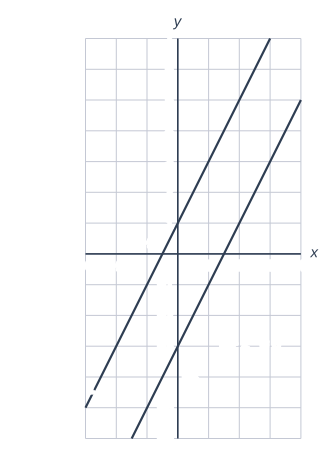
2 marksThe lines \(y = 2x + 1\) and \(4x - 2y = 6\) are drawn on the grid.
Use the graph to explain why these simultaneous equations have no solution.
\(y = 2x + 1\)
\(4x - 2y = 6\)
Model answer
A solution of the simultaneous equations would be a point that lies on both lines, i.e. a point where the lines cross.
\(4x - 2y = 6\) rearranges to \(y = 2x - 3\), so both lines have gradient 2.
The lines are parallel (with different y-intercepts), so they never meet. So there is no solution.
Explanation
The solution of two simultaneous equations is the point of intersection of their graphs. Lines with the same gradient and different intercepts are parallel and never meet, so no pair of values satisfies both equations. Algebraically, eliminating y leads to a false statement such as 2 = −6.
Mark scheme
-
1 mark
B1 for: the lines are parallel / never meet / do not intersect, so there is no point whose coordinates satisfy both equations
The idea that a solution would be a point of intersection must be stated or clearly implied.
-
1 mark
B1 for showing both lines have gradient 2, e.g. \(4x - 2y = 6\) rearranged to \(y = 2x - 3\)
Accept 'both have gradient 2 but different y-intercepts (1 and −3)'.