
Level:
Correct: 0
Incorrect: 0
Marks: 0/0
Exam Practice
Course:
Topics:
OCR GCSE Maths (Higher calculator) Smart practice A mixed round aimed at your weak spots
Unit 1
Number Operations and Integers
Unit 2
Fractions, Decimals and Percentages
Unit 3
Indices and Surds
Unit 4
Approximation and Estimation
Unit 5
Ratio, Proportion and Rates of Change
Unit 6
Algebra
Unit 7
Graphs of Equations and Functions
Unit 8
Basic Geometry
Unit 9
Congruence and Similarity
Unit 10
Mensuration
Unit 11
Probability
Unit 12
Statistics
Avg
score:
–
Topics
done:
0/121

Growth, decay and compound interest

Practise 18 exam-style questions on Growth, decay and compound interest for OCR GCSE Maths (Higher calculator). Write your answer as you would in the exam and get it marked in seconds against the mark scheme, point by point, with the Study Helper on hand if you get stuck.

  • 18 questions
  • 2–5 marks each
  • Instant marking
  • No sign-up needed
18 questions, marked as you go

Sample questions with model answers

Here are 4 of the questions in this topic, each with a model answer, an explanation of why it earns the marks and the mark scheme an examiner would use.

Question 1

2 marks

Jack invests some money at 5% per year compound interest for 2 years.

He says,

"Over the 2 years, my money will increase by 10%."

Is Jack correct?
Show how you decide.

Model answer

Multiplier for 2 years \(= 1.05 \times 1.05 = 1.1025\)
This is an increase of 10.25%, not 10%.
No, Jack is not correct. (In the second year he also earns interest on the first year's interest.)

Explanation

Compound interest means multiplying by 1.05 each year, so after 2 years the multiplier is \(1.05^2 = 1.1025\), an increase of 10.25%. The extra 0.25% is the interest earned in the second year on the first year's interest. Adding the percentages only works for simple interest.

Mark scheme
  1. 1 mark

    M1 for \(1.05^2\) or 1.1025 oe

    Or with an amount, e.g. £100 → £105 → £110.25. Exact values.

  2. 1 mark

    A1 for No, the increase is 10.25%

    Accept 'No, it is more than 10%' with 1.1025 or £110.25 from £100 seen. 'No' with no working scores 0.
Question 2

3 marks

The mass of a sample of caesium-137 halves every 30 years.
A sample contains 80 g of caesium-137.

Work out the mass of caesium-137 left in the sample after 75 years.
Give your answer correct to 3 significant figures.

Model answer

Number of half-lives in 75 years \(= 75 \div 30 = 2.5\)
Mass left \(= 80 \times 0.5^{2.5}\)
\(= 14.142...\) g
= 14.1 g (3 s.f.)

Explanation

Every 30 years the mass is multiplied by 0.5, and 75 years is 2.5 lots of 30 years, so multiply by \(0.5^{2.5}\). After 60 years there is 20 g; the next 15 years multiply by \(0.5^{0.5} = 0.707...\), not by 0.75, because decay is not linear. That is why the answer is 14.1 g and not 15 g.

Mark scheme
  1. 1 mark

    M1 for \(75 \div 30\) or 2.5 (half-lives)

    Exact value. Or a multiplier for each year, \(0.5^{\frac{1}{30}} = 0.97716...\) (accept 0.977 to 0.9772); correct answer with no working scores full marks

  2. 1 mark

    M1 for \(80 \times 0.5^{2.5}\) oe

    E.g. \(20 \times 0.5^{0.5}\) or \(\dfrac{20}{\sqrt{2}}\), or \(80 \times 0.97716...^{75}\) (accept 0.977 to 0.9772 for the yearly multiplier). 0.5 and 2.5 are exact values.

  3. 1 mark

    A1 for 14.1

    Accept 14.14 to 14.15 or 14.1 (14.142...); more accurate answers are accepted. 15 (halfway between 20 and 10) scores M1 M0 A0. 20 or 10 scores M0 M0 A0 unless 2.5 half-lives is seen. If 0 scored, SC1 for their answer to more than 3 figures correctly rounded to 3 s.f.

Question 3

3 marks

Account A pays 3% per year compound interest.
Account B pays simple interest.

Liam invests the same amount of money in each account for 10 years.
At the end of the 10 years, the total interest from each account is the same.

Work out the rate of simple interest per year that Account B pays.
Give your answer correct to 2 decimal places.

Model answer

Suppose Liam invests £100 in each account.
Account A after 10 years: \(100 \times 1.03^{10} = £134.39\) (to the nearest penny), so the interest is £34.39.
Account B must also give £34.39 in 10 years, which is \(£3.439...\) each year.
Rate of simple interest = 3.44% per year (2 d.p.)

Explanation

Compound interest earns interest on interest, so 3% compound for 10 years gives more than 30%: the multiplier is \(1.03^{10} = 1.3439...\), a 34.39% increase. Simple interest earns the same each year, so divide 34.39% by 10. Any starting amount gives the same rate.

Mark scheme
  1. 1 mark

    M1 for \(1.03^{10}\) or 1.3439...

    Accept 1.343 to 1.344 (1.343916...). Or with an amount, e.g. £100 → £134.39; correct answer with no working scores full marks

  2. 1 mark

    M1 for (their \(1.3439... - 1) \div 10\) oe

    E.g. \(34.39 \div 10\), or the interest on £100 shared over 10 years. Accept 3.4 to 3.44 for this method value.

  3. 1 mark

    A1 for 3.44

    Accept 3.439 to 3.44 (3.43916...%); more accurate answers are accepted. 3 (assuming they are the same) scores 0. 34.39 (total over 10 years) scores M1 M0 A0. Premature rounding of \(1.03^{10}\) to 1.34 gives 3.4, which scores M1 M1 A0.

Question 4

4 marks

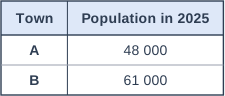
The table shows the populations of two towns, A and B, in 2025.

The population of town A is predicted to increase by 2.5% each year.
The population of town B is predicted to decrease by 1.5% each year.

After how many whole years is the population of town A first predicted to be greater than the population of town B?
You must show your working.

Table with columns "Town", "Population in 2025". Town: A; Population in 2025: 48 000 | Town: B; Population in 2025: 61 000.

Model answer

Town A after \(n\) years: \(48\,000 \times 1.025^n\)
Town B after \(n\) years: \(61\,000 \times 0.985^n\)
\(n = 5\): A = 54 307.6, B = 56 560.2 (A < B)
\(n = 6\): A = 55 665.3, B = 55 711.8 (A < B)
\(n = 7\): A = 57 056.9, B = 54 876.1 (A > B)
The population of town A is first greater after 7 years.

Explanation

Use a multiplier for each town: 1.025 for a 2.5% increase and 0.985 for a 1.5% decrease, and work out both populations for the same number of years. After 6 years, A is still about 47 people below B, so you need accurate values to see that the answer is 7, not 6. Show the values either side of the change.

Mark scheme
  1. 1 mark

    M1 for \(48\,000 \times 1.025^n\) or \(61\,000 \times 0.985^n\) for any whole number \(n \geqslant 2\)

    Or year-by-year values. Values: \(n = 6\): A 55 665.28..., B 55 711.80...; \(n = 7\): A 57 056.91..., B 54 876.12... Accept values rounded or truncated to the nearest whole number or better.

  2. 1 mark

    M1 for both towns worked out for the same value of \(n\), for at least two values of \(n\)

    Or \(\left(\dfrac{1.025}{0.985}\right)^n\) compared with \(\dfrac{61\,000}{48\,000} = 1.2708...\): \(n = 6\) gives 1.2696..., \(n = 7\) gives 1.3212...

  3. 1 mark

    A1 for correct values for both towns for \(n = 6\) and \(n = 7\)

    55 665 < 55 712 (or 55 711) for \(n = 6\), and 57 057 (or 57 056) > 54 876 for \(n = 7\). Values must be accurate enough to show A < B when \(n = 6\).

  4. 1 mark

    A1 for 7

    Accept 7 years or 2032. 6, from rounding the values too much, scores M1 M1 A0 A0. If 0 scored, SC1 for 7 with no or insufficient working.

Ready to try the rest? Every answer you write is marked against the mark scheme, so you can see exactly where the marks are.

Study Helper Hints first, answers after you try

Stuck on this one? Ask for a hint and I’ll point you in the right direction, without giving the answer away. Once you’ve checked your answer, I’ll show you how the marks are awarded.