
Level:
Correct: 0
Incorrect: 0
Marks: 0/0
Exam Practice
Course:
Topics:
OCR GCSE Maths (Higher calculator) Smart practice A mixed round aimed at your weak spots
Unit 1
Number Operations and Integers
Unit 2
Fractions, Decimals and Percentages
Unit 3
Indices and Surds
Unit 4
Approximation and Estimation
Unit 5
Ratio, Proportion and Rates of Change
Unit 6
Algebra
Unit 7
Graphs of Equations and Functions
Unit 8
Basic Geometry
Unit 9
Congruence and Similarity
Unit 10
Mensuration
Unit 11
Probability
Unit 12
Statistics
Avg
score:
–
Topics
done:
0/121

Substituting into formulae

Practise 14 exam-style questions on Substituting into formulae for OCR GCSE Maths (Higher calculator). Write your answer as you would in the exam and get it marked in seconds against the mark scheme, point by point, with the Study Helper on hand if you get stuck.

  • 14 questions
  • 2–4 marks each
  • Instant marking
  • No sign-up needed
14 questions, marked as you go

Sample questions with model answers

Here are 4 of the questions in this topic, each with a model answer, an explanation of why it earns the marks and the mark scheme an examiner would use.

Question 1

2 marks

The power, P watts, used by an electrical component is given by the formula

\(P = I^2R\)

where I is the current in amps and R is the resistance in ohms.

Work out the value of P when \(I = 0.37\) and \(R = 220\).
Give your answer correct to 3 significant figures.

Model answer

\(P = 0.37^2 \times 220\)
\(= 0.1369 \times 220\)
\(= 30.118\)
\(P = 30.1\) watts (3 s.f.)

Explanation

Only the current is squared, so square 0.37 first and then multiply by 220. Squaring after multiplying, \((0.37 \times 220)^2\), is a common error. 30.118 has 3 significant figures 3, 0 and 1, so it rounds to 30.1.

Mark scheme
  1. 1 mark

    M1 for \(0.37^2 \times 220\) or \(0.1369 \times 220\)

    Exact values from the question. Or for 30.118 seen; correct answer with no working scores full marks

  2. 1 mark

    A1 for 30.1

    Accept 30.1 to 30.12 (exact value 30.118); more accurate answers are accepted. \(0.37 \times 220 = 81.4\) or \((0.37 \times 220)^2\) scores 0. If 0 scored, SC1 for their answer to more than 3 figures correctly rounded to 3 s.f.
Question 2

2 marks

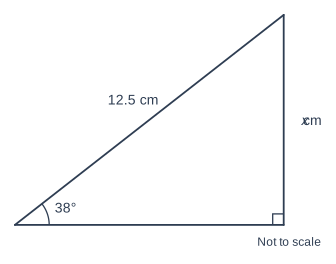
The diagram shows a right-angled triangle.

The hypotenuse is 12.5 cm and one of the angles is \(38^\circ\).

Work out the value of x.
Give your answer correct to 3 significant figures.

Geometry diagram, marked "Not to scale". A triangle (its vertices are not labelled). The angle at an unlabelled point is marked as a right angle (90°). The angle at an unlabelled point is marked 38°. The unlabelled side going up and to the right is labelled 12.5 cm. The unlabelled side going upwards is labelled x cm.

Model answer

x is opposite the angle of \(38^\circ\), and 12.5 cm is the hypotenuse.
\(\sin 38^\circ = \dfrac{x}{12.5}\)
\(x = 12.5 \times \sin 38^\circ = 7.6957...\)
\(x = 7.70\) (3 s.f.)

Explanation

Label the sides from the given angle: x is opposite, 12.5 cm is the hypotenuse, so use sine. Make sure your calculator is in degrees. The answer must be less than 12.5, because the hypotenuse is the longest side.

Mark scheme
  1. 1 mark

    M1 for \(12.5 \times \sin 38\) oe

    Exact values from the question. Or \(\sin 38 = \dfrac{x}{12.5}\). Using cos (9.85...) or tan (9.77...) scores M0; correct answer with no working scores full marks

  2. 1 mark

    A1 for 7.70

    Accept 7.70 or 7.7, or answers from 7.695 to 7.696 (exact value 7.6957...); more accurate answers are accepted. 7.69 (truncated) scores M1 A0. 3.70... (calculator in radians) scores M1 A0.

Question 3

3 marks

\(R = \dfrac{3p - q^2}{p + 2q}\)

Work out the value of R when \(p = -2.3\) and \(q = 1.9\).
Give your answer correct to 3 significant figures.

Model answer

Numerator: \(3 \times (-2.3) - 1.9^2 = -6.9 - 3.61 = -10.51\)
Denominator: \(-2.3 + 2 \times 1.9 = -2.3 + 3.8 = 1.5\)
\(R = \dfrac{-10.51}{1.5} = -7.00666...\)
\(R = -7.01\) (3 s.f.)

Explanation

Work out the numerator and the denominator separately, then divide. Take care with \(-q^2\): only q is squared, so it is \(-3.61\). If you type the whole fraction into a calculator, put brackets round the top and round the bottom.

Mark scheme
  1. 1 mark

    M1 for numerator \(3 \times (-2.3) - 1.9^2\) or \(-10.51\)

    Exact values from the question; correct answer with no working scores full marks

  2. 1 mark

    M1 for denominator \(-2.3 + 2 \times 1.9\) or 1.5

    Exact values from the question.

  3. 1 mark

    A1 for \(-7.01\)

    Accept \(-7.01\) to \(-7.006\) (exact value \(-7.00666...\)); more accurate answers are accepted. \(-2.19...\) (from \(-6.9 + 3.61\)) scores M0 M1 A0.

Question 4

4 marks

A bicycle wheel has a diameter of 66 cm.

The bicycle travels 2.5 km.

Work out the number of complete turns the wheel makes.

Model answer

Circumference \(= \pi d = \pi \times 66 = 207.345...\) cm
2.5 km \(= 2500\) m \(= 250000\) cm
Number of turns \(= 250000 \div 207.345... = 1205.7...\)
The wheel makes 1205 complete turns.

Explanation

Each turn moves the bicycle forward one circumference, \(\pi \times\) diameter. Change the distance into centimetres so the units match, then divide. The question asks for complete turns, so 1205.7 is rounded down, not up.

Mark scheme
  1. 1 mark

    M1 for circumference \(= \pi \times 66\)

    Accept 207.3 to 207.4 (exact value 207.345...). \(\pi \times 132\) or \(\pi \times 33^2\) scores M0; correct answer with no working scores full marks

  2. 1 mark

    M1 for converting 2.5 km to 250 000 cm, or 66 cm to 0.66 m with 2.5 km as 2500 m

    Units must be consistent.

  3. 1 mark

    M1 for their \(250000 \div\) their circumference

    Implied by 1205.7... (accept 1205.6 to 1205.8).

  4. 1 mark

    A1 for 1205

    Complete turns, so round down. 1206 scores M1 M1 M1 A0.

Ready to try the rest? Every answer you write is marked against the mark scheme, so you can see exactly where the marks are.

Study Helper Hints first, answers after you try

Stuck on this one? Ask for a hint and I’ll point you in the right direction, without giving the answer away. Once you’ve checked your answer, I’ll show you how the marks are awarded.