
Level:
Correct: 0
Incorrect: 0
Marks: 0/0
Exam Practice
Course:
Topics:
OCR GCSE Maths (Higher calculator) Smart practice A mixed round aimed at your weak spots
Unit 1
Number Operations and Integers
Unit 2
Fractions, Decimals and Percentages
Unit 3
Indices and Surds
Unit 4
Approximation and Estimation
Unit 5
Ratio, Proportion and Rates of Change
Unit 6
Algebra
Unit 7
Graphs of Equations and Functions
Unit 8
Basic Geometry
Unit 9
Congruence and Similarity
Unit 10
Mensuration
Unit 11
Probability
Unit 12
Statistics
Avg
score:
–
Topics
done:
0/121

Angles in polygons

Practise 16 exam-style questions on Angles in polygons for OCR GCSE Maths (Higher calculator). Write your answer as you would in the exam and get it marked in seconds against the mark scheme, point by point, with the Study Helper on hand if you get stuck.

  • 16 questions
  • 1–5 marks each
  • Instant marking
  • No sign-up needed
16 questions, marked as you go

Sample questions with model answers

Here are 4 of the questions in this topic, each with a model answer, an explanation of why it earns the marks and the mark scheme an examiner would use.

Question 1

2 marks

Explain why regular octagons cannot fit together around a point without gaps or overlaps.

Model answer

Each interior angle of a regular octagon = \(180^\circ - 360^\circ \div 8 = 135^\circ\)
Angles at a point add up to 360°.
\(360 \div 135 = 2.66...\), which is not a whole number.
(Two octagons leave a gap of 90° and three would overlap: 405°.)
So regular octagons cannot fit together around a point.

Explanation

For identical regular polygons to fit round a point, a whole number of interior angles must make 360°. That works for equilateral triangles (60°), squares (90°) and regular hexagons (120°), but not for octagons (135°). Two octagons leave a 90° gap, which is why octagons and squares can tile together.

Mark scheme
  1. 1 mark

    B1 for the interior angle of a regular octagon = 135°

    Exact value. From 180 − 360 ÷ 8 or 1080 ÷ 8.

  2. 1 mark

    B1 for: 360 ÷ 135 = 2.66... is not a whole number / 135 is not a factor of 360

    Accept 'two octagons make 270° and three make 405°, so they cannot make exactly 360°'. Must refer to angles at a point (360°).
Question 2

3 marks

Each interior angle of a regular polygon is 162° larger than each exterior angle.

Work out the number of sides of the polygon.

Model answer

Let the exterior angle be e°. Then the interior angle is (e + 162)°.
Interior + exterior = 180° (angles on a straight line):
\(e + e + 162 = 180\)
\(2e = 18\), so \(e = 9\)
Number of sides = \(360 \div 9 = 40\)

Explanation

At each vertex the interior and exterior angles lie on a straight line, so they add up to 180°. Form an equation for the exterior angle, then use the fact that the exterior angles of a regular polygon add up to 360°. A common error is to take 180° − 162° = 18° as the exterior angle.

Mark scheme
  1. 1 mark

    M1 for \(e + (e + 162) = 180\) oe

    Exact values. Interior angle + exterior angle = 180°. Or interior − exterior = 162 with interior + exterior = 180; correct answer with no working scores full marks

  2. 1 mark

    A1 for exterior angle = 9

    Exact value. Or interior angle = 171.

  3. 1 mark

    B1 for 40

    Exact answer. FT 360 ÷ their exterior angle if it gives a whole number. 360 ÷ 18 = 20 (using 180 − 162 as the exterior angle) scores M0 A0 B0.

Question 3

3 marks

Some identical tiles are each in the shape of an isosceles trapezium.
The two acute angles of each tile are 78°.

The tiles are placed side by side, joined along their sloping sides, to make a complete ring. The longer parallel sides of the tiles form the outside edge of the ring, which is a regular polygon.

Work out how many tiles are in the ring.

Model answer

At each corner of the outside edge, two tiles meet, so each interior angle of the outer regular polygon is \(2 \times 78^\circ = 156^\circ\).
Exterior angle = \(180^\circ - 156^\circ = 24^\circ\)
Number of sides = \(360 \div 24 = 15\)
There is one tile along each side, so there are 15 tiles in the ring.

Explanation

Each vertex of the outer polygon is where two acute 78° angles meet, so the interior angle is 156°. The number of sides comes from the exterior angle, 24°, and each side belongs to one tile. A common error is to use 78° itself as the interior angle.

Mark scheme
  1. 1 mark

    M1 for interior angle of the outer polygon = \(2 \times 78\) or 156

    Exact value. Two acute angles meet at each vertex of the outside edge; correct answer with no working scores full marks

  2. 1 mark

    M1 for \(360 \div (180 - \text{their } 156)\) oe

    Exact values. Or \((n - 2) \times 180 = 156n\).

  3. 1 mark

    A1 for 15

    Exact answer. 360 ÷ 78 = 4.6... or 360 ÷ (180 − 78) = 3.5... score M0 M0 A0.

Question 4

4 marks

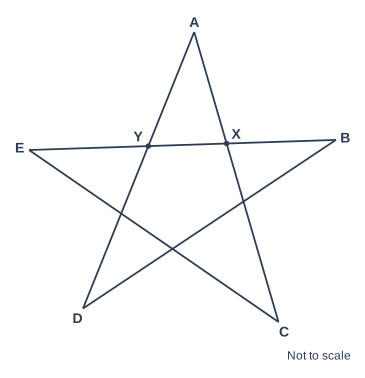
The diagram shows a five-pointed star made from the straight lines AC, CE, EB, BD and DA.
EB crosses AC at X and AD at Y.

Prove that the angles at the five points of the star add up to 180°.
That is, prove that angle CAD + angle DBE + angle ACE + angle ADB + angle BEC = 180°.

Geometry diagram, marked "Not to scale". Line segments AC, CE, EB, BD and DA are drawn. X lies on AC and EB. Y lies on EB and DA.

Model answer

In triangle CEX, X is on AC and on EB, and A is on CX extended beyond X.
Angle AXE is an exterior angle of triangle CEX, so angle AXE = angle XCE + angle XEC = angle ACE + angle BEC (the exterior angle of a triangle equals the sum of the interior opposite angles).
Y lies on XE, so angle AXY = angle AXE = angle ACE + angle BEC.
In triangle BDY, Y is on BE and on AD, and A is on DY extended beyond Y.
So angle AYB = angle YBD + angle YDB = angle DBE + angle ADB, and angle AYX = angle AYB.
In triangle AXY: angle XAY + angle AXY + angle AYX = 180° (angles in a triangle add up to 180°).
Angle XAY = angle CAD, so
angle CAD + angle ACE + angle BEC + angle DBE + angle ADB = 180°.

Explanation

The trick is to collect the five point angles into one triangle, AXY. Each of the angles at X and Y is an exterior angle of a smaller triangle, so it equals the sum of two point angles. Then the angle sum of triangle AXY gives the result for any five-pointed star, not just a regular one.

Mark scheme
  1. 1 mark

    M1 for angle AXY = angle ACE + angle BEC (the exterior angle of triangle CEX equals the sum of the interior opposite angles)

    Or via angles in triangle CEX and angles on a straight line at X. Reason needed.

  2. 1 mark

    M1 for angle AYX = angle DBE + angle ADB (the exterior angle of triangle BDY equals the sum of the interior opposite angles)

    Or via angles in triangle BDY and angles on a straight line at Y. Reason needed.

  3. 1 mark

    M1 for angle CAD + angle AXY + angle AYX = 180° (angles in triangle AXY add up to 180°)

    Reason needed.

  4. 1 mark

    A1 for substituting to complete the proof: angle CAD + (angle ACE + angle BEC) + (angle DBE + angle ADB) = 180°

    A complete, reasoned proof by another route also scores full marks. Measuring or using a regular star (36° each) scores 0.

Ready to try the rest? Every answer you write is marked against the mark scheme, so you can see exactly where the marks are.

Study Helper Hints first, answers after you try

Stuck on this one? Ask for a hint and I’ll point you in the right direction, without giving the answer away. Once you’ve checked your answer, I’ll show you how the marks are awarded.