Level:
Correct: 0
Incorrect: 0
Marks: 0/0
Exam Practice
Course:
Topics:
OCR GCSE Maths (Higher calculator) Smart practice A mixed round aimed at your weak spots
Unit 1
Number Operations and Integers
Unit 2
Fractions, Decimals and Percentages
Unit 3
Indices and Surds
Unit 4
Approximation and Estimation
Unit 5
Ratio, Proportion and Rates of Change
Unit 6
Algebra
Unit 7
Graphs of Equations and Functions
Unit 8
Basic Geometry
Unit 9
Congruence and Similarity
Unit 10
Mensuration
Unit 11
Probability
Unit 12
Statistics
Avg
score:
–
Topics
done:
0/121

Ruler and compass constructions

Practise 12 exam-style questions on Ruler and compass constructions for OCR GCSE Maths (Higher calculator). Write your answer as you would in the exam and get it marked in seconds against the mark scheme, point by point, with the Study Helper on hand if you get stuck.

  • 12 questions
  • 1–5 marks each
  • Instant marking
  • No sign-up needed
12 questions, marked as you go

Sample questions with model answers

Here are 4 of the questions in this topic, each with a model answer, an explanation of why it earns the marks and the mark scheme an examiner would use.

Question 1

2 marks

Ben wants to bisect angle PQR using only a ruler and a pair of compasses.
Here are his steps.

Step 1: With the compass point on Q, make an arc that crosses QP at X and QR at Y.
Step 2: With the compass point on X, make an arc of radius 5 cm inside the angle.
Step 3: With the compass point on Y, make an arc of radius 7 cm that crosses the first arc at Z.
Step 4: Use the ruler to join Q to Z with a straight line, extended beyond Z.

Ben's line QZ does not bisect angle PQR.

Explain the mistake Ben has made and how he should correct it.

Model answer

Ben's mistake: in step 2 he uses radius 5 cm but in step 3 he uses radius 7 cm, so ZX is not equal to ZY.
Correction: the arcs centred on X and on Y must have the same radius, e.g. use 5 cm for both. Then Z is the same distance from X and Y, and QZ bisects the angle.

Explanation

QX = QY because both points are on the same arc centred on Q. If ZX = ZY as well, triangles QXZ and QYZ are congruent (SSS), so angle XQZ = angle YQZ. With radii 5 cm and 7 cm, ZX is not equal to ZY, so Z is not on the bisector.

Mark scheme
  1. 1 mark

    B1 for: the arcs centred on X and Y have different radii (5 cm and 7 cm)

    Accept 'he changed the radius in step 3' or 'step 2 and step 3 use different radii'. Do not accept 'the radii are too big' or 'step 1 is wrong'.

  2. 1 mark

    B1 for: the arcs from X and Y must have the same radius (so that Z is the same distance from X and from Y)

    Accept e.g. 'use 5 cm for both arcs' or 'use 7 cm for both' or 'keep the compasses the same width'. The reason in brackets is not required.
Question 2

3 marks

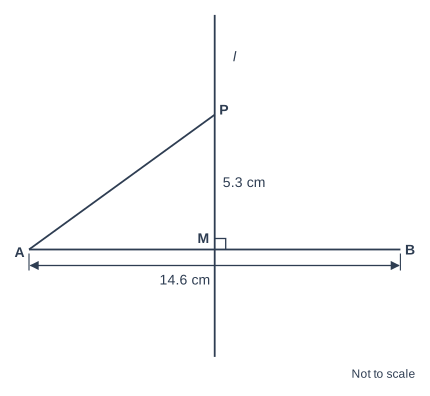
The diagram shows a line segment AB of length 14.6 cm.
The line l is the perpendicular bisector of AB. It crosses AB at M.
P is a point on l with PM = 5.3 cm.

Calculate the length of PA.
Give your answer correct to 3 significant figures.

Geometry diagram, marked "Not to scale". Line segment AB is drawn. A straight line is drawn through P and M, extending beyond P and M. Line segment PA is drawn. M lies on AB. Angle BMP is marked as a right angle (90°). A double-headed dimension arrow alongside AB (the distance from A to B) is labelled 14.6 cm. PM is labelled 5.3 cm. The text "l" is written near P.

Model answer

l bisects AB, so M is the midpoint of AB.
\(AM = 14.6 \div 2 = 7.3\) cm
Angle AMP = 90°, so by Pythagoras
\(PA^2 = 7.3^2 + 5.3^2 = 53.29 + 28.09 = 81.38\)
\(PA = \sqrt{81.38} = 9.02108...\)
PA = 9.02 cm

Explanation

The perpendicular bisector cuts AB in half at right angles, so triangle AMP is right-angled at M with AM = 7.3 cm. Pythagoras then gives the hypotenuse PA. The common error is to use the whole length 14.6 cm instead of half of it.

Mark scheme
  1. 1 mark

    B1 for AM = 7.3

    Exact value: M is the midpoint of AB. May be seen in a Pythagoras calculation; correct answer with no working scores full marks

  2. 1 mark

    M1 for \(7.3^2 + 5.3^2\) oe

    Exact values. FT their AM (not 14.6). Implied by 81.38. Using 14.6 instead of 7.3, giving 15.5 (15.53...), scores B0 M0 A0.

  3. 1 mark

    A1 for 9.02

    Accept 9.02 to 9.022 (calculator value 9.02108...); more accurate answers are accepted.

Question 3

3 marks

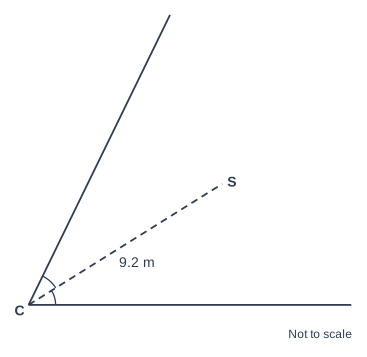
The diagram shows two straight walls of a garden that meet at the corner C.
The angle between the walls is 64°.

A sprinkler is placed at the point S, on the bisector of the angle between the walls.
CS = 9.2 m.

Calculate the shortest distance from the sprinkler to each wall.
Give your answer correct to 3 significant figures.

Geometry diagram, marked "Not to scale". A line is drawn from C going to the right. A line is drawn from C going up and to the right. Dashed line segment CS is drawn. CS is labelled 9.2 m. The angle at C between the line going to the right from C and CS and the angle at C between CS and the line going up and to the right from C are each marked with a single arc (equal angles).

Model answer

S is on the bisector, so CS makes an angle of 64° ÷ 2 = 32° with each wall.
The shortest distance to a wall is the perpendicular distance.
Distance = \(9.2 \times \sin 32^\circ = 4.87525...\)
The sprinkler is 4.88 m from each wall.

Explanation

A point on the bisector of an angle is the same distance from both arms of the angle. The perpendicular from S to a wall makes a right-angled triangle with hypotenuse CS = 9.2 m and angle 32° at C, so the distance is 9.2 sin 32°. Common errors are using the full 64° or using cosine.

Mark scheme
  1. 1 mark

    B1 for 32

    The angle between CS and each wall, 64 ÷ 2. May be seen in a trigonometric expression; correct answer with no working scores full marks

  2. 1 mark

    M1 for \(9.2 \times \sin 32\) oe

    Exact values from the question. FT their 32. Recognises that the shortest distance is perpendicular to the wall. 7.80 (from \(9.2 \cos 32\), the distance along a wall) scores B1 M0 A0. 8.27 (from \(9.2 \sin 64\)) scores B0 M0 A0.

  3. 1 mark

    A1 for 4.88

    Accept 4.875 to 4.88 (calculator value 4.87525...); more accurate answers are accepted. Accept one answer for both walls, or 4.88 m given for each wall.

Question 4

4 marks

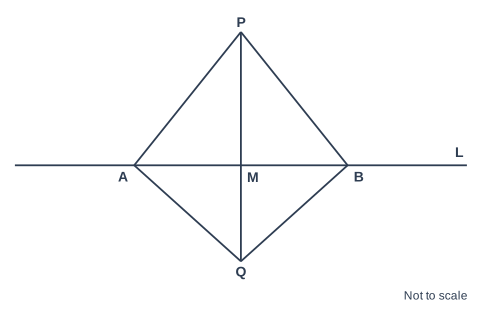
Here is how Nadia constructs the perpendicular from the point P to the line L.

Step 1: With the compass point on P, she draws an arc that crosses L at A and B.
Step 2: With the compass point on A and then on B, she draws two arcs with the same radius. These arcs cross at Q, on the other side of L from P.
Step 3: She draws the straight line PQ, which crosses L at M.

The diagram shows the points and the lines PA, PB, QA, QB and PQ.

Prove that PQ is perpendicular to L.

Geometry diagram, marked "Not to scale". A straight line is drawn through A, M and B (in that order), extending beyond A and B. Line segments PA, PB, QA, QB and PQ are drawn. M lies on PQ. The text "L" is written near B.

Model answer

PA = PB (radii of the same arc centred on P)
QA = QB (the arcs centred on A and B have the same radius)
PQ is common to triangles PAQ and PBQ.
So triangles PAQ and PBQ are congruent (SSS), and angle APQ = angle BPQ.
In triangles APM and BPM: PA = PB, angle APM = angle BPM and PM is common, so the triangles are congruent (SAS).
So angle AMP = angle BMP.
Angle AMP + angle BMP = 180° (angles on a straight line), so each angle is 90°.
So PQ is perpendicular to L.

Explanation

The proof uses congruent triangles twice: SSS shows that PQ bisects angle APB, then SAS shows that the two angles at M are equal. Equal angles on a straight line must each be 90°. A shorter route: P and Q are each equidistant from A and B, so both lie on the perpendicular bisector of AB, which must be the line PQ.

Mark scheme
  1. 1 mark

    M1 for PA = PB (radii of the same arc) and QA = QB (arcs with the same radius)

    Both equalities with reasons.

  2. 1 mark

    M1 for PQ is common, so triangles PAQ and PBQ are congruent (SSS)

    Or: P and Q are both the same distance from A and B, so both lie on the perpendicular bisector of AB. Or: APBQ is a kite (two pairs of equal adjacent sides).

  3. 1 mark

    M1 for angle APM = angle BPM, so triangles APM and BPM are congruent (SAS, PM common)

    Or: so PQ is the perpendicular bisector of AB. Or: the diagonals of a kite cross at right angles. Accept 'triangle PAB is isosceles and PM bisects the angle at P, so PM is perpendicular to AB' with these reasons.

  4. 1 mark

    A1 for angle AMP = angle BMP and they add up to 180° (angles on a straight line), so each is 90° and PQ is perpendicular to L

    A fully reasoned conclusion is needed. Full marks for a complete correct proof by any route (e.g. P and Q both on the perpendicular bisector of AB, so line PQ is that perpendicular bisector; or the kite argument), provided each statement has a reason. Statements without reasons: max M1 M1 M0 A0.

Ready to try the rest? Every answer you write is marked against the mark scheme, so you can see exactly where the marks are.

Study Helper Hints first, answers after you try

Stuck on this one? Ask for a hint and I’ll point you in the right direction, without giving the answer away. Once you’ve checked your answer, I’ll show you how the marks are awarded.