
Level:
Correct: 0
Incorrect: 0
Marks: 0/0
Exam Practice
Course:
Topics:
OCR GCSE Maths (Higher calculator) Smart practice A mixed round aimed at your weak spots
Unit 1
Number Operations and Integers
Unit 2
Fractions, Decimals and Percentages
Unit 3
Indices and Surds
Unit 4
Approximation and Estimation
Unit 5
Ratio, Proportion and Rates of Change
Unit 6
Algebra
Unit 7
Graphs of Equations and Functions
Unit 8
Basic Geometry
Unit 9
Congruence and Similarity
Unit 10
Mensuration
Unit 11
Probability
Unit 12
Statistics
Avg
score:
–
Topics
done:
0/121

Congruent triangles

Practise 14 exam-style questions on Congruent triangles for OCR GCSE Maths (Higher calculator). Write your answer as you would in the exam and get it marked in seconds against the mark scheme, point by point, with the Study Helper on hand if you get stuck.

  • 14 questions
  • 1–4 marks each
  • Instant marking
  • No sign-up needed
14 questions, marked as you go

Sample questions with model answers

Here are 4 of the questions in this topic, each with a model answer, an explanation of why it earns the marks and the mark scheme an examiner would use.

Question 1

2 marks

Triangle ABC is congruent to triangle PQR.

In triangle ABC, AB = 6.4 cm, BC = 8.1 cm and angle ABC = 74°.
In triangle PQR, QR = 6.4 cm, PR = 8.1 cm and angle PRQ = 74°.

Write the vertices of triangle PQR in the order that corresponds to A, B and C.

Model answer

The 74° angle is between the 6.4 cm and 8.1 cm sides in each triangle, so B corresponds to R.
AB = 6.4 cm and QR = 6.4 cm, so A corresponds to Q.
BC = 8.1 cm and RP = 8.1 cm, so C corresponds to P.
Triangle ABC is congruent to triangle QRP.

Explanation

Match the equal angles first, then the sides next to them. The order of the letters in a congruence statement shows which vertices correspond, so the answer is QRP, not PQR.

Mark scheme
  1. 1 mark

    B1 for B corresponds to R

    The 74° angle is between the 6.4 cm and 8.1 cm sides in both triangles. May be implied by an answer with R in the middle; correct answer with no working scores full marks

  2. 1 mark

    B1 for QRP (A corresponds to Q, B to R and C to P)

    Accept 'triangle ABC is congruent to triangle QRP' or A → Q, B → R, C → P. PQR (the order given) scores 0 for this mark.
Question 2

3 marks

Triangle T has angles of 40°, 65° and 75°. The side opposite the 40° angle is 6 cm.
Triangle U also has angles of 40°, 65° and 75°. The side between the 40° and 65° angles is 6 cm.

Are triangles T and U congruent?
Show how you decide.

Model answer

In triangle U, the side between the 40° and 65° angles is opposite the 75° angle, so in U the side opposite 75° is 6 cm.
In triangle T, by the sine rule:
side opposite 75° = \(\dfrac{6 \times \sin 75^\circ}{\sin 40^\circ} = 9.016...\) cm
So the sides opposite the 75° angles are 9.02 cm and 6 cm: they are not equal.
The triangles are similar (same angles) but not congruent.

Explanation

Having the same angles makes the triangles similar. They are congruent only if a pair of corresponding sides is equal, and here the 6 cm sides are in different positions: one is opposite 40°, the other opposite 75°. The sine rule confirms the sizes are different.

Mark scheme
  1. 1 mark

    B1 for recognising that in triangle U the 6 cm side is opposite the 75° angle

    May be implied by a correct comparison of corresponding sides.

  2. 1 mark

    M1 for a correct sine rule to find a corresponding side, e.g. in T the side opposite 75° = \(\dfrac{6 \sin 75}{\sin 40}\)

    Or in U the side opposite 40° = \(\dfrac{6 \sin 40}{\sin 75}\). Exact values from the question.

  3. 1 mark

    A1 for No, with a correct comparison, e.g. in T the side opposite 75° is 9.02 cm but in U it is 6 cm

    Accept 9.01 to 9.02 (or 3.99 to 3.993 for the side opposite 40° in U, compared with 6 cm in T). A conclusion that the 6 cm sides are not corresponding sides, so the triangles are similar but not congruent, is needed.

Question 3

4 marks

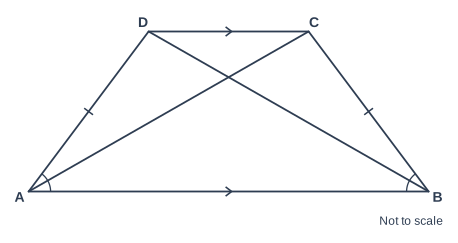
The diagram shows a trapezium ABCD with AB parallel to DC.
AD = BC and angle DAB = angle CBA.

Prove that triangle ABD is congruent to triangle BAC.

Geometry diagram, marked "Not to scale". Trapezium ABCD. Line segments AC and BD are drawn. Angle DAB and angle CBA are each marked with a single arc (equal angles). AD and BC are each marked with one short dash (equal lengths). AB and DC are each marked with an arrowhead (parallel lines).

Model answer

In triangles ABD and BAC:
AD = BC (given)
angle DAB = angle CBA (given)
AB = BA (common side)
The equal angles are between the equal sides, so triangle ABD is congruent to triangle BAC (SAS).

Explanation

The two triangles overlap and share the side AB. In triangle ABD the angle at A is between AD and AB; in triangle BAC the angle at B is between BC and BA. So two sides and the included angle match: SAS.

Mark scheme
  1. 3 marks

    M3 for three correct statements with reasons: AD = BC (given), angle DAB = angle CBA (given), AB is common (to both triangles)

    M2 for two correct statements with reasons, or three correct statements with missing or incorrect reasons. M1 for one correct statement with a reason, or two correct statements without reasons. Accept 'AB = BA (shared)'.

  2. 1 mark

    A1 for the condition SAS

    Dependent on M3 and no incorrect statements. The angles at A and B are the included angles between AD, AB and BC, BA.

Question 4

4 marks

In triangle ABC, AB = 9 cm, BC = 6.5 cm and angle BAC = 38°.

Show that there are two different triangles ABC with these measurements, and work out the two possible sizes of angle ACB.
Give your answers correct to 1 decimal place.

Explain what this shows about two sides and a non-included angle as a condition for congruence.

Model answer

Sine rule: \(\dfrac{\sin ACB}{9} = \dfrac{\sin 38^\circ}{6.5}\)
\(\sin ACB = \dfrac{9 \sin 38^\circ}{6.5} = 0.8524...\)
Angle ACB = 58.479...° = 58.5°, or angle ACB = 180° − 58.479...° = 121.520...° = 121.5°.
Both are possible: 38° + 121.5° = 159.5° < 180°, leaving 20.5° for angle B (and 83.5° in the first case).
So there are two different triangles, with angle ACB = 58.5° or 121.5°.
Both triangles have AB = 9 cm, BC = 6.5 cm and angle A = 38°, but they are not congruent. So two sides and a non-included angle (SSA) is not enough to prove that two triangles are congruent.

Explanation

Sine is positive for both an acute angle and its supplement, so the sine rule gives two possible angles at C. Both fit with the 38° angle at A, so two different triangles match the same data. This is why SSA is not one of the conditions for congruence.

Mark scheme
  1. 1 mark

    M1 for \(\sin ACB = \dfrac{9 \sin 38}{6.5}\) oe

    Sine rule. Exact values from the question. May be implied by 0.852 (accept 0.852 to 0.8525).

  2. 1 mark

    A1 for 58.5

    Accept 58.47 to 58.5. The full value is 58.479...

  3. 1 mark

    B1 for 121.5 with a check that it gives a possible triangle, e.g. 38 + 121.5 < 180

    FT 180 − their acute angle. Accept 121.5 to 121.53. The check may be shown by working out the third angle, 20.5°.

  4. 1 mark

    B1 for explaining that the two triangles have AB, BC and angle A equal but are not congruent, so two sides and a non-included angle (SSA) is not a condition for congruence oe

    Accept 'two sides and an angle that is not between them do not fix the triangle'. The explanation must refer to the two triangles found.

Ready to try the rest? Every answer you write is marked against the mark scheme, so you can see exactly where the marks are.

Study Helper Hints first, answers after you try

Stuck on this one? Ask for a hint and I’ll point you in the right direction, without giving the answer away. Once you’ve checked your answer, I’ll show you how the marks are awarded.