
Level:
Correct: 0
Incorrect: 0
Marks: 0/0
Exam Practice
Course:
Topics:
OCR GCSE Maths (Higher calculator) Smart practice A mixed round aimed at your weak spots
Unit 1
Number Operations and Integers
Unit 2
Fractions, Decimals and Percentages
Unit 3
Indices and Surds
Unit 4
Approximation and Estimation
Unit 5
Ratio, Proportion and Rates of Change
Unit 6
Algebra
Unit 7
Graphs of Equations and Functions
Unit 8
Basic Geometry
Unit 9
Congruence and Similarity
Unit 10
Mensuration
Unit 11
Probability
Unit 12
Statistics
Avg
score:
–
Topics
done:
0/121

Perimeter of rectilinear and composite shapes

Practise 12 exam-style questions on Perimeter of rectilinear and composite shapes for OCR GCSE Maths (Higher calculator). Write your answer as you would in the exam and get it marked in seconds against the mark scheme, point by point, with the Study Helper on hand if you get stuck.

  • 12 questions
  • 2–4 marks each
  • Instant marking
  • No sign-up needed
12 questions, marked as you go

Sample questions with model answers

Here are 4 of the questions in this topic, each with a model answer, an explanation of why it earns the marks and the mark scheme an examiner would use.

Question 1

2 marks

A regular hexagon has sides of length 4.6 cm.
An equilateral triangle has sides of length 9.3 cm.

Kim says,
"The hexagon has the greater perimeter because it has more sides."

Is Kim correct?
Show how you decide.

Model answer

Perimeter of the hexagon = \(6 \times 4.6 = 27.6\) cm
Perimeter of the triangle = \(3 \times 9.3 = 27.9\) cm
27.9 > 27.6, so the triangle has the greater perimeter.
Kim is not correct.

Explanation

The perimeter of a regular polygon is the number of sides multiplied by the length of one side. The hexagon has more sides, but each side is much shorter, so the number of sides alone does not decide which perimeter is greater. Work out both perimeters and compare them.

Mark scheme
  1. 1 mark

    M1 for \(6 \times 4.6\) or \(3 \times 9.3\), or 27.6 or 27.9 seen

    One correct perimeter, or one correct method.

  2. 1 mark

    A1 for No, with 27.6 and 27.9

    Both perimeters and a correct conclusion are needed, e.g. 'No, the triangle has the greater perimeter: 27.9 cm is more than 27.6 cm'. Alternative: comparing 9.3 with \(2 \times 4.6 = 9.2\) (each side of the triangle is longer than two sides of the hexagon, and the triangle has half as many sides) with the conclusion No scores M1 A1. 'No' with no working scores 0.
Question 2

3 marks

The length of a rectangle is 2.4 times its width.
The perimeter of the rectangle is 61.2 cm.

Work out the length of the rectangle.

Model answer

Let the width be \(w\) cm. Then the length is \(2.4w\) cm.
Perimeter: \(2w + 2 \times 2.4w = 61.2\)
\(6.8w = 61.2\)
\(w = 61.2 \div 6.8 = 9\)
Length = \(2.4 \times 9 = 21.6\) cm

Explanation

The perimeter includes two widths and two lengths, so it is 2w + 2(2.4w) = 6.8w. Solve for the width, then multiply by 2.4 to get the length. A common error is to forget that the perimeter contains each side twice and divide 61.2 by 3.4 only.

Mark scheme
  1. 1 mark

    M1 for \(2w + 2 \times 2.4w = 61.2\) oe, or \(6.8w = 61.2\), or \(3.4w = 30.6\)

    Any letter. Or M1 for 61.2 ÷ 2 = 30.6 with the length and width shared in the ratio 1 : 2.4 (3.4 parts); correct answer with no working scores full marks

  2. 1 mark

    M1 for \(61.2 \div 6.8\) or \(30.6 \div 3.4\), or width = 9

    Dependent on the first M1.

  3. 1 mark

    A1 for 21.6

    Accept 21.6 cm. A correct answer with no working scores 3 marks. 9 (the width) as the final answer scores M1 M1 A0. \(61.2 \div 4 \times 2.4 = 36.72\) or \(61.2 \div 3.4 \times 2.4 = 43.2\) scores 0.

Question 3

3 marks

A piece of wire is 80 cm long.
The wire is cut into two pieces.
One piece is bent to make a square.
The other piece is bent to make a circle.

The length of each side of the square is equal to the radius of the circle.

Show that the length of each side of the square is 7.78 cm, correct to 3 significant figures.

Model answer

Let the side of the square and the radius of the circle be \(x\) cm.
Wire in the square = \(4x\) cm
Wire in the circle = circumference = \(2\pi x\) cm
\(4x + 2\pi x = 80\)
\(x(4 + 2\pi) = 80\)
\(x = \dfrac{80}{4 + 2\pi} = \dfrac{80}{10.283...} = 7.7796...\)
= 7.78 cm (3 s.f.)

Explanation

The two pieces of wire together make 80 cm: the perimeter of the square, 4x, plus the circumference of the circle, 2πx. Factorise to get x(4 + 2π) = 80 and divide. In a 'show that' question you must show the more accurate value 7.7796... before rounding to the given 7.78.

Mark scheme
  1. 1 mark

    M1 for \(4x\) and \(2\pi x\) seen, or \(4x + 2\pi x\) oe

    Any letter for the side of the square / radius of the circle. \(\pi x^2\) (the area) scores M0.

  2. 1 mark

    M1 for \(4x + 2\pi x = 80\) and \(x = \dfrac{80}{4 + 2\pi}\) oe

    Or \(x(4 + 2\pi) = 80\), or \(80 \div 10.28...\).

  3. 1 mark

    A1 for 7.779... seen, leading to 7.78

    A value to more than 3 s.f. must be seen (7.7796...; accept 7.779 or 7.78 from \(80 \div 10.283...\)). Using \(\pi = 3.14\) gives 7.782..., which is acceptable. Alternative: showing that \(x = 7.775\) gives a total of 79.95... cm and \(x = 7.785\) gives 80.05... cm, so the side is 7.78 cm to 3 s.f., scores 3 marks. Substituting 7.78 only, to get 80.00..., scores M1 M0 A0. This is a 'show that' question: 7.78 stated with no method scores 0.

Question 4

4 marks

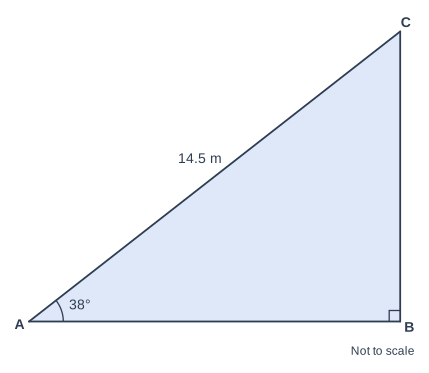
The diagram shows a field ABC in the shape of a right-angled triangle.
Angle ABC = 90°, angle BAC = 38° and AC = 14.5 m.

A farmer puts a fence all the way round the edge of the field.
The fence costs £9.85 per metre.

Work out the cost of the fence.
Give your answer correct to the nearest pound.

Geometry diagram, marked "Not to scale". Triangle ABC (shaded). Angle ABC is marked as a right angle (90°). Angle BAC is marked 38°. Side AC is labelled 14.5 m.

Model answer

\(AB = 14.5 \cos 38^\circ = 11.426...\) m
\(BC = 14.5 \sin 38^\circ = 8.927...\) m
Perimeter = 14.5 + 11.426... + 8.927... = 34.853... m
Cost = 34.853... × £9.85 = £343.30...
= £343 (to the nearest pound)

Explanation

Use trigonometry in the right-angled triangle: AB is adjacent to the 38° angle and BC is opposite it, with AC the hypotenuse. Add the three sides and multiply by the price per metre. Keep full calculator values until the end: rounding the perimeter to 34.9 m first gives £344, which is wrong.

Mark scheme
  1. 1 mark

    M1 for \(14.5 \cos 38^\circ\) oe

    AB; implied by 11.4 or 11.42... (accept 11.4 to 11.43). Or \(14.5 \sin 52^\circ\); correct answer with no working scores full marks

  2. 1 mark

    M1 for \(14.5 \sin 38^\circ\) oe

    BC; implied by 8.9 or 8.92... (accept 8.9 to 8.93). Or M1 for \(\sqrt{14.5^2 - \text{their } AB^2}\) (Pythagoras) after finding AB. Calculator in radians (e.g. \(14.5 \cos 38 = 13.85...\)) scores M0 for that side.

  3. 1 mark

    M1 for (14.5 + their AB + their BC) × 9.85

    Implied by 343 to 344. Perimeter = 34.853...

  4. 1 mark

    A1 for 343

    Accept £343 or 343.30; accept 343 to 343.31 (exact value 343.304...). Premature rounding: using the perimeter rounded to 34.9 gives 343.77 = £344, which scores M1 M1 M1 A0. Using AB = 11.43 and BC = 8.93 gives 343.37, which is accepted as £343.

Ready to try the rest? Every answer you write is marked against the mark scheme, so you can see exactly where the marks are.

Study Helper Hints first, answers after you try

Stuck on this one? Ask for a hint and I’ll point you in the right direction, without giving the answer away. Once you’ve checked your answer, I’ll show you how the marks are awarded.