Converting and ordering fractions, decimals and percentages
Practise 12 exam-style questions on Converting and ordering fractions, decimals and percentages for OCR GCSE Maths (Higher calculator). Write your answer as you would in the exam and get it marked in seconds against the mark scheme, point by point, with the Study Helper on hand if you get stuck.
12 questions
1–4 marks each
Instant marking
No sign-up needed
12 questions, marked as you go
Sample questions with model answers
Here are 4 of the questions in this topic, each with a model answer, an explanation of why it earns the marks and the mark scheme an examiner would use.
Question 1
2 marks
Write \(\dfrac{27}{32}\) as a percentage. Give your answer correct to 1 decimal place.
Divide the numerator by the denominator to get a decimal, then multiply by 100 to get a percentage. 84.375 has a 7 in the second decimal place, so to 1 decimal place it rounds up to 84.4%.
Mark scheme
1 mark
M1 for \(27 \div 32\) or 0.84375 or 84.375 seen
Exact values (the division terminates). Accept 0.84375 or 84.375 seen; correct answer with no working scores 2 marks.
1 mark
A1 for 84.4 (%)
Accept 84.375 to 84.4 (the exact value 84.375 is accepted). 84.3 or 84.37 (truncated) scores M1 A0. 0.844 (not a percentage) scores M1 A0.
Question 2
2 marks
Write down a decimal that is greater than \(\dfrac{3}{7}\) and less than 43%.
Model answer
\(\dfrac{3}{7} = 0.428571...\) \(43\% = 0.43\) A decimal between them is 0.429
Explanation
Write both numbers as decimals: 0.428571... and 0.430. Any decimal between them works, for example 0.429. Take care: 0.4285 is slightly less than \(\dfrac{3}{7}\), so you need enough decimal places to be sure.
Mark scheme
1 mark
M1 for \(\dfrac{3}{7} = 0.4285...\) and 43% = 0.43
Both converted to decimals (accept 0.4285 or 0.4286 or better for 0.428571...); correct answer with no working scores full marks
1 mark
A1 for any decimal greater than 0.428571... and less than 0.43
e.g. 0.429 or 0.4286 or 0.42858. Do not accept 0.4285 (less than \(\dfrac{3}{7}\)) or 0.43. A correct decimal with no working scores 2 marks.
Question 3
2 marks
Which is closer to \(\dfrac{2}{3}\), 0.66 or 67%?
Show how you decide.
Model answer
\(\dfrac{2}{3} = 0.6666...\) \(0.6666... - 0.66 = 0.00666...\) \(0.67 - 0.6666... = 0.00333...\) 0.00333... is smaller, so 67% is closer to \(\dfrac{2}{3}\).
Explanation
\(\dfrac{2}{3}\) is 0.6666..., which is not 0.66. Find how far each number is from 0.6666...: 67% (0.67) is 0.0033... away, but 0.66 is 0.0066... away, twice as far. A common error is to assume 0.66 is the decimal for \(\dfrac{2}{3}\).
Mark scheme
1 mark
M1 for \(\dfrac{2}{3} = 0.666...\) with both differences found, 0.00666... and 0.00333...
Or the differences as fractions, \(\dfrac{1}{150}\) and \(\dfrac{1}{300}\), or as percentages, 0.666...% and 0.333...%. Accept 0.0067 and 0.0033 or better.
1 mark
A1 for 67%
Supported by the two differences. 0.66 (thinking \(\dfrac{2}{3} = 0.66\)) scores 0. 67% with no valid working scores 0.
Question 4
4 marks
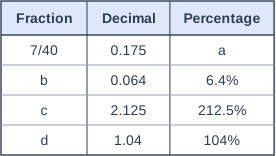
The table shows some numbers written as a fraction, a decimal and a percentage.
Work out the values of \(a\), \(b\), \(c\) and \(d\). Write any fractions in their simplest form.
To change a decimal to a percentage multiply by 100. To change a decimal to a fraction, use place value (0.064 is 64 thousandths) and simplify. A percentage over 100% or a decimal over 1 gives a fraction greater than 1, which can be written as a mixed number.
Mark scheme
1 mark
B1 for \(a = 17.5\%\)
Accept 17.5 or \(17\dfrac{1}{2}\)%; correct answer with no working scores full marks
1 mark
B1 for \(b = \dfrac{8}{125}\)
\(\dfrac{64}{1000}\) or \(\dfrac{32}{500}\) (not simplified) scores B0.
1 mark
B1 for \(c = 2\dfrac{1}{8}\) or \(\dfrac{17}{8}\)
Either form. \(\dfrac{2125}{1000}\) scores B0.
1 mark
B1 for \(d = 1\dfrac{1}{25}\) or \(\dfrac{26}{25}\)
Either form. \(\dfrac{104}{100}\) scores B0. \(\dfrac{1}{25}\) (whole number part missing) scores B0.
Ready to try the rest? Every answer you write is marked against the mark scheme, so you can see exactly where the marks are.
Ctrl + Enter to check
Study HelperHints first, answers after you try
Stuck on this one? Ask for a hint and I’ll point you in the right direction, without giving the answer away. Once you’ve checked your answer, I’ll show you how the marks are awarded.